


In honor of the 10th anniversary of the Chicago Review of Books, The New Chicago Renaissance series revisits exemplary works of literature about Chicago from the last 10 years and explores their continued relevance. Join us all year long as 12 leading writers and artists explore books that they love and why they’re meaningful to our understanding of modern Chicago.

“We walk through the world at its leisure. We’re here at its mercy and with its blessing. At some point, we have to ask ourselves how we want to live.”
—Megan Stielstra, “Here is My Heart”
I grew up on the east coast, went away for school, and always thought I would return to live a life not necessarily of great monetary wealth but at least rich in coastal elitism. Enter Chicago, to derail my plans. More specifically, enter Megan Stielstra. In 2013, I was a graduate student at Columbia College, and given the opportunity to choose an elective alongside my required workshop courses. At the time, Stielstra was teaching a class on storytelling, essentially a primer for the Live Lit scene that had welled up in the bookstores and bars of the city during the Obama aughts. Reader, I did not take this class. How could I, cynical twenty-something that I was, bare my deepest thoughts in front of an audience? I could hardly bare my deepest thoughts in front of myself, hence the specialty in fiction writing1. Luckily, I had friends who were braver than me, and who dove into Stielstra’s praxis head-on, gushing about the class, their work, and the things she was teaching them over stale popcorn and pool at Wabash Tap. I was jealous. She sounded phenomenal. She sounded like she had her shit together. Most of all, she sounded unafraid.
When I got the chance to see her perform, my awe grew tenfold. If reading Stielstra feels like taking part in a conversation she’s having directly with you, hearing her perform her work is a community-building experience. She didn’t only enchant my graduate school cohort—I’d challenge you to find anyone who has left a Megan Stielstra reading without tears in their eyes, and a newfound personal gumption. She’s a master of timing and inflection (see “The Walls Would Be Rubble” from Once I Was Cool), and a pillar of warmth. On the page, you get the sense that she’s genuinely curious—she wants to learn and discover and build beauty, and she’s shown up to listen to you (as nonsensical as that seems in the context of her own published essays). In person, Stielstra confirms this suspicion, building a bridge between herself and her audience, and then inviting everyone to cross together, a communal conversation that leaves you feeling part of something true. How could someone capable of such community-building and emotional honesty possibly be scared? She was a god to us grad students, the personal essayist sublimated in her ideal form.
But writers are people, not gods, and those of us who read are better for it. In 2017, Stielstra published The Wrong Way to Save Your Life, a collection of mostly autobiographical essays. Structurally, the book is divided by the decades of her life, with vignettes of memory and experience marking each series of corresponding essays. These are filled with the humor, vulnerability and openness that defines all her work, but she adds to this a studied and deliberate excavation of fear. It seemed I was wrong, Stielstra was never fearless. The difference between us wasn’t conquered fear, but a willingness to look it in the eye.
As she says herself, “anger is easier.” And what a time it was to be angry in 2017. Privileged white liberals like myself, spoon-fed progress and equality, were facing the reality of a national populous with a different agenda. I personally was pregnant, and then saddled with both PPD and a new baby I felt wildly unequipped to keep alive2. I was angry, I was scared. To be honest, I’m still angry and scared—less mind-numbingly, Chicken Little’s sky is falling than I was as a new mother with an embarrassingly late understanding of the tragedies of American history, but angry and scared nonetheless, because who wouldn’t be in an age of fascism and AI and climate change, sending kids to school through metal detectors, tear gas on Chicago streets. I’m also scared to acknowledge these things in this essay about a writer I admire, to air my own fears when I know how lucky I am to have them mostly in a nebulous way, rather than as constant maps to my small daily choices. I am scared of the world, and, like so many of my millennial-writer ilk, I’m terrified of vulnerability. After reading The Wrong Way to Save Your Life, I realized Megan Stielstra is too. But guess what? She writes it anyway.
In The Wrong Way to Save Your Life, Stielstra writes about school shootings. She writes about bullying and depression and bureaucracy. She writes about privilege, and luck, and real estate and hard decisions. Not once does she censor herself, walk back a feeling or write off an exploration as sappy or trite. In Stielstra’s hands, nothing is sappy or trite, because it all comes from a place of genuine feeling. She has an essay about postpartum depression, another about her father’s heart disease. The titlular piece centers on a fire in her Rogers Park apartment. Towards the end of the collection is an especially heart-wrenching essay called “We Say and Do Kind Things.” In it, her dear friend’s two year-old has been diagnosed with pediatric cancer, and in the face of this news, Stielstra doesn’t know what she can do. “I wanted to kick myself for all the times I could have helped but hadn’t,” she writes. “I wanted to go to med school and find a cure. I wanted to raise a gazillion dollars for research. I wanted to give Sophia a unicorn. I wanted to hug Sarah, but the table was at a weird angle. I wanted a better angle. I wanted a better world. I wanted to be a better person.” What can we do? What can any of us do? In so many circumstances, it’s easier to burrow back under the covers, to freeze up or close our eyes. If we can’t solve the problems, will never conquer the fear, then why try? Stielstra reminds us to try despite possible failure, to find the small moments of kindness that are within our control: a hug for a crying stranger, a dance in an elementary school gym. It’s a blueprint for how to live, and a reminder that there is, in fact, no wrong way to save your life. The only wrong way is not trying at all.
In certain circles of contemporary literature, being above it all, too cool, remaining witty and sardonic, is highly lauded. Feelings? Flowery! Messy emotional truths? Fine, but at a distance. But to quote Stielstra: “if you’re hiding parts of yourself to look cool or make someone love you, please repeat after me: fuck that noise.” To me, this exemplifies not only Megan Stielstra and the permission she brings to her students, but the ethos of Chicago itself. We’re a city known for improvisational comedy, highwire entertainment that requires big risks and safe nets. We keep NBC in business with our many procedural shows, and consequently keep a vast array of film and TV professionals in steady work. If you want to have a fulfilling creative life, to chase your professional artistic dreams and still feel like yourself, there is no better place to go.

We’re also a city that runs out in our bathrobes to tell border patrol to let go of our neighbors, that lines up on school corners with whistles and shows up in huge numbers to march through the streets. In Chicago, it is cool to care. Much of this obviously stems from our history as a city of labor organization and social reform. But it also comes from our art, its authenticity and openness, its welcoming arms.
I’ve seen a lot of great protest signs over the past few years, from Home Alone gags to gorgeous art pieces, but one that has stuck with me is the simple Sharpie message “Do it scared.” This is the perfect encapsulation of Megan Stielstra’s work, its impact on not only my own writing, but the way I want to exist in the world. Very little meaningful work can be done without opening some vulnerability, setting forth some emotional risk. As a graduate student, I had yet to understand the importance of dissecting my own heart. Reading Megan Stielstra has helped me to get there. I thought I’d go east, but I stayed in Chicago, where we do it scared, and we do it sincere. If I could go back, I’d take that Columbia College class ten times over—and every friend that I texted when I couldn’t for the life of me come up with the name of our bar hang said that they would, too.
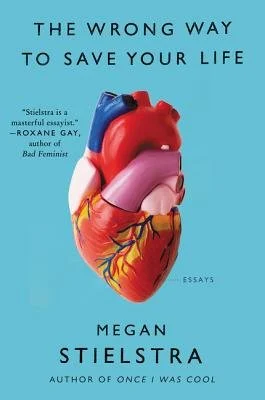
NONFICTION
The Wrong Way to Save Your Life
By Megan Stielstra
Harper Perennial
Published August 1, 2017

- What is an ode to Megan Stielstra without footnotes? This one to say that at the time, I was clearly not a very good fiction writer. I’ve since learned that my own best work comes from the same soul-baring I was so afraid of, done up in character and plot, but authentic and terrifyingly vulnerable nonetheless. I’d be remiss not to mention this basic fact of literature, on the chance one of you thinks they can do good work without doing hard work.
↩︎ - I eventually figured it out, in no small part thanks to “Channel B,” an essay from Stielstra’s earlier collection, Once I Was Cool. As a fellow artist known for writing about mental health and new parenthood, I bet some of you can already guess that I owe a bit of the domestic horror of my own postpartum book to Stielstra’s true story about her glitchy baby monitor. We all owe her more than that—the collective willingness to discuss postpartum mood disorders is a fairly recent phenomena, and Stielstra got there before the zeitgeist, pushing this necessary conversation to the mainstream. I’m so grateful to her for paving this particular path. ↩︎


This is great! Thank you!