


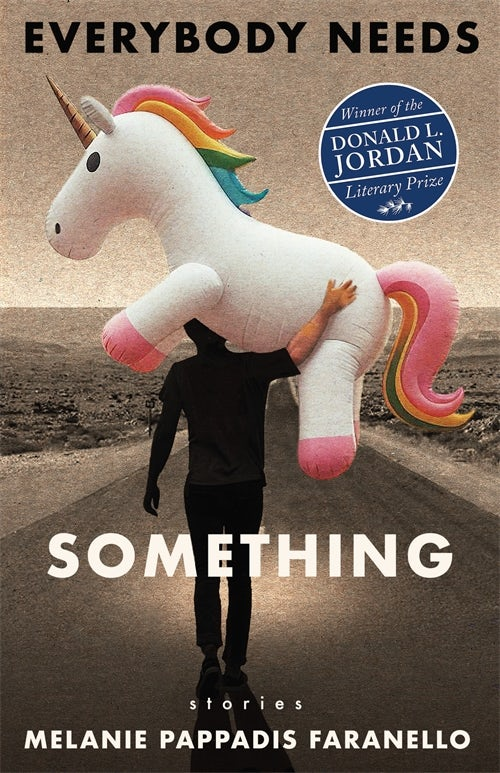
I know it’s early to call it, but the cover of Everybody Needs Something is quite possibly the best cover of the year. It’s so vivid, unique, and captivating. But what makes it so great as a reader’s introduction to Melanie Pappadis Faranello’s debut story collection? The image is actually drawn from a line in the first story, “My Father, My King.” It’s the shortest in the collection—flash, really—and the only one written in first person singular, so it feels like a bit of an anomaly among the longer third person POV stories. The sentence in that first story talks about carrying an oversized inflatable on the narrator’s shoulder, like winning a prize from a carnival. And Peter Selgin, the artist who designed the book cover, created an image that beautifully encompasses the themes of these fourteen short stories.
The stories have quite a range, something I always admire in a collection, but they all dive into our universal need for connection. Even the most introverted among us still desires love and companionship, at least sometimes. And Pappadis Faranello’s emotionally astute stories, most quite quiet and yet incredibly strong, explore love and loss with poignancy and grace. We meet these characters in the aftermath of grief as they deal with aging parents, at a crossroads in marriage, or trying to rebuild their lives after a loss. And the book cover with the man walking alone, a colorful inflatable unicorn on his shoulder, offers unexpected buoyancy, even a bit of whimsy—hope for the journey. That’s what I loved best about these stories, at their core: they’re hopeful. And aren’t we all looking for more hope these days? Melanie Pappadis Faranello has you covered in Everybody Needs Something.
I met Melanie a few years ago at AWP and we’ve kept in touch. She’s a warm, delightful person as you can imagine from the warmth in this collection. I was happy to get the opportunity to discuss Everybody Needs Something with her via email.

Rachel Leon
Most of the stories are written in third-person POV (except the first story and “The Children Will Perform at the Gala”), so I’d love to start by talking about POV. Is it fair to say you gravitate to third? How do you settle on POV? (And do you want to talk about the two outliers in the collection?)
Melanie Pappadis Faranello
I love writing in close third. For some reason, I feel freer to explore character, which seems backwards. I enjoy the ability to dive deep into interiority while also being able to pull back or shift into other characters. Whenever I start a piece in first, it ends up veering quickly into third unintentionally—unless it’s flash or a personal essay.
That said, I wrote an early novel in first person—an unreliable narrator who unravels psychologically. It felt very claustrophobic, so I rewrote the entire manuscript in close third, which was daunting, but liberating, and allowed me access to new parts of that world which surprised me.
The two outliers in the collection that you mention are both flash. One is the opener before getting into the longer pieces. And the second, which is different in tone, style, voice, is placed in the middle of the book, after the triptych, to give the reader a break.
Rachel Leon
I shy away from talking about individual stories in interviews about collections, but I’d love to talk about the triptych stories: “I. Just Fine,” “II. Airways,” and “III. Arboretum.” They all feature the same main character, Will, in three distinct times, so they’re linked, but also very much standalone. I’ve read collections where linked stories don’t appear chronologically like this, nor are they visually linked like you do here. Did you ever consider spreading them out? How’d you decide to number them?
Melanie Pappadis Faranello
These three stories eventually became the second novel manuscript I wrote called In Other Kinds of Weather. The main character, Will, became Frank. But it’s the same guy. After finishing that novel, I knew so much more about the character that didn’t appear in these stories, so when I returned to these individual pieces, I felt they belonged together because I had in my head the trajectory that occurred inside the larger work. So I numbered them to make it intentional.
Rachel Leon
You’ve mentioned to me that there is a range in the age of these stories—some are quite old (if I’m remembering correctly) and a few are newer. Can you talk about the process of compiling this collection and choosing which stories would be included?
Melanie Pappadis Faranello
Yes, these stories accumulated over years, written throughout different phases of life, so the book binds together a range rather than a specific moment in time. I’d been sending the individual stories out, publishing a few in literary magazines, but I hadn’t been thinking of them as a collection until more recently. I’d been working on novel manuscripts, so between those larger projects, I’d set a goal to write one or two stories as a way to reset and start new work.
When I realized I had enough for a collection, I assembled the stories to see what it would look like. I chose a few of the older stories that had been published along with the newer ones. I really enjoy the process of shaping longer narratives when working with novels, so I tried this approach with the collection, but found it much more difficult to do with disparate pieces. I looked for patterns and themes, and considered this when arranging them, then rewrote a few of the older pieces. When I learned the manuscript won the contest and was going to be published, I suddenly wanted to rewrite the entire collection. But I had to accept that nothing ever really feels done since we keep evolving over time, and so part of the process is just to let go and move on, start something new. That’s what I tried to do.
Rachel Leon
Speaking of the contest, the collection won the Donald L. Jordan Literary Prize. What drew you to submit this collection for that prize?
Melanie Pappadis Faranello
I saw this contest announced in Poets and Writers. The prize money was extremely generous, $10K, which is the highest I’d seen for a contest like this, and it came with book publication with Columbus State University Press, handled by University of Georgia Press. The contest judge, Debra Jo Immergut wrote a beautiful, haunting psychological novel, You Again, which I really enjoyed. I feel like that’s important for entering contests, to become familiar with the judge’s work and consider whether your writing might resonate. That said, I’d entered other contests and open submission calls to no avail, so when I got the news that I’d won the DLJ Prize, I was shocked and very thrilled. It’s always so unpredictable and I’m incredibly grateful.
Rachel Leon
The collection’s title comes from a story with the same name. It’s such a great title. I think the unifying theme in the collection is our universal need for connection, but the “something” feels truer (and certainly truer than “someone”), leaving wiggle room for any anomaly. I’m curious when you knew the story “Everybody Needs Something” would be included and how quickly you decided it was the perfect title for the collection?
Melanie Pappadis Faranello
I was deciding between three different stories in the collection to use for the book’s title. I ran them by a friend, and she chose Everybody Needs Something. I’m glad she did. I think it reflects the themes throughout the book, the longing and searching for something that often feels vague or out of reach, the often faulty if only… then…

The designer and editor did a great job with the cover image—a man walking alone down a long empty road (in monochrome), while carrying an inflatable unicorn (a bright pop of color). To me, the image feels lonely and human and quietly desperate. Where is he going? Does he really need that unicorn?
I think if you asked people What do you need? you’d get a variety of answers at first—a drink, a vacation, a bathroom, a nap, new shoes—but if you kept asking, you’d probably start hearing something deeper and more universal—to be loved, to be heard, to be understood, to be seen, to be safe, to survive. I feel like we sometimes mistake needing the former for the latter.
Rachel Leon
I really admire your community work and how you’re looking to incorporate it into your book launch. Can we wrap up by talking about Poetry on the Streets and the Community Poem Project?
Melanie Pappadis Faranello
Thank you for asking! I’m so excited about drawing on my community work that I do through Poetry on the Streets, engaging communities in self-expression and bringing everyday people’s words into public spaces. I’ve always had a strong desire to integrate this work with my writing life, and this felt like a good opportunity to do so.
I created Poetry on the Streets in 2017 when I set up a typewriter in public spaces—street corners, bus stops, parks, pedestrian areas, and invited passersby to stop, pick an emotion word, and write a spontaneous poem about it. For three years, people on the street from different walks of life wrote about love, fear, joy, pain, loss, hurt, regret…strangers shared stories and moments of human connection. POTS evolved over the years, and I’ve created many collaborative projects, each one asking How many strangers do we pass by each day on the street and what if we stopped to listen?
To accompany my book launch, I’ve drawn on this work and created a community engagement component called The Community Poem Project. It invites people across the country to add one line to a growing collaborative poem on the theme of connection. Notecards with QR codes for entries will be handed out at events, and each book sold onsite will include a card so people can engage and add their words. Some of the prompts are: “What does connection mean to you? What do you need? What do you love?” “I need more…” “I need less…” “I hope…” “I miss…” “I carry…”
Anonymous responses will appear online, and when the poem grows large enough, it will be transformed into a physical exhibit to be displayed in a public space. A public art display representing interconnectedness, stitching together people’s words for others to see and add to.
I’m excited to see how it develops. Often with my Poetry on the Streets projects, I have the final image in my mind of what I want to create, but no idea how I will actually get there. Luckily, I’ve been able to pull most of them off so far, I guess by trusting in the project’s intention, letting the process unfold, learning and adjusting along the way. It’s kind of similar to writing in that sense, or any creative process!
FICTION
Everybody Needs Something
By Melanie Pappadis Faranello
Columbus State University Press
Published March 15, 2026


