


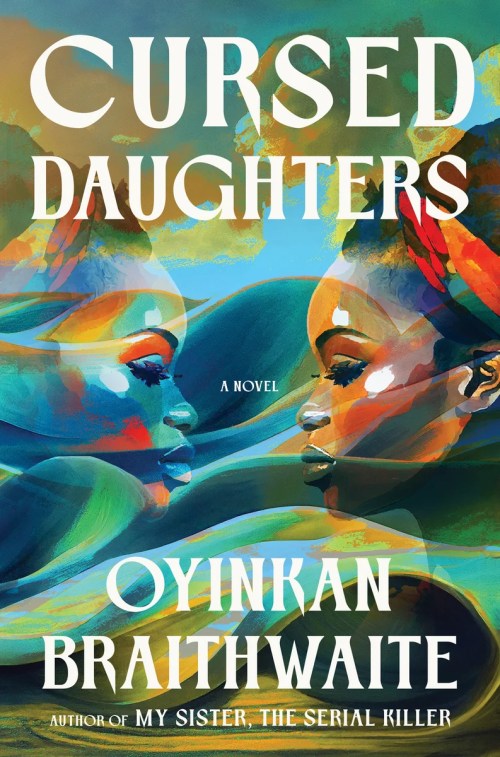
In Cursed Daughters, Oyinkan Braithwaite tackles a provocative and mysterious premise of reincarnation and the legacy of generational trauma in a Nigerian household. At the heart of the novel is the Falodun family, particularly its women, who are trapped in the cycle of a curse that weaves through every fabric of their lives. “No man will call your house his home. And if they try, they will not have peace,” she writes. It is these maddening depths of isolation and psychological violation that Braithwaite explores while treating with care and hope the possibilities of love, courage, and healing. Through the desires, heartbreaks, and fears of the Falodun women, Braithwaite confronts the legacy of a fraught past and keeps us questioning, too, the myths that take hold of our own lives.
Braithwaite and I corresponded by email.

Tryphena Yeboah
When you wrote My Sister, The Serial Killer in 2017, you were in a completely different season of your life than you are in right now. How did the changes over the past few years shape your writing of Cursed Daughters?
Oyinkan Braithwaite
When I wrote My Sister, the Serial Killer, I was a single woman living with my parents, with very few responsibilities. By 2023, when I began writing Cursed Daughters, I was married, pregnant, battling hyperemesis gravidarum, and hosting my father as he faced a difficult health diagnosis. I cannot pretend I was the same woman. But I hope that in the years between My Sister, the Serial Killer and Cursed Daughters, I have grown, as a person and as a writer.
Tryphena Yeboah
You’ve been open about how you wanted to get far away from your first book and not box yourself in. Can you please share a little more about making this intentional move and what that looked like?
Oyinkan Braithwaite
My Sister, the Serial Killer did well. Its success surprised me. I could have tried to write My Sister, the Serial Killer Part 2, or at least attempted to replicate its genre and style in the hopes of continuing that success. Only, as far as I was concerned, that story was done. And I need to challenge myself, as a writer. I wanted my next novel to feel fresh and different for my sake. I wanted to try to do things I had never done before in my journey as a writer.
Making that move simply meant giving myself the space and freedom to follow the story that wanted to be told; without worrying about how the world would receive it, what was expected of me, or whether it would achieve the same level of success.
Tryphena Yeboah
One may begin the novel with the certainty that there is indeed a curse over the Falodun women. But as the story unfolds, you almost start to question if the curse is merely a superstition that drives their actions and succeeds in convincing them to accept this as reality, to live and make decisions in response to what they’re seemingly destined for. What was important to you in grappling with agency and choice as well as the maddening impact a long-held belief can have on someone’s life?
Oyinkan Braithwaite
As I wrote this story, the curse began to serve more than one purpose. On one hand, and mainly because I am drawn to magical realism, it was simply a curse. But it also became a metaphor for generational trauma. The Falodun family, whether they believed in the curse or not, was still a family that had endured the loss of husbands and fathers for generations, and had been irrevocably shaped by those losses.
And as you mentioned, the curse also functioned as a self-fulfilling prophecy. I wanted to explore how a family’s belief in a curse could influence their decisions; how, in acting on that belief, they sometimes brought about the very misfortunes they feared. And when things fell apart, they could turn to the curse and say, “I knew it. It was never going to work.”
When I approach a ‘theme’, I rarely do so armed with the answers. I approach it with curiosity. I want to engage with the topic, whatever it may be, and invite readers to do the same. In this case, while a family curse might seem unusual to some, I believe readers will still connect with the broader ideas of inherited trauma, family traditions, and the weight of expectation.
Tryphena Yeboah
There’s something quite entrancing about the Falodun home—it houses both generations of family and the tangible presence of a curse. Afoke senses the curse in its corridors. Monife’s room is left mostly untouched after her death. In the end, we’re left with a house filled with memories, ghosts, and so much buried underneath. What was important to you in designing and capturing this collective sense of place and what it symbolizes?
Oyinkan Braithwaite
The Falodun house was built by an ancestor who claimed not to believe in the curse—but, just in case, he constructed a home for his six daughters: a haven they could retreat to if their marriages ever fell apart. And over the generations, that is exactly what it became.
I wanted this house to be filled with the lingering presence of the women who had lived, loved, and died within its walls. And to serve as a reminder to those currently residing there that they were destined to fail at love. I imagined the house as dimly lit, with many corridors, and shaped by the architecture of the Nigerian homes I remembered from my childhood. Description does not come naturally to me, but I did my best to bring it to life.
Tryphena Yeboah
The concept of reincarnation is a fascinating one, and in Cursed Daughters, you complicate it further with family dynamics, the Falodun curse, and the landscape of Nigerian culture and traditions. Do you remember what drew you to the subject? Were there any guiding questions you returned to as you developed the draft?
Oyinkan Braithwaite
I don’t remember what drew me to the idea of reincarnation. There are a lot of kooky concepts swirling in my mind; basically all the time. But one question I kept returning to was this: what would it be like to try to forge a path for oneself, whilst burdened with the choices and legacy of an individual whose life ended tragically.
Tryphena Yeboah
I appreciate the contradictions that are woven in the novel, particularly the contrast surrounding family. When Ebun gives birth to Eniiyi, we witness these communal acts of service until Ebun finally finds herself alone with Eniiyi, free to mother as she wishes. But you write, “She wondered why she thought she could do this alone. The weight of the responsibility she had given herself began to feel crippling.” In several instances, we see a tension familiar to many of us—how the same place that provides refuge and love can also be a site of contention, betrayal, and failure.
Oyinkan Braithwaite
I am interested in family. You are born into a family, not of your own choosing, and you inherit so much from the get-go—culture, language, tradition and the like. And there is a sense of loyalty to family that is expected, whether or not it has been earned. But, family can also be…complicated. You might know, for instance, that your mother would die for you, and still recognize that she’s the reason you never leave the house without a full face of makeup. That’s the duality that fascinates me.
I often think of Philip Larkin’s poem “This Be the Verse”: “They fuck you up, your mum and dad. They may not mean to, but they do…”
Tryphena Yeboah
On the subject of tension, I really empathize with Eniiyi and Grandma West. Both women are plagued by a sense of loss and a haunting reminder of what once was. They are both living under the shadow of Monife, tethered to a past that is out of reach. What did you discover in your writing about memory, silence, and a past that lingers?
Oyinkan Braithwaite
Grandma West’s grief was a little difficult to navigate, partly because I didn’t want the book to become overwhelmingly sad. So, it was actually quite helpful to me as the writer that Grandma West channeled her grief into Eniiyi—using her as a way to turn away from her own pain, and as a vessel for the unfulfilled hopes she once had for her child.
Eniiyi, meanwhile, must contend with the legacy of a woman she never met. Yet no one will truly talk to her about what happened to her aunt, and that silence hurts far more than it helps.
Tryphena Yeboah
I must admit—this is a funny book. The comedic elements seem strongest in the dialogue between characters, many of which felt like real-life conversations I was eavesdropping on. It is also dark. When Kemi said, “No one spends money better than a man that has his own family to take care of at home,” you laugh but are quickly reminded of the context of infidelity and a broken family. And there’s the moment Monife writes Kalu’s middle and surname for her juju to avoid any confusion in the spirit world. Their relationship is on the brink of falling apart, and you offer us this lightness against the threat and seriousness of the moment.
Oyinkan Braithwaite

I think that’s real life—comedy and tragedy often occupying the same space. And though I sometimes explore dark themes, I’m not the kind of writer who wants to immerse myself, or my readers, in unrelenting brutality, tragedy, or horror; page after page after page. We all need a little relief. So I try to offer that relief and sometimes my solution is interpreted as humor. I am rarely ever trying to be funny. And when I do try, nobody laughs.
Tryphena Yeboah
For some reason, this novel reminded me of Nollywood movies I watched growing up. I am not sure if it is the ominous imagery of Eniiyi sleepwalking like someone possessed and having sinister dreams about Monife. Or all the coincidences we come across—Eniiyi’s uncanny resemblance to Monife, the scar and left-handedness, and her falling in love with Kalu’s son, etc. I wondered if this was your way to let the reader suspend any disbelief about the curse? To make it as palpable to us as it was to the Falodun family?
Oyinkan Braithwaite
I definitely wanted to heighten the surrealist elements of the story, mostly for my own enjoyment! But yes, I also wanted readers to oscillate between believing the curse was a myth and then doubting their certainty.
I use the term surrealism very loosely. I also consider this story a work of magical realism. Either way, I am drawn to the uncanny, to the ghost stories, to the ‘something’s not quite right’ stories. But I also love full blown epic fantasies—I will read anything Robin Hobb writes, for example.
Tryphena Yeboah
It is impossible to miss your criticism of socialized gender norms in the novel. There are different expectations on Tolu and the girls. At Ebun’s graduation, Kemi remarks “We do not know what a woman will become until she marries.” In the end, however, it is Tolu who speaks up and causes the scale to fall from their eyes. I was relieved to see someone finally question the superstition and insist on breaking the cycle, but I did wonder about the male voice of reason and authority here in saving the day.
Oyinkan Braithwaite
Tolu may have been raised in the same house as the women, but he was not raised in the same ‘environment’. The curse did not apply to him. Or any man from the family. He never had to carry the weight of a history inherited from an ancestor he’d never known. In that sense, he possessed a kind of objectivity that his mother, aunts, and sister lacked.
That said, I don’t believe Tolu saved the day. He offered clarity about the past, yes—but ultimately, the women made their own choices and forged their own paths. The women in this story exist in a patriarchal society; but in spite of that, or perhaps because of that, they are forces to be reckoned with.
Tryphena Yeboah
Can you tell me a new habit you picked up while writing Cursed Daughters?
Oyinkan Braithwaite
Writing when the baby sleeps!
Fiction
Cursed Daughters
By Oyinkan Braithwaite
Doubleday
Published November 4, 2025


What a thoughtful exploration of how belief, trauma, and family intertwine.