


Over the course of the five novels in Mia P. Manansala’s A Tita Rosie’s Kitchen Mystery series, we’ve gotten to see Lila Macapagal forge deeper connections with her friends and family, start a business with her BFF and her BF’s girlfriend, and solve lots of murders.
Now, we have book six, Death and Dinuguan, which is also the last book in the series. While it’s sad for us readers, it’s wonderful that Manansala sticks the landing beautifully and creates a wonderful sendoff for the characters we have grown to love and cherish.
In Death and Dinuguan, Lila and her friends at Brew-ha Cafe are preparing for Valentine’s Day. Chocolate is the word of the day. There’s a new chocolate shop in the area, Choco Noir, which presents new opportunities for the women of Brew-Ha and their new fellow business owners to collaborate and create friendships. Plus, one of the co-owners is Lila’s boyfriend’s cousin, Hana.
But there’s a sour note in the season; someone is robbing small businesses, and they seem to be targeting women-owned businesses. Worse yet, one of those robberies turns fatal for one of the owners of Choco Noir and puts Hana into a coma that she may never recover from. Now, Lila and her community have to work together to find out who is behind the robberies and bring them to justice for their new friends.
We had a chance to talk with Mia P. Mananasala about Death and Dinuguan.
This interview has been lightly edited for length and clarity.

Elisa Shoenberger
How does it feel to have finished Tita Rosie’s Mystery Series?
Mia P. Manansala
I keep describing it as bittersweet because that’s the best way to say it, right? I’m not going to pretend that I’m not sad. This is the book that made me an official author. It took me places I never would have imagined. I got to meet so many wonderful readers and heard so many personal, touching stories about what these books meant to people.
Saying goodbye to this world and these characters is a little bit hard, but in all honesty, I think ending the series at this time is what’s best, both for me and for the readers. I still have ideas for possible stories about Lila and her crew, but I’ve also started to feel a little burnt out. I wanted to write other stories and explore other worlds that weren’t really possible with the kind of deadlines that I had with these contracted books.
I’ve read a lot of long-running series where I could start to tell where I think the author was maybe phoning it in. I did not want to leave my readers with that feeling. It’s hard to say goodbye, but it was the right time to say goodbye.
Elisa Shoenberger
What made you choose to focus on the season leading up to Valentine’s Day?
Mia P. Manansala
With the books, I choose seasons, holidays, and festivals because it makes it easier for me to choose the food. Otherwise, it’s just a Tuesday. I feel like setting does not just include the physical location, but the time of year. We’re in the Midwest. We experience all the seasons. A Midwestern summer is such a joyous, wonderful thing, as opposed to the harshness of our winters, right? We’ve got the glories of our falls with the changing leaves.
I try to play with the seasons, as opposed to not feeling the changing of time. Also, holidays and festivals make it a little more fun for me because Lila is working at a cafe. It’s almost like a ticking clock because this festivity is happening, and ideally, you would want things wrapped up by a certain date.
I don’t know what it was about Valentine’s Day. It’s like a weird chicken-and-egg situation. I don’t know which idea came first. The titular food here is a very tough sell to most Western palates; it’s basically a stew thickened with pork blood. It is really delicious. If you’re Filipino, it’s a pretty typical thing.
For my mom’s generation, a euphemism for dinaguan was “chocolate meat” because the stew is very brown in a different way than Western beef stew, and its texture looks a little bit different. So to get kids to eat it, the adults are gonna say, “Oh, it’s chocolate meat.” The kids are like, “Oh, I love chocolate.” The adults are not going to say: “Oh, it’s blood stew.”
When people hear that, they’re like: “Oh, is it like a mole?” No, there’s literally no chocolate in it. It’s just an euphemism to trick children into eating it when they are younger. So playing with the idea of a chocolate meat euphemism led me to Valentine’s Day, centered around chocolates.
I thought it would be really fun. There is a Filipino-owned chocolate store in Norridge, IL (named Chocs ’N Boxes) just outside of Chicago. If I create this chocolate shop, I can start going to the shop for research.
I chose the holidays because they help me to center the food. Then once I decide on that, I can dig into other things. I think the idea of a chocolate shop opening up in Shady Pines and having Jae’s cousin be one of the co-owners brought it all together.
The other thing about Valentine’s Day is that it centers on different kinds of love: familial and platonic. So, even though Valentine’s Day celebrates romantic love, I made a concerted effort to show that it was not the only type we were celebrating in the book. When I came up with the idea, I knew it was the last book in the contract, but I didn’t yet know it was the last book in the series because I didn’t find out until after I turned in the first draft.
But again, it feels very fitting that the last book is this huge celebration of community and love that she’s been celebrating this whole time. It felt right to explore how she’s made this her home and found all these people she cares about.
Elisa Shoenberger
One thread running through the series is the importance of small businesses, from Lila and her friends in Brew-Ha and Tita Rosie’s restaurant, and the challenges of running your own business. Could you talk about that?
Mia P. Manansala
Cozies often take place in small towns that have small businesses that survive. As little as I know about business, I know it takes an immense amount of work to even begin to think about turning a profit. Starting a business is already hard. But then, to be a woman on top of that, there are particular barriers, and to be a woman of color on top of that? There are certain barriers that people don’t know exist until they are part of a particular marginalized group. You know the different ways that you are seen or treated, whether you will get funded, and if people are willing to give you loans.
I knew that Lila and other business owners forming that support group—it’s like a friend group where they can vent comfortably— would be important. And then with the hostile chamber of commerce, it’s going to be a clash of different personalities. Have you seen town hall meetings? It felt natural that there would be some interesting issues to dig into there, especially with people grumbling about all these women’s businesses. I wasn’t sure how far to dig into it, so I pulled back on some things. I still wanted to keep it cozy.
Elisa Shoenberger
Do you have a favorite moment with Lila across the series?
Mia P. Manansala
There’s this one line early on in the first book that I really like because it shows that Lila is a character who thinks she’s self-aware, but she’s only up to a certain point, where she really does not know. There are certain aspects about herself that she doesn’t want to dig too deeply into. I like this line because it shows a little bit of her self-awareness: what’s the line between selfishness and independence? She’s really trying to think through what that means for her, her family, and her expectations.
Six books later, I’m learning something new about her every time. That was one of those moments where I’m like, “Oh, she’s starting to become very real to me because this is what she’s grappling with.” Early on, that was something I really appreciated because it helped guide me. I feel like every time she has a moment of clarity. I feel like saying, “Good for you. You went to therapy, or you finally listened to your friends.”
Elisa Shoenberger
Do you have an unexpected favorite character?
Mia P. Manansala
It’s probably Adeena from the very first book. She had an entire subplot in the first book that I cut out because it was taking away from the plot. I had to remind myself that this is Lila’s story.

The subplot was interesting and good for me to know about her character because it would inform how I think about her and the decision she makes later on. It gives this character a depth that I don’t necessarily need to go into on the page.
I didn’t set out to be like: “I love best friend characters, so I’m gonna give her a lot to do.” It unfolded naturally as I was drafting. I got to know that side of her, which really contrasts with her generally happy-go-lucky character. There’s an underlying current of insecurity and shame that many people don’t get to see from her, making her more than just the sassy best friend, which I loved.
Elisa Shoenberger
How did writing your young adult book, Death in the Cards, impact Tita Rosie’s Kitchen Mysteries?
Mia P. Manansala
It gave it a freshness. I was writing those books back-to-back, which, in some ways, is helpful because I’m fully in the world basically at all times. That seems good on the surface, but it can really lead to burnout. It can lead to you getting tired of it. I have other ideas I wanted to explore. Having two different projects to jump back and forth between, particularly since they were in the same genre, but their voices, ages, and audiences were different, so it was almost like a palate cleanser.
I was able to work on one project and let the other one marinate for a little bit. When it was time to go back to it, I could go back to it excited because I had spent time away from it, as opposed to constantly working on the same thing over and over again. It allowed me to read outside of what I was normally reading, which again brings in fresh perspectives, voices, and ideas.
Elisa Shoenberger
What’s next?
Mia P. Manansala
I have no books coming out in 2026, but two in 2027. I am hoping next year will be fruitful. I get to work on new things that I didn’t have time for in the past. At first, I was a little disappointed. I’ve been keeping up a pretty strong pace since I debuted in 2021.
Again, the whole reason the publisher and I decided to end the series is because I wanted to take the time creatively to work on projects that were important to me. That’s what I’m reminding myself: “It’s not a year off. I’m not slacking. I am taking the time to work on the projects that matter to me.”
One of those books is Murder Under the Full Moon, the sequel to Death in the Cards. The other has yet to be announced.
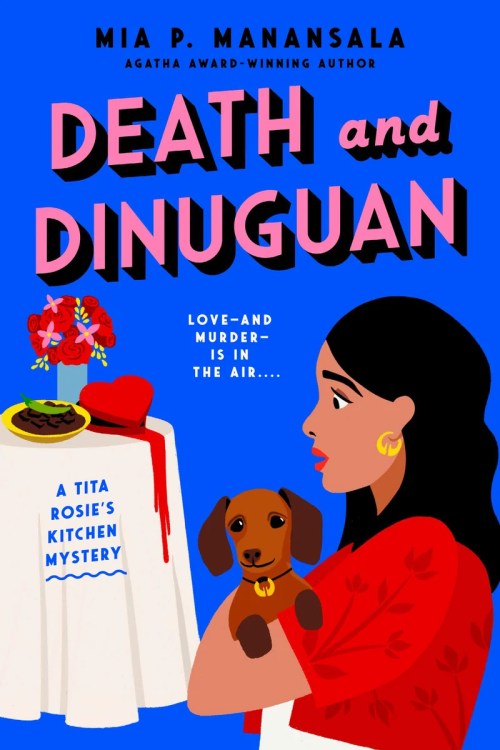
FICTION
By Mia P. Manansala
Berkley
Published November 25, 2025


