


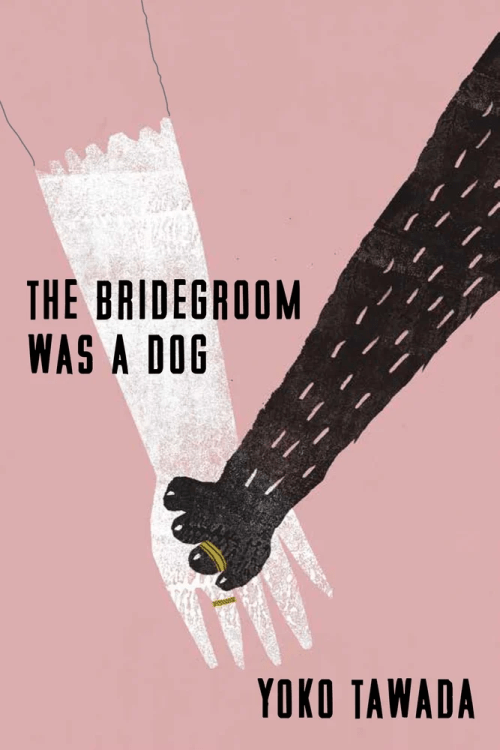
The teacher holds a spot of intrigue in the literary canon and among the folklore in the upcoming reissue of the 1998 classic The Bridegroom Was A Dog by Yoko Tawada. Mitsuko, blown in by the wind, rents a house in Southern Japan and opens up the Kitamura Finishing School to the chagrin of mothers hungry for gossip and needing somewhere to send their children. Mitsuko’s lessons deviate from the traditional math and English, focusing instead on social dynamics—or her flagrant disregard for them—such as the infamous “snot tissues,” which become softer after being reused three times. However, the novella awakens when the central story “The Bridegroom Was a Dog” makes its way from the mouths of the children to the mothers. In one exalted breath, “The Bridegroom Was a Dog” mimics the experience of seeing your grade-school teacher buying a pregnancy test—first marked by, “Oh no, did they see me?”, followed by intrigue that they exist outside the confines of school.
Similar to when students begin to question how babies appear, “The Bridegroom Was a Dog,” the story told by Mitsuko, is positioned as a folktale that all should know, and therefore no one asks about. In the story, a dog with a fascination for licking bottoms clean becomes entangled with a young girl in a relationship that devolves from the bizarrely physical into a branch of Clue-like endings. But it’s the penchant for bottoms, almost uncannily, that serves as a focal point when Taro, a doglike man, comes to the finishing school when it’s not in session and begins a tryst with Mitsuko.
Through their dalliances students begin to watch from the bushes, and mothers make insinuations about what it means for a man to be “cleaning Mitsuko’s house.” Their sexual but animalistic relationship becomes a focal point amongst parents who begin to question where Taro came from and what exactly he wants out of Mitsuko, while Taro’s unrestrained social ineptness and salivation toward Mitsuko become a point of tension in Mitsuko’s appearance to the town mothers and children.
Confronted by a student’s mother, Mitsuko learns that Taro once went by another name, Iinuma, was betrothed to another woman, and was “playing around” with a student’s father.
This student, Fukiko, falls under Mitsuko’s care. She ensures the child is fed, and devises a clever solution to stop Fukiko’s bullies, who’ve been wiping their snot on her notebook. Mitsuko provides the other students a “snot notebook,” encouraging them to continue the ritual while eliminating the need for bullying. What’s unique about Mitsuko’s position as a teacher is both her bluntness and her innocence. For she asks why the students refuse to play kindly with Fukiko, not understanding the social rules of being a pariah. While she seems unaffected by her threadbare clothes, viewing her own anatomy as one of her possessions, she seems somewhat unaccustomed to idioms and innuendos—demonstrated in her question of “playing around.”
In popular culture, Kelsey McKinney’s You Didn’t Hear This From Me: (Mostly) True Notes on Gossip’s academic approach becomes a perfect study to how knowledge spreads in the small town of “The Bridegroom Was a Dog.” The pristine apartment building, introduced in a paragraph-long sentence, and the pigeon—a metaphor for only cleaning up one’s mess if it’s on one’s property—anchor the book, and the vagrant newcomers to town, to the culture of gossip.

In his simpleminded depth, constantly repeating the phrase, “I see what you mean,” Taro is reminiscent of the obsessive character Bartleby in Herman Melville’s novella, “Bartleby the Scrivener,” who responds to most demands, “I’d prefer not to.” These declarations, universally applicable for the characters, both serve as a point of frustration and generate moments of tension and endearment in the stories.
“The Bridegroom Was a Dog” is structured like a spiral. In the center lives the word-of-mouth story, which spirals into a shell-like shape to mirror Taro’s appearance and animalistic qualities. The story concludes by taking the reader closer to the center, learning how Iinuma became Taro. Mitsuko, much like in the conclusion of Marilynne Robinson’s Housekeeping, sets into motion her established vagrant ways of caretaking, despite social norms, with her expected departure.
FICTION
The Bridegroom Was a Dog
By Yoko Tawada
New Directions Publishing Corporation
Published November 25, 2025


