


If you are like I was a few months ago, you may not know exactly where your clavicle is. If you took an anatomy test, and one of the questions was “which one of these body parts is real,” and “clavicle” was one of the options, you might stop and think about it before deciding that yes, the clavicle exists somewhere on your body and is not just a funny name for a musical instrument. Or maybe you’re Spanish writer Marta Sanz, deftly weaving together a book of autofiction with an unnamed protagonist, making a reader look up at the end of the book and say, “Oh wait: Did that main character have a name? Or was it nonfiction?” Yes and no. Just like the clavicle. Do we remember that it exists? Perhaps. Do we spend all day thinking about it? Probably not.
My Clavicle And Other Massive Misalignments is written in short spurts. Some sections are written in just a paragraph, others, over a few pages. The book is largely compelling because of Sanz’s voice; her (auto)fictive character is a funny and alive, kind of unsentimental, menopausal, overworked writer, who by the end of the first page, already describes an “attack of the farts.” By the end of the second, calls another writer a bitch. This excellent voice-work is also due to Katie King, who translated Sanz’s writing from Spanish.
We also learn a lot about this character through internal monologue, though that may not be exactly the right way to describe what Sanz is doing: Her character is vulnerable and talks to the reader with the kind of intimate interiority that’s unique to an essay collection. I wouldn’t consider, for example, rumination on the page à la Nora Ephron as “full of internal monologue;” I’d say she’s essaying, or I’d say something happened, she’s bothered, and she wants to talk about it.
That’s why—even with its section breaks—My Clavicle reads more like a book-length essay than what it intended to do, or what it was marketed as… Fiction? That said, Sanz asserts near the beginning of the book that she thinks “every text is autobiographical” but “sometimes our disguises are less modest than naked declarations,” though, ironically, while the book is quite vulnerable about this Sanz-like character’s life, it is still supposedly fiction, and so the book itself feels like a bit of a disguise. Women are like this, Sanz seems to imply: lengthy, tiny, middling, whatever. Multifaceted, maybe. We are all over the place. Perhaps in 2025, that’s not original or groundbreaking, but I’m not sure it was Sanz’s intention to challenge readers to learn new things about Society and The World At Large. Part of me thinks she just wanted to talk. (Although it’s certainly possible Sanz is hoping to depict the difficult balance of womanhood like this—can’t be too vulnerable because then you’ll be scrutinized, can’t say too little because then you’ll be scrutinized.)
Genre aside, it is quite enjoyable to be in this woman’s mind. Some particulars: She’s married. Sometimes her husband stands over her shoulder as she’s writing and that makes her nervous. It’s fine. Doctors aren’t taking her seriously. That’s not fine. She hyperbolizes all over the place about how she feels like she’s going to die. Or is it hyperbole? Sanz often reminds us without being overt that, oh yeah, women’s health issues go undiagnosed every day, even after consistent, insistent conversations with medical professionals claiming there’s nothing wrong. Although she’s darkly comedic (“I can’t tell if what I’m seeing is my body or a scene from a horror movie”), she still gets us to slow down and think about the issues. It’s effective because we trust her narrative voice enough to know we aren’t headed down a dead end—or in Sanz’s case, towards a fractured clavicle.
So what is this story (if there even is one) about? Honestly, it’s not really about anything—or at least not in a traditional, Hero’s Journey kind of sense. The clothesline the narrative hangs on is the main character’s clavicular pain (difficult, tiresome), the realities of the writer’s life (lots of travel), her cholesterol (bad), and her relationship with her husband (generally good). If art imitates life, then My Clavicle does a good job, because it’s all over the place—but not all over the place in a way that feels disorienting. Although, if it is disorienting, it’s because, Sanz is saying life is disorienting, and fractured like the main character’s pain, in a way we don’t ask for.

The clavicle, by the way, is just your collarbone (thanks, Google), which is something I can easily locate. Just like Sanz’s unnamed protagonist we later see in email correspondence, is coincidentally named Marta, sometimes the thread between what we know and what we don’t know is thinner than we think.
FICTION
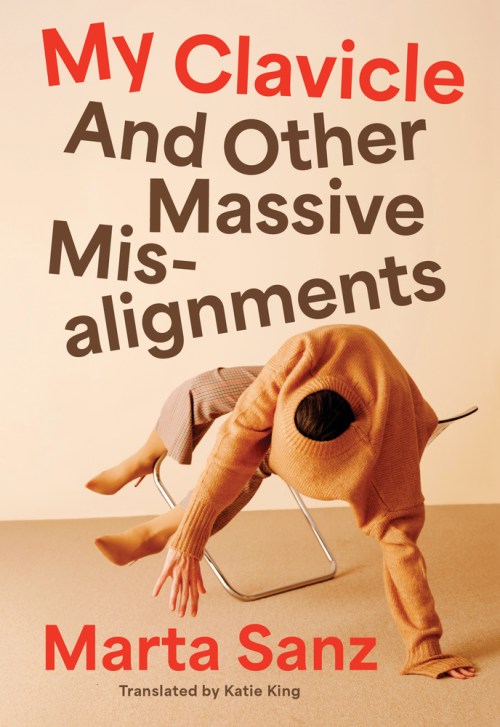
My Clavicle And Other Massive Misalignments
By Marta Sanz
Translated by Katie King
Unnamed Press
Published July 29, 2025


