


The Portuguese word saudade is defined as “a vague and constant desire for something that does not and probably cannot exist, for something other than the present, a turning towards the past or towards the future; not an active discontent or poignant sadness but an indolent dreaming wistfulness.” It’s deeper, more poetic than nostalgia. Saudade is a melancholic and sorrowful form of yearning. Nostalgia is a more general sentiment, a longing for the past, one that is often associated with happy memories—but memories lie. Nostalgia belies the reality of the past memory: it idealizes the past and engages in selective-remembering of positive aspects while ignoring negative experiences. We misrepresent, through sentimentality, those past moments and memories, and in turn limit our growth and close ourselves off to new, important experiences in the present. While defined by sadness, within saudade there lies a glimmer of hope in reunion, return, even revitalization. More than anything, the ability to create something beautiful out of the sadness.
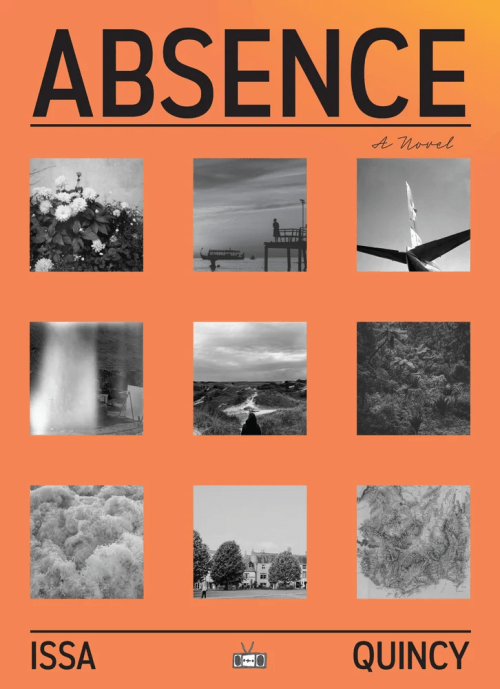
This idea of saudade is a determining characteristic in Issa Quincy’s debut novel Absence—a book defined, like its title, by what isn’t there. Absence is a lyrical, affecting novel that explores the hollow spaces carved out by grief, identity, and memory in an introspective and layered style. In a narrative that shifts fluidly between timeframes and states of mind, Quincy constructs a haunting portrait of a life defined as much by what is missing as by what remains. The novel is as much an elegy as it is a meditation on how people carry their losses—not just the loss of loved ones, but the loss of self, of belonging, and of meaning in the aftermath of events and trauma big and small.
The central thread of Absence is the memories and stories recounted by an unnamed narrator. As a child, his mother would read to him a poem—a poem that stuck with him and would resurface during his life in strange and unexpected contexts. Through phenomenological everyday objects (sometimes phantoms), our narrator encounters myriad and varied characters: a beloved schoolteacher whose mysterious secret is revealed only after his death; a grieving woman who habitually returns to a Tunisian hotel, hoping her missing brother might return; the rebellious son of an Indian tycoon who finds solace in letters from an estranged aunt, running counter to his own family’s expectations; and additional characters like a child in rural Britain, an aging doctor in Cyprus, and a figure wandering through the jungles of Thailand. All of these characters are enmeshed in the musical echoes of memory and absence.
Despite its elegiac tone, in Absence there is an underlying philosophical wave of hope. Ernst Bloch saw art and literature as vital for encouraging hope and envisioning a better future. For Bloch, hope was an existentialism. Art and literature are powerful tools that allow us to express our human desires and to push towards a better lived reality. This idea of absence—of what’s missing—this loss isn’t necessarily only the end of something. For our narrator, these reveries and ruminations lead to new understandings, new connections. This loss becomes an echo, a ripple, that reaches out and connects the disparate cast of characters in this book—an interconnected ensemble cast, using moments and fragments to build a mosaic of emotional resonance. It shapes, and reshapes, understanding, grief, and identity. Quincy excels at depicting the quiet, human moment between people. A shared meal, a conversation on a beach at nighttime or in a pub, a noticing of aging in an old friend—all become acts of resistance against a type of negation.

Absence challenges readers in the best way: it demands their attention, but offers in return a moving, artful examination of what it means to exist in a space vacated and left behind by others. Its contemplative, poetic style invites readers to ponder the beauty and pain in everyday absences and objects. Through a poem, letters, a photograph, and especially stories told and retold, the characters in Absence are able to recall and relive bits of the past long lost to time. Not in a way that sinks into sentimentality, but one which points to the future and leaves space for things that are not-yet.
FICTION
Absence
By Issa Quincy
Two Dollar Radio
Published July 15, 2025


