


The pull to write a novel or poem, the incentive to conduct an experiment that leads to a discovery, stems from an iteration of the same basic questions, however refined—what is the meaning of life? Why are we here? What are we made of? It’s refreshing to engage with a work that directly breaks down such impossibly complex yet fundamental human inquiries by looking at what we have accomplished.
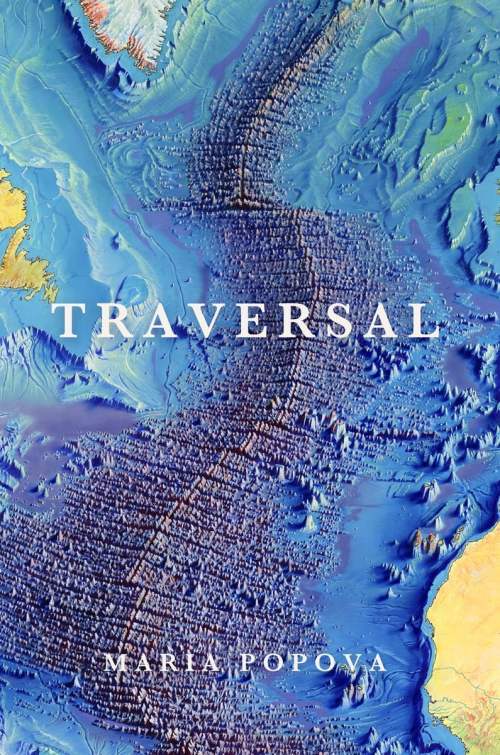
In Maria Popova’s ambitious, remarkable book, Traversal, she explores the lives of prominent visionaries, from scientists to poets, delving into how each contributed to our understanding of both the world and our interior lives—and how knowing one supports a deeper knowledge of the other. Popova is the author of several other books and creator of The Marginalian, through which she provides “marginalia on our search for meaning.”
Focusing on some of our most ambitious thinkers, writers, researchers, and explorers—including, prominently, James Cook and his expedition to Tahiti in 1769 to witness the traversal of Venus, Mary Shelley and the creation of her masterpiece, Dorothy Crowfoot Hodgkin and her discovery of the structure of penicillin and insulin, Walt Whitman, Ruth Benedict, and Frederick Douglass—Popova traverses through their groundbreaking contributions to science and the literature canon, providing insight into their personal struggles with love and loss. Examining their motivations, she reveals much about the experience of being alive, of being in love, and of questioning life’s purpose when faced with inevitable death.
In the book’s Prelude, Popova writes of our tendency as a species to “go on searching for an organizing principle to fathom the ultimate questions… Over and over, we discover that it is all one question, that there might just be a single answer: love. Our love of knowledge. Our love of mystery. Our love of beauty transcending the vanity of ambition. Our love of truth prevailing over the howling hunger for power.” These statements aptly preface a work that sees everyone, and everything, as essentially one and the same. Suffering, no matter the origin or outcome, is still human suffering. Love, in all its forms, is still love.
Popova devotes a large portion to Mary Shelley’s experiences, alongside Percy Shelley, a complicated man, egotistical and limerent, with a “savior complex.” Mary had a sad life, first losing her mother at birth—the author and philosopher Mary Wollstonecraft—and then the estrangement from her father for most of her life, the loss of three children by her early twenties, and the sudden death of Percy at sea.
Popova discusses how no one but Mary could have written Frankenstein, just as each of us is “a living unit of personhood—fragments of biographical fact woven together with the figments of slippery autobiographical memory and deliberate self-mythologizing.”
Mary published one of the most important works ever written, one that reflects the “scaffolding of the mind, which takes the shape of the society it inhabits; that each Creature is the product of its culture.” Popova points out how present-day adaptations of Frankenstein have gotten the book wrong, leading to popular misconceptions—Frankenstein is the creator’s name, while the monster is called the Creature. Yet the Creature wasn’t born a monster, but a sensitive, sentient being whose rejection by society turned him violent. Popova calls it the Creature’s “exquisite, devastating triumph of self-awareness: ‘I am malicious because I am miserable.’” Mary explored how a human being, born with a clean slate of love and curiosity, could end up committing atrocities against his fellow humans.
Another of the most compelling portions of the book—though each of the book’s 600 pages provides an interesting trove of knowledge—centers around Whitman. Popova portrays his demeanor as a steady, everyman’s philosopher who provided our species with some of the most profound insights into how and why we live.
She writes that the Earth is “constantly created and destroyed and re-created by insentient physical forces, constantly dying, constantly being reborn.” This concept is reflected frequently in Whitman’s work. His celebrated Leaves of Grass went through nine editions throughout his lifetime. Popova astutely points out that while grass is made of blades, not leaves, Whitman’s title, which he never changed, reflects how cutting grass leads to “more ferocious growth” from below; that a “leaf,” at the time, was the standard term for a page of a book. Thus, Whitman might have been conveying: “Here is an immortal book of truth indestructible by time and events.”
In our search for meaning, we lean on those who came before us, both their discoveries and their minds. Whitman writes:
It avails not, time nor place—distance avails not,
I am with you, you men and women of a generation, or ever so many generations hence,
Just as you feel when you look on the river and sky, so I felt,
Just as any of you is one of a living crowd, I was one of a crowd.
[…]
What is it then between us?
What is the count of the scores or hundreds of years between us?

Just like Whitman’s lifelong work, with all its iterations, Popova’s Traversal could go on into infinity, demonstrating how each discovery, connection, birth, and death has contributed to our current world, a world that is relentlessly being revised. She says, “Everything we call progress is but the gene editing of our cultural genome. It is editable. We are editing it, this very moment, the genome of knowledge and the genome of possibility forever entwined.”
The breadth of Traversal is an astonishing accomplishment, though at times we can feel the heft of what it took to write it, with many facts becoming indigestible given the distance covered in each section. But throughout, the work triumphs in asking the most challenging questions, some unanswerable, some leading to unifying conclusions. To hold the book’s worldview would mean to see how each living thing is a world in itself, and yet we simultaneously make up the world with atoms we own only temporarily. We’re all the same stuff: “What makes a body a person is what makes a planet a world—chemistry, chance, and connection,” Popova writes. Within us, then, we have the potential for a tolerant, loving world. But power and fear of difference get in the way.
Just as Victor Frankenstein’s inspiration to create life grew “into the deformity of an ambition blind to its own consequences and responsibilities,” our leaders continue to seek insatiable power. The outcome is a once-hopeful world that abandons and destroys itself. Popova may spend so much time discussing the lives of the Romantics, like the Shelleys, Lord Byron, and Samual Taylor Coleridge, because, she says, they might have been “more reasonable than us,” reminding us, “uncomfortably, how we lived and how we loved before capitalism blinded us into the cult of cost-benefit analysis.” Even with their emphasis on passion over reason and idealization of the past, the Romantics glorified nature and the individual and elevated the arts.
Perhaps most of all, Popova’s moving work reminds us that there’s much to cherish about life in all its mysteries and repetitions; namely, each other and the natural world. Everything is made from the same stardust, and, as James Baldwin said and Popova quotes, “we are still each other’s only hope.”
NONFICTION
Traversal
By Maria Popova
Farrar, Straus and Giroux
Published February 17, 2026


