


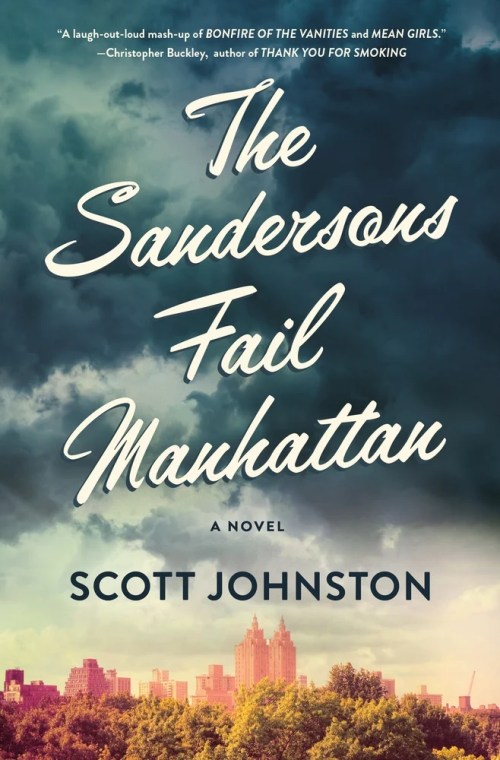
Cutting satire depends on humor and irony, but also empathy. When the political commentary lacks that final ingredient, as in Scott Johnston’s The Sandersons Fail Manhattan, we’re left with unrelatable, unmoving characters who exist in a world detached from reality. The novel’s publicity sheet bills it as a satire mocking Manhattan’s elite, their private schools, and the society behind them. It’s a subject with plenty of mass appeal, like last year’s Plays Well With Others by Sophie Brickman, a novel that examines class hierarchies and questions modern parenting trends. Instead, Johnston’s novel reads like a manifesto written by an aggrieved boomer scrolling Facebook memes created by Fox News anchors attacking everything from rent regulation to racial identity.
The Sanderson family, headed by William and his wife Ellie, live in the privileged world of Manhattan’s finance class–an apartment in the Upper East side, a house in the Hamptons, two daughters in private school, with Yale-shaped ambitions for them both. As the novel unfolds, their lives are derailed by every woke boogeyman imaginable, though the central grievance in the novel is the existence of trans people, often referred to as “the trans.”
The novel opens with William—a recent addition to the board of Lenox Hill School, a private institution for girls that at one time fed the Ivies—staring down his daughter’s shortcomings as a Yale applicant. He decides to make those shortcomings a problem for the head of school, Padma, to solve. The crisis, we’re told, is that Yale’s desperate DEI initiatives have made it much more challenging for privileged white girls to attend.
Padma is sent on a mission to rectify the situation with Yale’s admissions board and secure Lenox Hill’s traditional pipeline. She’s been busy recruiting new students to help fill out the necessary diversity in the student body, including a trans girl, Easter Riddle, whose Instagram activist parents are famous among the “woke community,” and another girl, Clover, who identifies as a goblincore eco–sexual.
This echoes William’s experience at work, where the big contract he wants to land requires a greater commitment to diversity than his company has implemented. William, and presumably Johnston, is affronted by the idea of ensuring equal opportunities.
The villain of the novel is Padma, who embodies the woke crisis. She wants to rid the Lenox Hill School of the Sandersons, and tries setting traps to push them out. Her first attempt involves accusing them of racism, although to everyone’s surprise, Ellie is half black. This renders Padma’s attempts to levy the accusation impossible, presumably because the Lenox Hill School curriculum does not include Nella Larsen on their reading lists. The real trouble begins when the Sanderson girls, Ginny and Zoey, are caught bullying trans students from other private schools. When Easter Riddle disappears, they get the blame, leading to their suspension. Their trouble at school also threatens William’s career when their involvement jeopardizes his hard-won contract.
There’s clearly an agenda in this novel. Progressive politics are a threat to these characters—and to Johnston—but whether rightly or wrongly, the bigger problem here is the stilted writing. Dialogue is treated as an opportunity to dump information on readers who are presumed too stupid to understand big words. A better editor might have trimmed the worst of the awkward conversations, but instead, we have moments like William visiting the HR department to find out whether the board member Cy fits any part of the LGBTQ category required in the request for a proposal. Besides the heavy handed product placement for Levain cookies, the banter between William and Tanya, the HR rep, is the first time I’ve wondered if part of a novel was written by an LLM. There’s no sense of humanity here. It reads like William is entering prompts into Google, and Tanya’s answers offered to create a sense of plot and define the imaginary crisis created by DEI initiatives. And while Levain may not have paid for a mention, lines like, “Damn, they are good though,” certainly suggests they would have gotten their money’s worth if they had.
That’s one of the biggest problems with the novel, especially in the first hundred pages. So many of the scenes are meetings that could have been an email. For instance, William takes Cy out for drinks in an attempt to suss out whether he falls into the magical LGBTQ check box for their proposal. This scene isn’t funny or witty or entertaining or heartfelt. It reads like filler in an attempt to imitate the idea of people.
The novel finally picks up about a third of the way through when the focus shifts to Ginny, Zoey, and Clover. It’s not as cutting as Mean Girls or Gossip Girl, but it tries, and Johnston is surprisingly at his best when writing teenage girls. There are absolutely moments in this middle portion of the book that build page-turning tension, and there’s quite a good unraveling of the plot as the three girls finally confront Easter Riddle, even if the plot feels borrowed from Season 1 of Search Party.
The trouble with all this is that the plot and page-turning is derailed by the perpetual victim syndrome rotting each of these characters to the core. It’s a fantasy further from reality than the wizarding world of Harry Potter, where DEI hobgoblins lurk around every corner. The girls are bad people, doing bad things. Johnston has failed to create characters to empathize with, and that’s an essential component of satire.

Bad people can make great characters. Consider Brett Easton Ellis’s Rules of Attraction, a novel focused on rich kids at an expensive private college. The characters are morally bankrupt, each in their own way, but readers empathize because Ellis created well–rounded figures, flawed and tragic, but brimming with humanity. The same can’t be said for Johnston’s characters. They are too much one-sided caricatures, either villains who are conspiratorial liberals, or heroes, the inevitable conservative victims.
The true nature of the novel is revealed when Ellie, in exile in the Hamptons, comes across Bob Ellison who has also been exiled by the woke mob. He tells her, “I’m really sorry for what happened to you guys,” reinforcing the idea that the Sanderson family are the victims rather than the perpetrators. There is no accountability, no recognition they might have played a part in their undoing. Bob, of course, turns out to be a history buff with fetish for Nazis, providing him the credibility, at least within the novel, to compare progressive ideology to Nazi-style fascism. But fundamentally this is why the novel fails at satire. The Sandersons perceive themselves as the victims of the great atrocities of progressive politics, without any accountability for their own actions.
There are moments when The Sandersons Fail Manhattan does have some excitement, but these are few and far between labored diatribes. There is certainly an audience–buyers–for this novel, but whether they can read more than 160 characters or not is not the point. Finally, though, if we’re meant to take away from this novel that society has allowed progressive politics to displace the once great meritocracy, it’s a self-defeating argument. The publication of The Sandersons Fail Manhattan is proof-positive that white male privilege still exists.
FICTION
The Sandersons Fail Manhattan
by Scott Johnston
St. Martin’s Press
Published July 8, 2025


