


When Etsy Beaucarne, a struggling academic, is contacted by a Special Collections librarian at a regional university and informed that a distant ancestor’s journal has been unearthed at a construction site, she is confident that this previously unknown literary artifact may be her ticket to tenure.
The journal, named “The Beaucarne Manuscript” after its author, Arthur Beaucarne, describes Arthur’s life in the early 1900s as a geriatric Lutheran pastor in Miles City, Montana. Though the days of massive, wasteful buffalo slaughters were 40 years in the past, an entry in Beaucarne’s journal records a troubling incident that brings them back to mind for the town’s older residents: the mysterious appearance of a skinned human corpse left lying out on the prairie. When similarly brutalized bodies continue to appear, locals begin calling them “humps” because of their resemblance to the maimed buffalo corpses that dotted the prairie after they were stripped of their hides.
Arthur is further unsettled by the sudden appearance of a new parishioner at his Sunday service, an “Indian gentleman” whose “presence is disconcerting.” The man introduces himself as Good Stab, of the Pikuni band of the Blackfoot Confederacy, and asks for Arthur to hear his confession. Over many Sundays he tells the pastor the story of his life—and his afterlife. After being both shot by a soldier and bitten by a strange creature, Good Stab posthumously wakes to find himself bounding through the woods in ravenous pursuit of the soldier that killed him.
Initially dismissive and condescending toward his visitor, Arthur nevertheless records Good Stab’s story in his journal even as he rejects its truth. But his skepticism erodes as Good Stab continues his compelling testimony about his descent into monstrosity.
Good Stab’s vampirism follows many conventional rules: his senses are heightened, he has extreme strength and endurance, and his stealth allows him to elude Arthur’s notice even when he’s in close proximity. He can heal himself even after grievous injury, which makes him nearly impossible to kill. And of course, he drinks blood. Insatiably and uncontrollably.
But though he does tick the boxes of your standard-issue vampire, Good Stab is hardly a humdrum representative of the undead. After his transition, he finds that his form is mutable. He’s dismayed to discover that when he feeds on deer, he begins to grow antlers, but even when he pivots to hunting unlucky trappers traveling through the mountains, their coarse facial hair begins to grow on his formerly smooth Pikuni face. This revelation puts him in a painful bind: to remain Pikuni, he must feed on Pikuni. His allegiance to his people, so strong that it transcends his undoing, reveals the deep empathy that coexists with his unending hunger. Though the tears that stream down his face are made of blood, they are tears all the same, and they make Good Stab a complex and unforgettable protagonist.
Horror fans will be more than satisfied with the book’s careful, clever balance of the sanguinary and the suspenseful. While the body count is high—and puts the “viscera” in “visceral”—the interludes of raw slaughter take nothing away from Arthur’s slow slide from faint unease into barely suppressed panic as his relationship with Good Stab deepens. At first, only a tantalizing tension slithers between the two men as they sit facing each other in Arthur’s chapel, illuminated by just a single candle to accommodate Good Stab’s sensitivity to light. But as Good Stab’s confession unfolds and Arthur begins to verify small details of his tale and ruminate on his cryptic asides, Good Stab’s menace becomes so powerful that even when he is not present (or is he?), the possibility of him permeates Arthur’s every thought and action.
The story is constructed through alternating sections of Arthur’s journal: his verbatim transcription of Good Stab’s story, and his own increasingly fraught reflections on the rupture their relationship has created in his life and his understanding of himself. The characters’ voices are profoundly distinct—Good Stab’s straightforward account is infused with understated emotion and strung through with Pikuni thoughts and words, while Arthur’s affected prose attempts to elevate himself above those around him and conceals as much as it reveals. Together these two narrators create not a seamless narrative, but one in which the seams are the focus: the tangled, inescapable ties that bind them too tightly together.

When the journal concludes, Etsy, Arthur’s great-great-granddaughter, reenters the story. As Arthur’s dark legacy comes crashing into her life, she is forced to determine what to do with and about it. The transition from a dark and demon-haunted chapel and the battle-scarred Montana wilderness to Etsy’s campus apartment complex and lackluster life is initially jarring, but the gulf between them makes her course of action all the more stunning.
The Buffalo Hunter Hunter is brimming with blood and loaded with deaths that range from raucous exterminations to heartbreaking tragedies. But in addition to this, it offers moments of gentle reprieve and electric connection, subtle humor and clever stratagems, stark choices and satisfying triumphs. In its celebration of death, it affirms life, and readers who are looking for thrills can find them in both places.
FICTION
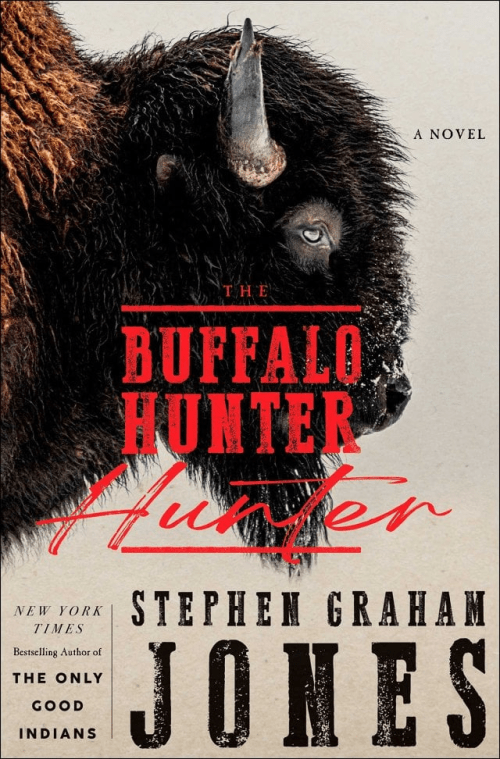
The Buffalo Hunter Hunter
By Stephen Graham Jones
S&S/Saga Press
Published March 18, 2025


