


Celebrated Canadian author Heather O’Neill’s fifth novel is, in its surface telling, the timely story of a country torn apart by invasion and war. In its deeper meaning, the novel is a coming-of-age tale that describes the journey the 14-year-old protagonist, Sofia Bottom, makes to cast off the ties that bind her to her famous and formidable mother. The result is a stirring combination of a picaresque quest that takes Sofia away from the safety and familiarity of home and out to a wider world in turmoil, and a poignant interior exploration of the challenges inherent in mother-daughter relationships.
The Capital of Dreams begins in an undefined time period as the small, largely forgotten, fictional European nation of Elysia is under attack. Formerly citizens (of a different ethnic class) of the invading Enemy’s country, Elysians are a progressive people. “The country,” as the narrator describes, “was in the vanguard of art and ideas. Nothing was boring or traditional.” To the nationalistic and conservative Enemy, however, who believes in “the nuclear family, the supremacy of males, and pure bloodlines,” Elysia – particularly its glorified Capital – embodies “the worst excesses of the West,” with its perceived intellectual elitism and artistic decadence. As the Enemy closes in on the Capital, Elysian artists, thinkers, and cultural figures are targeted for extermination, no one more so than Clara Bottom, a fierce defender of Elysian culture, staunch feminist, and the country’s most revered scholar and political writer.
For Sofia, however, her mother Clara, is a confusing mix of idol and adversary. On the one hand, Sofia desperately wants her mother’s attention, loving her “monstrously, ferociously.” Yet she understands that other people, including her mother’s adoring students, “knew and appreciated Clara in a manner Sofia never could.” The sense of her lifelong estrangement from Clara is evident in flashbacks throughout the novel as Sofia reflects on Clara’s exacting standards and seemingly relentless criticism of her, even extending to her enjoyment of reading Elysian fables and folktales: “Oh Sofia, you can’t always read children’s books for the rest of your life. It will break my heart if you don’t grow as a reader. There’s so much out there for you to read and discover. Talking hares are a waste of time…It’s through reading that I became an adult. You can’t learn anything in your enchanted forests.”
Yet it is in Elysia’s enchanted forests among faeries, magical trees that come to life, and talking animals that Sofia, in her struggle to survive, becomes an adult. When Clara’s desperate plan to send her daughter off on a train in order to smuggle her new manuscript out of the war-torn country fails and the manuscript is lost, Sofia becomes the heroine of her own folktale. Left to roam the countryside and face all manner of danger in the form of thieves, enemy soldiers, and landmines, she befriends a talking Goose and together they travel in search of the elusive Black Market and the promise of recovering her mother’s manuscript. Along the way, they meet a cast of fascinating characters, many of them children, forever changed in devastating ways by the war. In this Alice in Wonderland-like setting O’Neill so hauntingly evokes, Sofia must continually overcome obstacles and choose to move forward on her journey or, like others, be forever trapped in hopeless circumstances.
While the novel’s fantastical elements and fast-paced action enliven the storyline, it is the quieter moments of Sofia’s reflections on her fraught relationship with her mother, and her stubborn refusal to bend to her will, where O’Neill’s insightful writing truly shines. On the brink of womanhood and in the middle of war, the rebellious Sofia is coming into her own, rejecting her mother’s desires for her and embracing her own path, yet in so doing is actually becoming very much a product of Clara’s efforts to raise an independently minded daughter who can survive on her own in a tumultuous world. A shocking revelation at the end of the novel concerning an act of ultimate betrayal confirms that the cunning Sofia has learned from Clara’s example that “You had to forge your own destiny. And she would have to forge one apart from her mother.”
Truly one of Heather O’Neill’s most imaginative and richly allegorical works – and one that can undeniably be read as a reflection of our current geo-political times – The Capital of Dreams will appeal to readers of fantasy and adventure, as well as those interested in a novel that explores the dark corners of human relationships, the limits of love in the face of survival, and the toll of war.

FICTION
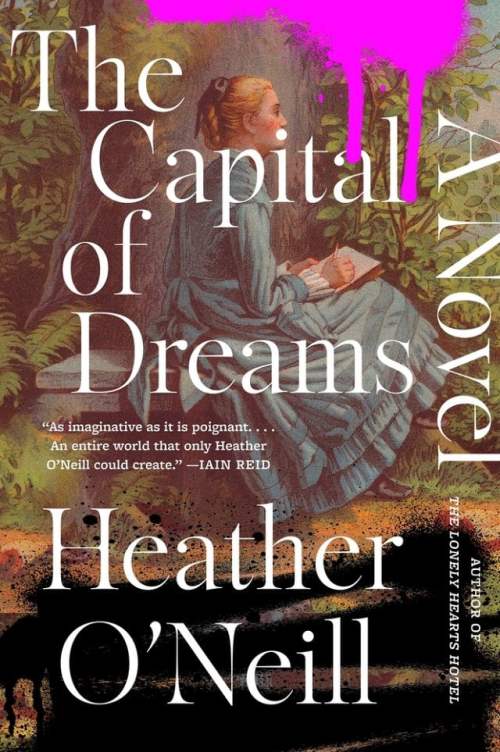
The Capital of Dreams
Heather O’Neill
Harper Perennial
Published January 7, 2025


