


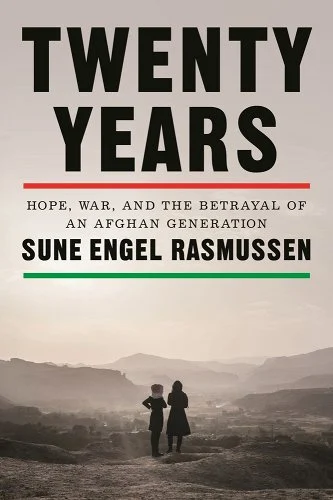
Compared to the amount of writing that exists on America’s 2003 invasion of Iraq, far less has been written about the NATO-sponsored invasion of Afghanistan and the ensuing decades of war that have followed. Governments positioned both of these military actions (along with others in places like Yemen and Syria) as a “Global War on Terror,” a nebulous moniker that avoids the nuanced distinctions between these distinct wars. While the invasion of Iraq can be dismissed as a political vendetta against then dictator Sadaam Hussain, or an attempt to stabilize the oil producing Middle East region for corporate business interests, or even an unfounded search for weapons of mass destruction, America’s war in Afghanistan remains the greater mystery. As the canon of writing about this war grows, few authors have been able to connect the myriad political and military events of those decades to the personal accounts of Afghans who fought on both sides of the struggle to define a new country as Sune Engel Rasmussen has done in Twenty Years: Hope, War, and the Betrayal of an Afghan Generation.
The Danish-born Rasmussen lived in Afghanistan for nearly a decade as a foreign correspondent for The Wall Street Journal and The Guardian, cultivating the relationships and contacts behind the stories that make up Twenty Years. Of the book’s eight major voices, the majority of the page count is dedicated to just three. Zahra returns to Afghanistan where she outlives the abusive husband and father of her children and builds a career working at several NGOs. Eventually, she writes a controversial memoir that leads to a failed campaign for a parliamentary seat. Omari embraces his father’s stories of fighting Russians with the Mujahideen and dreams of telling his own stories of defending his homeland against the latest wave of foreign invaders. After earning the trust of his superiors, he studies engineering after the war even as traumatic events continue to haunt him. Parasto’s confidence in the Afghan government is betrayed by the abrupt American withdrawal that forces her to open schools for girls that operate in secrecy until the work becomes too dangerous for her to stay in the country. Rasmussen arranges these personal stories against the chronological backdrop of better known current events involving American generals and presidents.
Placing personal accounts from a Taliban fighter next to a woman with a masters degree working in government implies several dimensions of irreconcilable conflict that are never resolved. As careful as Rasmuseen is to let any contradictions between opposing narratives speak for themselves, a more critical tone emerges in his analysis of United States policy failures. Observations like, “It’s hard to do effective counterinsurgency if you’re actively undermining the government meant to serve as an alternative to the insurgents” may read like truisms of military philosophy, but they are necessary reminders of the hubris that dominated so much of the war while it was still happening. Only when Rasmussen crosses into the idealism of hypothetical solutioning does his narrative journalism project feel weakened, “By including the Taliban, the United States could have shown the Afghan people that it was serious about building a democracy with space for anyone who wished to take part.” While Rasmussen may be forgiven for indulging in moments awash with hindsight bias, the interpersonal stories of friendship, love, and loss are what make Twenty Years stand out from any cursory policy analysis offered by others without Rasmussen’s credentials and talent.
As the not so subtle subtitle of this project implies, betrayal and disappointment are major themes that run through each of the narratives. But while the women tend to focus on economics and education, the men tend to gravitate towards violence. After a young man named Saif is disciplined for his role in retaliatory attacks while serving with pro-government forces, he leaves the country to fight with a militia of foreign fighters who support Bashir Assad’s Syrian government. While fighting in Syria, Saif observes of Afghanistan, “Our country is in the hands of traitors.” In a final note of frustration, even the loyal Talib Omari admits that, “They used me to fight their war, but at the end of the day, I’m nothing.” The conclusions reached by these young Afghans are as much a collective awakening to the practicalities of national identity politics as they are a shedding of the youthful idealism that is lost when the brutality of combat becomes less abstract and more personal.
In the book’s final section titled A Note on Reporting and Sources, Rasmussen acknowledges “Memory, though, is volatile” and “Writing a book based partly on people’s recollections of events entails working with different realities.” Other writers have won awards for their portrayals of the war in literary fiction (Jamil Jan Kochai, Khaled Hosseini) or used the journalist’s point of view to access the absurdity of war as outsiders looking in (Kim Barker, Matthieu Aikins), but Rasmussen’s real strength lies in his arrangement of how others talk about themselves. With Twenty Years, Rasmussen employs tactics of a nonfiction narrative style that’s closer to writers like Svetlana Alexievich, Cornelius Ryan, and Studs Terkel who wrote about war through the voices of the soldiers and other people that were affected in different ways.
While Rasmussen wisely avoids making any tidy conclusions of his own about the future of Afghanistan, his writing succeeds in detaching the personal accounts of hope and suffering from the American context of a supposedly justified military response to 9/11. In opposition to the familiar stereotypes of abused housewives, starving children, and Islamic extremists that have too often been used to garner support for unpopular government actions, the voices of Omari, Parasto, Saif, Zahra, and others ultimately embody different struggles to build a future that never materialized for any of them. Perhaps the voices missing from Twenty Years are those of the victors, the ones who succeeded in building the future of prosperity they imagined would emerge after decades of war and disillusionment. If only they existed.
NONFICTION

by Sune Engel Rasmussen
Farrar, Straus and Giroux
Published on August 6, 2024


Thank you for sharing the post.
I know its not the same but i see some similarities between this book and one I’ve read – The Beauty of your face (https://collectiveniss.wordpress.com/2022/02/27/book-review-the-beauty-of-your-face-by-sahar-mustafah/).
While, Twenty Years is non-fiction and provides a historical and journalistic account of Afghanistan’s recent history, The Beauty of Your face offers a more personal, narrative-driven exploration of one woman’s life and emotional journey.