


During my first year of law school, I took Criminal Law with the rest of the 1L students in my class. Before we discussed the Model Penal Code or what the case law had to say about how crimes are or should be punished, we examined something more elementary: why we punish at all. There were the retributive theories based on the idea that punishment is justified when it is deserved, that is, when a wrongdoer freely chooses to violate society’s rules. There were the utilitarian theories, which cited incapacitation, rehabilitation, and deterrence as justifications for punishment.
In the world of The Repeat Room, Jesse Ball’s latest novel, all of these theories would be considered obsolete for falling under the umbrella of punishment. In this speculative world, our real-world system has become outmoded. That system punished, but the new system “looks forward.” No longer does past precedent serve as instruction for how current cases should be decided. Indeed, even the accused criminal’s crime is not particularly relevant. In The Repeat Room, jurisprudence is guided by “a promise of the future.”
The book opens with Abel, a man who works as a garbage collector and has been called to serve on a jury. The jury system is a secret to Abel and the rest of the potential jurors; the reader learns the rules as Abel does. One juror is selected from hundreds of candidates to issue a verdict. If the verdict is guilty, the accused is executed. If the verdict is not guilty, the accused is released. There is no trial, no prosecutor or defense lawyer, no appeal process. The only relevant evidence is the defendant’s life experience, which the juror inhabits as if he is living it before issuing the verdict.
This promise of the future boils down to iterative culling. By issuing verdicts for the defendants brought before the jury system, the group comprising society decides who gets to be a part of the group. “Therefore,” explains a woman who introduces herself to the group of jury candidates as an explainer, “the penalty of failing to appear to be fit is to be removed from the group.” It is a practical matter she compares to removing a cat that scratches your furniture from your home. Of course, for the accused, the penalty of execution looks a lot like punishment.
The culling is described in other ways: winnowing, weeding, a new social baseline, removal of hazards. Most harrowing, perhaps, is the most straightforward description: “a way to pick out who deserves to live.”
As Abel progresses through the stages of juror selection — itself a culling process — the bleakness of this society sets in. Potential jurors have identification numbers in lieu of names. They wear identical shapeless robes and eat food from pale plastic trays. A man has “a face like old debt”; the lights are “the kind that kept people cheerful, for the kind of people who have trouble being cheerful.” Even the snippets of information about what the world outside of the jury system has to offer fail to provide any respite from the gray haze that permeates this world. “Who draws anymore?” remarks one of the potential jurors. “If I want a picture of a diver or a musket or an elephant riding a canary, I just ask the telescreen and there it is.”
The desolation of the first half of the book mostly happens on a macro level. The harsh vision is one of a society. Individuals move around the pages, and we experience this society through Abel, but his personal backstory and feelings largely exist to illustrate the concept of the repeat room and jury system.

The second part of the book is the experience of the life of the accused from his perspective. It provides a new set of rules for a smaller society. This society consists of four family members: a mother, a father, a sister, and the accused. Before he was the accused, he was many other people, characters his parents made him become in order to avoid developing any semblance of a self. He and his sister, in this latter half of the book, are the subjects of their parents’ disturbing and brutal experiment. Amidst his palpable despair, the boy seeks love in the only place he can find it. The resulting relationship, taboo and tragic, culminates in an act that leaves him at the mercy of the juror’s verdict.
The two halves of The Repeat Room come together with a gut punch. The novel balances a large-scale critique of systems of judgment against the intricacies of individual human behavior to ask the question of who deserves to live. As every law student learns, societies have tried since societies have existed to create theories of punishment and justice systems to answer that question. But coming away from The Repeat Room with a definitive answer would be missing the point.
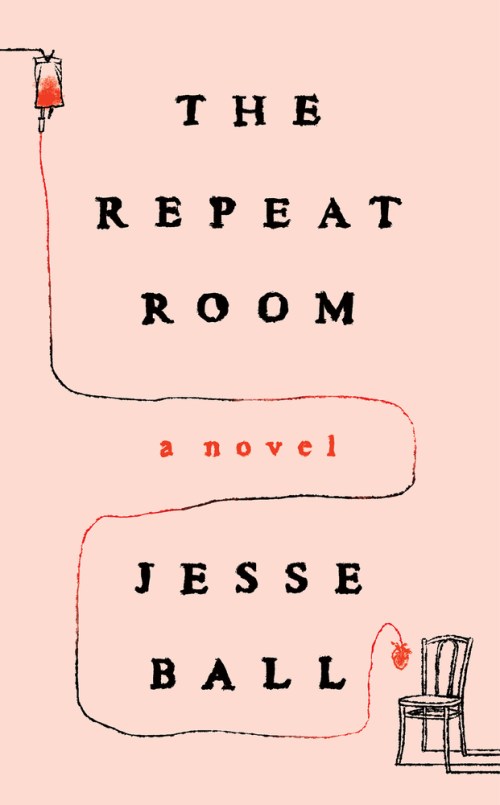
FICTION
The Repeat Room
By Jesse Ball
Catapult
Published September 24, 2024


