


Translation is inherently a poetic act, a submersion in sound, the word and multiplicities of meaning, and it’s wholly a delight that translator and novelist Idra Novey has published a new poetry collection, a dozen years after Exit, Civilian: Poems. Translators give us a world otherwise lost to us, unless we speak the original language. So do our poets. Soon and Wholly is deeply engaged with place and space: literal, emotional, and temporal and offers a variety of collaborations—such as Clarice Lispector, whom Novey has translated—as well as with the visual artist Erica Baum, and those that are anonymous to us, yet transformative for Novey. In her delicate and sure hand, this is a multisensory journey, less about destination, than motion, and emotion; as ephemeral as memory and as rooted as forests.
This conversation has been edited for clarity and length.
Mandana Chaffa
I was so taken with “Nearly” as a poetic preface, Idra. All of those “whiles,” “afters,” and “whens” offer echoes of storytelling, of course, but they also represent time: past, present and ongoing. So too are the sentence fragments that don’t offer resolution, much like life itself. To use this as a guide to what is to come—along with the epigraph from Edmond Jabès—had me in mind of life in, and as, a conditional. Was this poem always intended to serve as a kind of emotional direction for the collection?
Idra Novey
What an astute insight, Mandana, to frame “Nearly” as an emotional compass, guiding the direction of the poems that follow. I wrote the poems in this book over the last decade and I wanted to juxtapose them with some larger inquiry in mind, which you articulate so concisely: how to exist, in, and as, a conditional? “Nearly” circles that inquiry, as Jabès does in his Book of Questions. He saw every word as a question in the book of being.
Mandana Chaffa
Can we talk about your collaboration(s) with Erica Baum? I’ve known Erica and her work for a while, the way she origamis image and language is so generative, and joyfully dismantles classic ideas of language and meaning. I know you’ve partnered together in the past—notably in Clarice: The Visitor—but when it came to this collection; how did you intend to engage with her work? In my reading, I’d suggest the images came first, but I’d love to hear more about your process and outcomes for the section “Too Soon To Tell.”
Idra Novey
“Origamis” is such a vivid verb to evoke the folds and strips of images in Erica’s art. And your instinct is correct, that her images came first in our collaboration “Too Soon to Tell.” Early in the COVID-19 epidemic, Forma Gallery in the UK asked if Erica and I would like to take part in a project about distanced, artistic exchange during quarantine. Erica sent me three images and I wrote a prose poem in response to each one, and then she created the next images with my initial three prose poems in mind. We spoke over the phone weekly while we were confined in our apartments. The vibrant strips of color overlapping strips in Erica’s images shaped my approach to the stripped-down sentences in the poems. I wanted each line to vibrate on its own but also against the contrasting sound of the line before it, like a tuning fork.
The poem about Ana Mendieta included in this collection came about through a similar process, from watching Mendieta’s Silueta series repeatedly until I figured out a register and momentum for the poem in response. According to the Argentine writer Cesar Aira, what an author responds to, in writing back to a work of visual art, is not just the strokes of paint or shapes in a film, but what Aira calls “the mad solitary machine that moves around inside artistic activity.” It always feels new, writing back to the activity of some other artist’s mad solitary machine.
Mandana Chaffa
With the longer poems in the collection, I appreciate how much air you allow between the different sections; it affects pacing and breath, and narrative and arc, and has the effect of making it both concrete and dreamy at the same time.
I was especially affected by “That’s How Far I’d Drive for It” “for the poet H.G., who never published her poems.” A road trip for ancestral rhubarb examines the nature of desire, of what we seek—Trisha Brown’s “disruption of the every day”—and what it is for a poet to “to refine her gorgeous / poems and pile them in a drawer.” How much beauty there is that we’ll never know! Beyond its poignancy, the poem raises an eternal question for creators: what does it mean to be an artist, beyond publishing, awards and commercial success? And more, what if one doesn’t seek an audience? If a poet never shares her work, is she still a poet?
Idra Novey
Hilma af Klint wasn’t inclined to share her artwork during her lifetime. She requested that her nephew store her abstract paintings, unseen, for twenty years after her death. I have no doubt that many groundbreaking painters, and writers, are keeping their work offline and forgoing the pursuit of an audience right now for a variety of reasons. Thaddeus Mosley, a phenomenal sculptor in Pittsburgh, worked for the postal service for decades while carving massive sculptures out of felled trees and storing all his art in a garage. Mosley’s sculptures didn’t start appearing in museums until he was in his nineties. To write that poem about my friend Helen and her preference for placing all her poems in a drawer, I had to sit uncomfortably with my own reasons for seeking an audience. Is it a craven need for external validation? I would like to think what I crave above all is human connection, for my writing to lead to meaningful, nourishing conversations like this one with you. But desires are never pure or sourced from just one acceptable longing.
Lispector says of a woman entering
from “Regarding Marmalade, Cognates,
an empty room and finding a version
of herself so dark it makes her pause
and really see it
and Visitors“
Mandana Chaffa
Let’s talk about Clarice Lispector who figures both in your translating work, and in quite a number of poems in this collection. She’s clearly a passion of yours, as a subject, and as a kind of mirror and muse. I’m taken with the fact that in this collection, you’re using her letters—perhaps the most intimate forms of writing, other than diary entries—as seeds in your own poetry, as well as a way to have a kind of dimensional dialogue with each other.
Idra Novey
The Brazilian singer-songwriter Maria Bethânia has spoken of reaching for ‘minha Clarice’, my Clarice, at night. I think many of us who connect deeply with Clarice’s books refer to her this way, as if speaking of a beloved aunt. Clarice’s candor is so radical you finish her sentences convinced that they were written for you, and she belongs to you, and you in turn belong to her. Of course, Clarice doesn’t belong to any of us. And yet it is hard to resist, after reaching for her books on my bedside for many years, and after translating one of her novels, that some particle of Clarice’s sensibility hasn’t found its way into my relationship with language. Translating G.H. pulled me deep into her voice, but once the translation was complete, that time immersed in her sentences left me braver, more equipped to recognize when I could take my own sentences a little further and reach for a more unsettling kernel of truth.
Mandana Chaffa
In one of your addresses to Lispector you wrote: “You too worked as a translator, know one has to hang / the missing word / like a hat on a wall without a hook. / I’m either the hook / that could have or the hat which has to.” Would you talk about your translation work? Why did you start translating, and what calls to you now, either linguistically or thematically?
Also, do translations across writers and languages differ? I know that Lispector must be quite different from your collaboration with Ahmad Nadalizadeh on Garous Adbolmalekian’s phenomenal Lean Against This Late Hour and yet, and yet, there are certain echoes across subjects. Given limited bandwidth, how do you decide what translation projects you take on?
Idra Novey
I’ve followed the wind, for the most part. With translation projects, I prefer an open sail and some serendipity. There was no logical reason for me to be the poet who collaborated with Ahmad on his translations of Garous Abdolmalekian. I have no expertise in Persian literature. But I connected immediately to Garous’s image-driven parables when Ahmad sent them to me through a mutual friend. Garous’s tone and register made aesthetic sense to me and I was writing parable-like poems of my own, for Soon and Wholly. For the next five years, as I toured for my first novel and my second, Ahmad and I spoke on the phone regularly, going over each line of each poem multiple times. I loved learning from him about Persian authors and poets and directors I didn’t know. We formed a deep friendship through the process.
My current translation project is also a collaboration, although this time from Spanish, which is what I speak at home with my family. Garth Greenwell and I are co-translating the poems of his partner, Luis Munoz, who writes with a transfixing concision reminiscent of Kay Ryan. Luis’s poems are similarly compact and exquisite.
So what explains it, my failure
to recall these conjured trips, or why my psyche delivers words
from a woman I never sat with under packed rows
of dresses
Mandana Chaffa
So many of your poems make me think about the narrative act and its limitations: the fables from our childhoods and the stories we tell ourselves, whether from faded memories or definitive belief. With each passing year, I have fewer firm boundaries around what I think has happened in my life, and what, if any, truth I can profess. Within that uncertainty is poetry, isn’t it? The possibilities of all that might have been, that might yet be? Or as you describe so ars poetically in “Value City:” If there’s a temple beyond glands and bone / for all that goes blank in a lifetime, maybe it resides in the body / of a poem, in meanings left between the spread knees”.

How does memory—our stories of ourselves in place and time—create our identity, and how rooted are they? Are we?
Idra Novey
The memories I feel compelled to explore now, in my forties, are the ones that I’ve made a point of avoiding in earlier books. In my thirties, I worried I would be viewed as less intelligent, as a lesser thinker if I wrote too many poems, or a whole novel, set in the Allegheny Highlands of southwestern PA. I also just needed a few decades living elsewhere. I wasn’t ready. Teaching in Chile, translating other writers from rural landscapes, like the poet Manoel de Barros from the wetlands of Brazil, helped me return with an expanded sense of how to write inventively, rather than defensively, about the Allegheny Highlands. James Wright reinvented his approach to depictions of Ohio after translating Cesar Vallejo. His translations from Spanish, and later from German, of Trakl, radically transformed his poems about Martins Ferry. To figure out what’s gone blank from childhood can require an extended leave. Immersion in the works of writers I admire, in other languages, became my way of return.
Mandana Chaffa
Speaking of place—and time is surely a place, too—these poems, certainly your deservedly-lauded novel Take What You Need, reckon with location: those we choose, those that are thrust upon us. South America, Pennsylvania, and Brooklyn make their way into your work, to be sure; but also, especially, landscape, bodies of water, Earth. What places do you find yourself returning to repeatedly…and what hasn’t made it into your literary work because it isn’t yet time?
Idra Novey
I would like to write more about the forest where I played with my three siblings growing up, and also about flea markets. My grandmother made extra money buying jewelry at flea markets for people and she took me along. I started going to fleas again with my Helen while working on Take What You Need, which became sort of an ode to flea markets. The novelist Lisa Ko published a brilliant essay recently, connecting her writing practice to the optimistic meandering that happens at a flea market. If you rush through the aisles, you are likely to miss the best junk. Novels and poems are like that as well. You have to slow down, be willing to pick up broken trinkets, consider them in your hand. You never know until you hold something for a few minutes whether it might be the most precious find of the day.
She’d wanted forest.
She couldn’t recall wanting to turn into a tree specifically, but those
minutes in the hospital had been so loud, all the beeping machines and
those agonizing sounds coming from her mother.”[…]
Now she was a tree, with no feelings except in seeds and shadows.
Mandana Chaffa
The forest must have its own question! There’s an arboreal canopy over the collection as whole, including the gorgeous closing poem, “Afterlife.” On a personal level, I was stricken at the opening—and breathless at the end—having heard such agonizing sounds from those I love. More personally, I’ve a desire to become a tree—or tree food, more accurately—once this life in this vehicle is over, and this juxtaposition, the brief life awarded to us with language, with emotion, with this meaningful conversation! in contrast with a tree that has an entirely different experience of time and consciousness. Given how they figure in your work, I’d love to delve into your contemplations of trees, and especially forests, which are a kind of eternal, unlanguaged community, yes?
Idra Novey
The forest does indeed demand its own question! I am fascinated with arboreal forms of speech, how aspen trees talk to each other through chemical signals. I’d like to think that great art can cause a similar chemical signal between humans as what occurs, wordlessly, between aspens. I live for that chemical shift in the body that can happen while walking around a sculpture, or while reading a poem that compels me to slow down and murmur a line aloud in order to feel it in my mouth. That closing poem, “Afterlife,” was written in response to a photograph by Noell Oszvald of a woman bent over next to a tree. The woman’s shadow runs parallel to the tree’s shadow, and whether the woman’s shadow ends much sooner isn’t visible within the frame of the photo. There is a shared mortality conveyed in the photo. Our own shadows are in peril whenever we take trees, and their shadows, for granted.
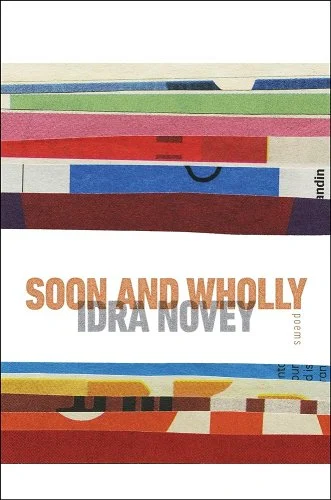
Poetry
Soon and Wholly
By Idra Novey
Published September 3, 2024
Wesleyan University Press


