


It’s hard not to hear Adrian Matejka’s name these days in the poetry world. An incredibly talented and connected writer, Adrian is loved by so many of poetry’s greats, and he is now the editor of Poetry Magazine, which, I mean, almost doesn’t need an introduction; it’s become so far-reaching. But I’ve been struck, for the last several years, running into Adrian at events around Chicago, how gracious, how warm, how humble and how daring he is.
It was no surprise that when I sat down to read Be Easy—his newest book, his first-ever New & Selected poems, pulling from six books—how gracious, how connective, how clear the through-line in language and tone. I quickly realized, though I should have known, I was reading a master. Adrian’s sonic skills, his emotional weights, his attention and focus on Black creatives, athletes, musicians—he is creating the world for us to settle in close to the artists he loves, we come to love, creating companion pieces to so much music, melding the personal and historical to settle us exactly into his life, his time, his place, all while the lyric swings us through, carries us with gracious arms.
Adrian and I met at a delicious restaurant, one of the most delicious I’d ever eaten at, called Ema, to discuss this book. You wouldn’t believe how many “omg this is so delicious” lines I had to remove from the transcript. Though we planned to discuss his book, we sidestepped, getting immediately into the state of affairs in the poetry world. I learned that even when you land one of the biggest jobs in the country, you can still have imposter syndrome! We shared feelings about writing and its place in institutions, and the overall shift to professionalization in artists. Right before this transcript started, we were discussing our outfits and what we used to wear as college professors—for me, wild artsy outfits, for him, suits and ties! We then got into his new book, Be Easy: New and Selected Poems, below!
This conversation has been edited for clarity and length.

Adrian Matejka
Maybe that’s part of what we’re talking about, though: hanging on to a part of the self that is less prone to professionalization, less interested in that stack of things that we’re being asked to do every day. That youthful part that allows for daydreaming and wonder and curiosity and all the things that meetings generally undercut.
Sam Herschel
They crush it from your spirit. I’ve had a lot of close friends, artist friends, poet friends who I’ve watched get slowly crushed over the years. I said that earlier, but I’ve been thinking about it a lot. It’s hard; we’re talking about finding a way to be in the world, in racial capitalism, in this insane system that we’re in.
Adrian Matejka
A system that was never meant for us.
Sam Herschel
Not in any way. That was never meant for a single creative thought or expression or daydream. I mean, really, that is the work.
Adrian Matejka
Sam, you just reminded me of something. Speaking of capitalism and oppressive structures, I worked at Amazon in its early, early days, when it was just a bookstore, and this one guy would take the orders to mail at the post office on his bike. The idea then was this radical idea that if we can take advantage of this new thing called the internet, we can get books to people who live in towns without bookstores. We can send books to anybody, any place. And that was an incredible idea. I worked at an independent bookstore when I was in college—shout out to Morgenstern’s in Bloomington, Indiana. All I wanted to do was write poems and work in a bookstore.
Obviously, Amazon is not that anymore, and I left as soon as it started to expand outside of Seattle. But it’s an example of a really great idea that got consumed by capitalism. I think when capitalism recognizes creativity, it always leads with the question: Can you help us make more money?
Sam Herschel
And it’s always been creative. People who have understood society at large understood how to make things happen. I mean, we have driven so much of everything.
Adrian Matejka
There’s a kind of a self-reflection that I think most creative people do, even when they don’t want to. Especially poets. Many of us want to create a thing that is better than the skills we have, and to get there, you must be self-assessing and critical. That assessment can sometimes become self-destructive criticism, and that’s dangerous. But when it’s working, the critique gives us clarity around where we are in that moment so we can move forward.
Sam Herschel
I want to talk about some of that too because it’s interesting. I mean, I see self-reflection and assessment. There’s also part of self-identification and self that awareness is necessary to say, I know who I am. And that’s a real gift because most people don’t want to know, because I think it’s not really that fun to know who you are.
Adrian Matejka
That’s the thing. The therapist I work with is always on me about one thing or another because I’m pretty good at not answering things when I am tired of talking about them.
Sam Herschel
No, you’re like, okay, I did it. I’m done. The trauma’s over; I processed it, it’s gone.
Adrian Matejka
Exactly! And maybe that’s one of the many differences between working on the self and working on a poem. At some point in your emotional life, you’ve got to synthesize to make space for the next thing. But the writing is kind of out of time and out of the range of therapy. It stays in whatever moment we were in.
Sam Herschel
Yes, I know. I mean, writing to me, a lot of it feels like catching up. Poetry, to me, is quieting the mind enough to settle into what’s actually in there, trying to slow the brain and the process down enough. Our world is so fast and quick, and in some ways, history feels so inaccessible because it’s not being actively discussed all around me. It is not in the sphere of everyday, and so it doesn’t feel part of my swirling, and so when I write, I get to delve into something which is so nice.
Adrian Matejka
In some way, somebody else’s problems.
Sam Herschel
Yes. Great. Thank you. It is someone else’s role. You know what I mean? Yes.
Adrian Matejka
Many of them overlap with our own. Yes. Or the cause of our own, but we weren’t the ones who experienced it at the time.
Sam Herschel
I mean, I’ve been writing a lot about my family; we’re talking about your book, but—
Adrian Matejka
We need to talk about it.
Sam Herschel
It’s really hard because they’re still very much in my life. You know what I mean? And in some ways, I’m like, God, it would be so much easier if I would just go back a little further and write about my ancestors or something before me. I mean, this is the moment I’m in, and I think as I’ve been sitting with my poetry and sitting with poetry in general, I’m like, what is the moment where you’re in? What are we talking about? And in a lot of ways, history can inform that, but I do feel like the through line of the history until the now is an important line. We do have to bring it back to where we are.
Adrian Matejka
It’s all so valuable, and the value needs to be made clear to the moment we’re in. That was the struggle I had with The Big Smoke. I started writing that book after hearing Patricia Smith’s poem from Blood Dazzler when it was still a manuscript.
She read a poem based on newspaper reports of all the atrocities in the New Orleans Superdome, where many people were trapped after Katrina. “They’re just like animals in there, murdering, raping, pillaging…” This kind of violent language. What I realized as she was reading was that the language being used for Black people after Katrina in 2005 was the exact same language used about Black people after The Great Storm in Galveston in 1900. The exact same. I was trying to navigate my history alongside many others, which was new for me.
Sam Herschel
How does the new and selected come to be? What happened? Were you approached? Did you pitch this? I don’t know. I don’t know a lot of people who have them. The process always seemed very mystifying.
Adrian Matejka
I was really lucky because I got to work with the same editor for almost all of my books. His name is Paul Slovak, and we were talking about doing a new and selected before he retired from Penguin. That didn’t work out, but another wonderful editor, Gina Iaquinta, whom I worked with on the Last On His Feet graphic novel, stepped in and worked on the project with me. That’s mostly logistical, but the idea behind it was to find a way to put all of these projects in conversation with each other. I try to push myself in a different aesthetic direction with each book, but putting together this new and selected helped me recognize that, whatever the outfits the poems dress up in, they mostly have the same underlying curiosities.
Sam Herschel
I mean, it was wild to read through this book and see how clear the thread line through the whole project was.
Adrian Matejka
I’ve definitely got some obsessions, daddy issues and all kinds of things.
Sam Herschel
Daddy issues, musicality, musicians, both a lot of prominent figures and also just the musicality of your language and your words and recreating songs on the page.
Adrian Matejka
I appreciate you saying that. Thank you. Yusef Komunyakaa was the first poet I ever saw. He’s still my favorite poet, and when I saw him read for the first time, it sounded like he was playing music with words. I didn’t even know what a poem was, but I was hearing him, and I thought, “I want to do whatever this is he’s doing.” That was 1993? It wasn’t really until my fifth collection, Somebody Else Sold the World, that I started to finally figure it out, and I only realized that is putting the new and selected together. This wasn’t anything intentional or mindful at the time, but when I started writing poetry, I didn’t think I should use language that I wouldn’t use in conversation. And I hadn’t been a professor yet, and I hadn’t spent time in these kinds of spaces where, I don’t know, polysyllabic language is kind of expected.
Sam Herschel
The words, the complexity of the words, increase the value almost.
Adrian Matejka
Yes. So I just stayed away from it. I was writing in the habit of Gwendolyn Brooks, who managed to balance that elevated diction with the desire to communicate. I still can’t consistently do that, but I keep trying. But Yusef? It’s all up and down in his work, and once he uses a word, it’s hard for me to imagine those sounds elsewhere. Like, I can’t use “ontological” in a poem because that word belongs to Yusef. But I’ve been trying to stretch into my vocabulary for the past ten years in hopes of deepening the noise that the poems make.
Sam Herschel
Different ways to create a complexity of sound and a world. In the poem, I was thinking about some of your lines where you use your incredible alliteration and hop between; there is a sonic quality to the work that feels so alive that sometimes, I mean to me sometimes feels more like, I don’t know, magical, almost like lyrical than using big words.
Adrian Matejka
One of the most interesting things about polysyllabic words is that they have all these fun sounds. All kinds of possibilities for rhyme and off-rhyme. I make fun of myself about this all the time because when I’m stuck in a poem, I just throw the word “magnanimous” in there because it’s got all these great sounds in it and helps me find my way when I get lost.
Sam Herschel

Good word. My word for that is oblong. It’s so good. It’s awkward, it’s kind of goofy, but—
Adrian Matejka
It has the great low vowel sound at the front. You need a lot of space to be able to make noise with.
Sam Herschel
Long. Yeah, there’s something nice about it. Also, while you’re writing about music, you like music too, and the combination of that is so strong. I mean, I listened to Maggot Brain like eight times since I read this book. But what I was so struck by with that long poem and that section, but especially that poem, it’s like how much the language and the lyrical elements of the poem matched the morose energy of the music, and the way that they are playing with each other is so gorgeous.
Adrian Matejka
It’s such an intense song, definitely one that changed my life. There are a few songs like that. It’s probably a dumb thing to try to make a list on the spot, but “Maggot Brain” would be in there. John Coltrane’s “Olé” as well. “Strange Fruit,” either Billy Holiday’s or Nina Simone’s version. Then, I don’t know, something from Bob Marley’s Exodus. Maybe the title track. But these are songs that, when you hear them, nothing is the same after. All possibilities open up.
Sam Herschel
Well, as you went through so many collections for your new and selected, were you thinking about the way that you’re preserving certain parts of your life, the way that you’re engaging with them differently?
Adrian Matejka
You know, when I was young, my mom would work late, and I would be at home taking care of my brother and sister. This was more than forty years ago, but there’s a poem in the new part of the book about that. I was listening to Nicholas Jaar, and something about “Space Is Only Noise” put me back in that Section 8 apartment. But I’m writing this at my dining table on the thirteenth floor, in this historic building in Lakeview with an actual view of the lake and a good job and a whole refrigerator full of food. But the poem is in a time when none of those things would’ve ever been imaginable to me. I didn’t even know how to imagine something that extravagant.
At what point do we leave that past in the past? What parts are always valuable, and what parts only have temporary space in the value catalog? “Map to the Stars” is me grappling with these questions, but I didn’t realize this when I was writing it.
Sam Herschel
Well, and I do think it’s unrealistic to think that our childhoods and pasts ever stop informing our lives. I don’t see that in any universe that we’re in. You know what I mean? And those things we were taught were what kept us alive. I mean, they were like our survival, and it’s really hard to let go of that in your brain. What is my survival? I mean, as a species, that’s what we have relied on. It’s how we got here.
Adrian Matejka
Memories also work as faulty historic documents for the self, but also as a smaller catalog of our moments of management and survival. To take this way back to the original question, I don’t really recognize some of the versions of myself in my poems. They need to be in there, though, even if they’re hard for me to read. There are some things that I’m grateful I survived and that are past. And then there are other things that, if I could have had that forever, I’d have everything I wanted. You know what I mean? There are a few poems about my daughter in the Somebody Else Sold the World section that feel this way to me. I love her always, but the toddler version of her was always next to me. We just did everything together, and I cherish that even as I’m proud of the adult version of her. This is mostly my nostalgia, though. It’s difficult to be a kid.
Sam Herschel
And you don’t really have much agency or control or much understanding. What’s right is being told to you by someone else who does not exist in the same time that you do and is not going to be is three when you’re three. They were three a long time ago.
Adrian Matejka
They didn’t even have cell phones or internet or cartoons on the three TV channels. And so that’s the thing I recognize when I went back to the poems about my daughter: this is my perspective. I hope she remembers me in this way, but this is really my nostalgia for building a snowman during a snowstorm. She might’ve been cold; she might have wanted to go back into the house. But I’m glad the poems exist, and I can go back to them without all the questions. The purity of the poetry world.
Sam Herschel
I mean, it’s a cataloging of you in your life in many ways. We catalog a lot of people in our work, but it is our world event, right? It goes back to us. The writing world—it’s a different space that you enter. Writing and therapy are the two things like that for me. I have to take a break after therapy. I’m like, don’t look at me, don’t engage with me. Give me an hour.
Adrian Matejka
I have to as well. I need time to kind of decelerate and get myself back together.
There have been a few times while I’ve been editor of the magazine where the pace or the general obligations of the job have unsettled me, and I’ll ask the question: “Why don’t you just leave?” That would never occur to me, first because I actually love doing the job 98% of the time, but also, I was raised with the expectation that you leave when you’ve finished the job. But I told him about Jack Gilbert and how Jack Gilbert and Linda Gregg…do you know their work?
Sam Herschel
Oh yes, I know Linda Gregg. She is the one I love. Charif Shanahan got me into her.
Adrian Matejka
Yeah, she’s incredible. So, so good. I really like Jack Gilbert’s work, too. His book The Great Fires is a beast. So the story goes that Jack Gilbert was on his ascent back in the 1960s—he won the Yale Younger Poets Prize in 1962 and got a Guggenheim right after. He was also an absolute stunner and was in Vogue and Esquire and Glamour for his looks more than his poems, even. He was basically a celebrity as a poet. And then he just disappeared. He moved to an island in Greece with Linda and lived there for a while, fishing and getting it on.
After about six years, they came back to the United States, and all of their contemporaries, like Gerald Stern and W.S. Merwin, had been moved through the academic ranks. Nobody really knew where he was, so they’re like, “Jack, where have you been?” And Jack says, “Living my life.” Then he drops a book called Monolithos that was a finalist for the Pulitzer. He was just writing and living his life. What a dream. So I told my therapist this, and every once in a while, when things are rough, he’ll ask, “Is it time for the Greek Island?” I’m like, not yet, but we’re getting close.
POETRY
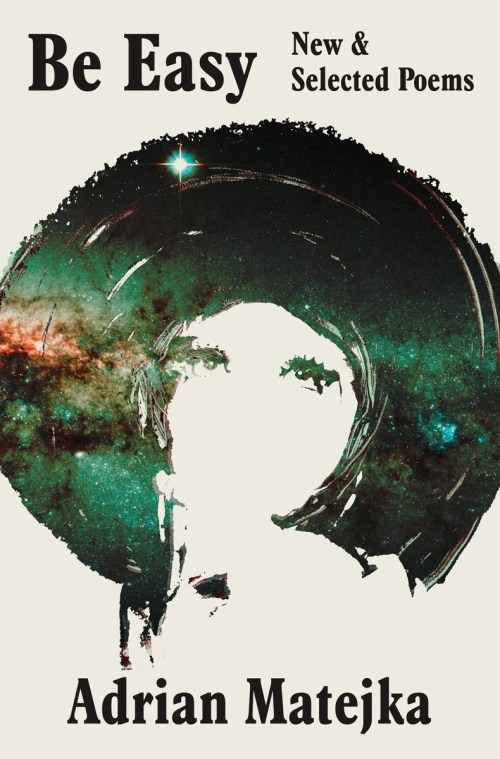
Be Easy
By Adrian Matejka
Liveright Publishing Corporation
Published May 05, 2026


@Snow Rider 3D, And then he just disappeared. He moved to an island in Greece with Linda and lived there for a while, fishing and getting it on.