


Founded by a group of elite Quaker women, the Bethany Home for Unwed Mothers opened its doors in 1876 in Minneapolis, Minnesota. Amidst the glitz of the Gilded Age Twin Cities, the Bethany Home provided unmarried and outcast women and mothers with food, shelter, work, and a second chance at life.
If you had peeled back the Midwest glamor outside of the Bethany Home, you would have also found a city racked with crime; more specifically, a city shocked by a particularly gruesome, bone-chilling, and immensely puzzling murder case.
Caroline Woods’ The Mesmerist tells the story of three women within the walls of the Bethany Home in 1894: the real-life Bethany Home treasurer Abby Mendenhall (neé Swift), the naive and lovestruck resident May, and the mysterious and mesmerizing new inmate Faith. As these women each fight to overcome the hardships dealt to them, they must also learn to survive perhaps the gravest danger of all: what is right in front of our eyes.
I was lucky enough to sit down with Caroline Woods and chat about her new novel.
This conversation has been edited for clarity and length.
Angie Raney
I’m from around Minneapolis and I had no idea the Bethany Home ever existed! How did you find the Bethany Home and why did you choose the Minneapolis setting specifically?
Caroline Woods
I first started reading a lot about Jane Addams and Hull House in Chicago. I was drawn to this overall idea of these very progressive wealthy women in the late 1800 who were actively trying to use their wealth and their political influence to make the lives of much poorer people—especially women—better. Jane Adams said that the women of the Bethany Home in Minneapolis seemed to instinctively get some things that we still argue about now, like the need for job training, universal pre-k, childcare, and postnatal care. It was kind of mind boggling.
What struck me about them was that they were committed to treating those women [which were mostly women who were involved in the sex trade] with kindness and dignity. In the Bethany home, the overarching ethos was that everyone deserves a second chance. No one has fallen.
So, I brought the idea to my editor, whom I wrote this book with. She said, “I think the Bethany Home is right for a story, but we need conflict.”
I quickly figured out that this very famous true crime had happened in Minneapolis in 1894. Because the Bethany home was in operation at the same time that this murder happened, I decided to stick these two things together.
Angie Raney
I had to remind myself while reading that the Bethany Home was a real place because it seemed so outlandish that, in the 1890s, there was a space for women—especially women that weren’t of suitable social class, were unwed, and had children—where they were treated with so much kindness. The way that you treated them too; it was so obvious that you cared for these characters just as much as Abby cared for the women herself.
You wrote, “We don’t know what men do in their other lives.” This book covers topics like sexual violence, misogyny, sex work, and abortion to name a few. This line so simply encapsulates the dangers that women faced back then, and that we still face to this day.
Caroline Woods
I think we still face a sort of pigeonholing that men don’t and that’s something else that [the novel] touches upon. We don’t know what men do when they get to be their other selves, and women don’t get to be other selves. You’re a wife or you’re the sex worker or a girlfriend or a mistress or a maid or the shopkeeper, but the man gets to occupy all of those places and roles.
Angie Raney
What was the research process like in terms of ensuring the historical accuracy of this book’s real life characters, as well as things as minute as dress and speech?
Caroline Woods
I usually do a multipronged approach. In this case, I had a great primary document, which was the complete journals and correspondence of Abby Mendenhall. Her journal was what we would think of today as a one line a day journal. It doesn’t sound like it gives you a lot, but it provided details about food, chores, and her daily routine, as well as insights into her character.
She was a little sassy and she was clearly very bored in her domestic role. I think it was her 37th birthday when she wrote something along the lines of, “my life at present is very monotonous. Is there any more than this? Shouldn’t the woman’s role in the sphere of the home be enough?”
Clearly, it wasn’t enough for her. Very soon after that when she was in her forties, they founded the Bethany Home. Right away, all her entries changed and she found her life. She never had any children and I think that the women of the home became her children. Ultimately, I got her character, the workings of the Bethany Home, and a lot of very esoteric chores that she did like pickling hogs feet or blacking the snow which were fitting of the time. I still don’t know what it means to black the snow (laughs).
I also read nonfiction written by contemporary historians in Minneapolis. Penny Peterson’s book, Minneapolis Madams, was informative about the entire sex trade in Minneapolis, and she talks a lot about the Bethany Home. There’s also a book I read (title redacted to avoid spoilers!) that really goes in-depth about the entire murder case included in the novel.
For historical fiction, I’ll read a novel that was written then to understand things like dress, common fabrics, what they ate, how they spoke, little slang terms. Kate Chopin’s, The Awakening was great for things like that and also studying what a feminist text would have looked like then, and how would you define a feminist attitude that’s 1890s appropriate.
Angie Raney
How did you ensure the historical accuracy of the novel’s Minneapolis?
Caroline Woods
When I went to Minneapolis, I visited the Hennepin History Museum. There, I could look through the archive where they had things like blueprints of the Bethany Home, transcripts from the murder trial, and lots of Bethany Home records, letters, and ledgers. But I also walked around Minneapolis and got the feel for what the river smells like and what it looks like in the winter.
When I wrote a book about Berlin in the thirties, I said the same thing, which is that the Berlin of the thirties doesn’t exist anymore. So, sometimes being on the ground doesn’t provide you with as much help. However, going to Minneapolis was great because you get details of the city that you can only get when you’re in that specific place.
Angie Raney
The novel is told from 3 alternating perspectives. You’ve got Abby, the treasurer of the Bethany Home who acts as a maternal figure to all of the girls. Then May, a young inmate who’s been through—let’s just say a lot. And then Faith, a mysterious new addition to the Bethany Home who shakes everything up. Because they’re such complex characters, was there a hardest woman to write?
Caroline Woods
In the very beginning, my editor and I both felt that Abby was a little distant and a bit stiff. So, we started incorporating the personality seen in her journals. Then, she kinda came to life.
With the other two, May is such an unreliable narrator, and that was a little bit of a challenge. There are so many layers because there’s what she’s telling the other women in the Bethany Home, what she’s telling herself, and then what really happened to her and where she really comes from, so to speak. That was challenging but fun. That’s why I didn’t do first person for any of them because I wanted a little bit of that distance between the implied narrator and the character to allow for some mystery.
Angie Raney
What was building Faith’s character like? I mean, she’s so complex, which as I say it, is a massive understatement.
Caroline Woods
Well, she’s all interior in the beginning because she’s not really speaking to anyone else. I wanted Faith to have what we would now call selective mutism, because while it’s not usually due to trauma, occasionally, trauma can bring it on. She can speak, but isn’t, so she’s more self aware than May, I think. I don’t think Faith is ever kidding herself about anything that happened to her, but she’s not sharing it with anybody else.
It was challenging then to think about when she was going to speak. How am I going to establish that she’s become close enough to another character that she will say something? And, I think I found a rhythm with that.
Angie Raney
The other piece with Faith is mesmerism, of course.

Caroline Woods
Right. Clearly everyone else in the home believes that Faith is a mesmerist, so what does Faith think about that, and how much does she believe in this thing that’s been kind of foisted upon her? That was fun to think about, like, how does she view her own power? How does she use it deliberately? How is some of it just circumstantial because of what people think and the fact that she’s just there in the room while strange things are happening.
Angie Raney
Did you ever find yourself going down a mesmerism rabbit hole?
Caroline Woods
It was all so fascinating to me. At first, it was considered a medical cure and then 100 years later, it really enjoyed this big resurgence, especially in the US; and some people attribute that to our post Civil War hunger for invisible forms of communication, seances, human spiritualism of all kinds. Very interesting.
Then there was a connection between the crime and the occult. It was like a door between those two ideas because they’re totally separate. I didn’t even find that one thing until well into writing the book. I was just going to fictitiously connect the crime to the Bethany Home, but then I read that, and thought, “they could be connected!”
Angie Raney
That actually leads into the next question I had. All three perspectives hold little puzzle pieces of information that fit into a bigger picture. How do you keep track of those really small details and ensure that everything comes together and has those shocking “click” moments?
Caroline Woods
There are 2 different ways that I write. One is I outline and try to plan those things ahead of time. When I set out to write this, I knew that certain things would be attributed to Faith in the eyes of the Bethany Home inmates, which would later be revealed to be her just allowing people to do what they had most wanted to do. Other things, I’ll be three-quarters of the way through or even done [with] a draft, and then I’ll get a moment and have to thread something back through.
Angie Raney
I was wondering if any of the heroines ever had a different ending? Obviously, one of the characters does not have a great finale, but I feel like most women got their flowers so to speak.
Caroline Woods
That’s a good question. I don’t think so. I think I knew the direction that each of them were heading, and I also knew that certain characters’ trajectories would sort of cross—that maybe where you expected one of them to end up would be where the other one does.
Angie Raney
I know you have a lot of promos coming up, but is there anything you’re excited for in the next upcoming weeks?
Caroline Woods
I’m very excited to go to Printers Row Lit Fest! The last time I went, it was right after I moved to Chicago 7 years ago, and I was just an audience member. I’m very happy to be returning as a presenter.
I’m also just excited for the book to be out there among readers and to be in the wild! I’m excited for this one in particular in a way that’s different from the last. I loved my previous books, but I just have a feeling this one is going to resonate with a lot of people; that a lot of women especially are going to love it and are going to tell their friends. I’m very excited to see if that happens and have a lot of people experience the story.
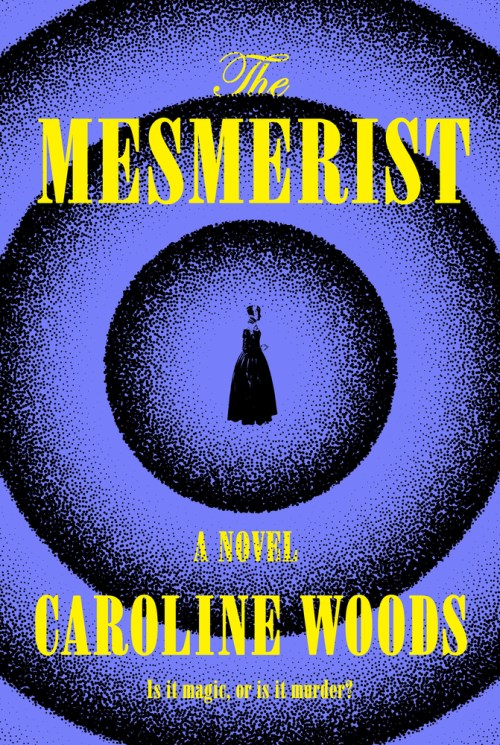
FICTION
The Mesmerist
by Caroline Woods
Doubleday Books
Published September 10th, 2024


