


Caro De Robertis tells stories of survival. They write of freedom, belonging, and the complexity of human connection—and in the case of their newest novel, The Palace of Eros, divine connection. This lyrical, evocative retelling of the myth of Psyche and Eros is at once intimate and expansive in De Robertis’ masterful hands.
Eros is a nonbinary goddess who rescues the beautiful Psyche from Aphrodite’s wrath and hides her in a palace built just for her. Their love is electric. It’s swift, transformative, and shatters everything Psyche thought she knew about herself. Only, she knows too little about her lover, since Eros can only visit her in the dark.
Infused with themes of gender fluidity, desire, restriction, and self-discovery, The Palace of Eros queers and revitalizes the original myth. It moved me profoundly, and I was beyond (beyond!) honored to talk to Caro about this novel’s creation and heart.

Jen St. Jude
Why were you drawn to this myth of Eros and Psyche, and what compelled you to retell it in such a queer, intimate way?
Caro De Robertis
I grew up reading Greek myths, and somewhere in my late teens, this story really pulled me in. I wrote some very bad pages attempting a fictional retelling. I don’t know where those pages are, and that’s probably just as well, but there was something under the surface that fascinated me in that period of my life where I was coming out to myself.
During the pandemic, I was looking around for a possible next novel idea. I had a novel I was hoping to work on that involved a great deal of primary research in Uruguay. I had a ticket to go in July of 2020.
Jen St. Jude
So…that didn’t work out.
Caro De Robertis
It’s like, oh, what happened? 2020 happened. Then, the pandemic changed so many things in our society and in our cultural consciousness, and I became very hungry to write a book about queer joy. The feeling I kept having was, “I want to write a book packed with enough queer joy to light up a town.”
Jen St. Jude
Oh, I love that.
Caro De Robertis
I’d written five novels set in Latin America with a lot of queerness, political repression, and trauma, all of which are important to me. But I also wanted to lean into that joy space. I revisited the myth of Psyche and Eros and wondered what would happen if I changed Eros’ gender and sexuality. I took the god Eros, a.k.a. Cupid, and recast her as a genderqueer, nonbinary, lesbian goddess, and all of a sudden all of these burning questions opened up underneath the story.
I feel like my early obsession with the story revealed its inner layer. This incredible passion between two people is deeply transgressive and can only express itself in the dark in order to be safe from social forces – or even divine forces – that do not want to support its existence.
Jen St. Jude
Genderqueer-nonbinary-lesbian-goddess is my new favorite phrase in the world.
Caro De Robertis
I mean, I love everybody’s trans and gender nonconforming truth. Trans men who are dear to me are like, “I’m a man. I’m not fluid.” And I love that and I relish that. But then there’s those of us who have a lot of labels that resonate with us and reflect us in different ways. We get to have lots of language if that’s what’s true for us! I’m trying to fight for that space.
Jen St. Jude
It’s abundance of language.
Caro De Robertis
Nonbinary and lesbian and genderqueer, you know. All the parts.
Jen St. Jude
Eros is able (at a cost and not without some trouble) to shapeshift and to inhabit different types of bodies. There’s no one right way to be Eros, and she’s able to explore this because of her divine nature. It’s obviously not every nonbinary person’s fantasy, but it is a very expressive, gorgeous way to describe that feeling. How did that feel to write?
Caro De Robertis
It was incredibly joyful. And it felt very freeing to be in this literary context where, because Eros is a divine being, I can give her this bodily capacity that is reflective of something that is very true and deep and natural as part of the human experience. Gender expressions are beautiful mysteries and also normal components of being alive. I think if we center queerness in our understanding, we can see so much more expansiveness about what we can be.
While I was writing, I read and reread books like Female Husbands by Jen Manion, Stone Butch Blues by Leslie Feinberg, and Jack Halberstam’s Female Masculinity in a very deep, close way. Halberstam’s book is a very global perspective on female masculinity, so I tried to root this world in some of that theory. I hoped to create a gripping story, but I also wanted to offer the book deep layers if I could.
Jen St. Jude
It is so layered. Everything is so intertwined when it comes to queerness, space, visibility, and freedom. I also recently read Female Masculinity and it was eye-opening for me to realize masculinity doesn’t inherently belong to men. For a woman to possess that doesn’t make her “mannish.”
Caro De Robertis
That transforms everything, doesn’t it? Masculinity does not belong exclusively to men. Butches, among others, are creators of masculinity. And for me, as a Latinx person, it informs what I tried to bring to this book. I am a genderfluid person, so in the times in my life where I’ve had a more femme external expression? That wasn’t dysphoric or false for me. It was simply not the whole of my own sense of gender. I couldn’t always locate myself in the masculinities that I saw around me, including in the ‘90s among butches or dykes, because I saw a lot of white masculinities that weren’t always a mirror of what I had inside me. I had to give myself permission to create my own.
Jen St. Jude
Going back to queer theory, I definitely feel like a gender failure. It’s just like, OK, I’m failing at both binary genders. I’m sitting in that space and owning it, and it’s freeing.
Caro De Robertis
And that’s the thing, the freeing notion is that actually, if I’m expressing my masculinity in this way, even alongside expressions of femininity, that’s my truth, right? We are actually making a contribution to the masculinities, rather than failing to fit. Reductive ideas of what masculinity is can be hurtful to men too.
While writing this novel, I was also interviewing queer and trans elders of color for The Baldwin-Emerson Elders Project, an oral history. So I was reading queer theory, and hearing about it in real time from these incredible elders who brought so much innovation and creativity into shaping their own gender expression in the face of zero validation from dominant culture. They created their own gender truth and then also pushed open spaces for the expansiveness we have today.
Some of them talked about being told that they weren’t butch enough. Or asking themselves, am I going to be a real man? Or actually, wait, is what I want to be transmasculine? Or there were decades of adulthood, seeking or creating terms for what they’d always been. I’ve been very inspired by their incredible lives while writing. These are the trailblazers.

Jen St. Jude
I’m really excited for that because often in documented queer history, the whiteness is overwhelming. Records are so dependent on who interacts with power, so for people of color, we have a lot more fractured parts of their stories than we do for white ancestors.
Caro De Robertis
We need so much more. The Palace of Eros is a story set in ancient Europe, so in some ways I wondered, am I leaving my Latinidad at the door in order to enter this literary space? But as I got into the writing I realized I never leave my Latinidad at the door, just like I never leave my queerness at the door. I am always all of myself, no matter what. The character of Psyche is the child and grandchild of local indigenous women who were colonized by the Greeks. It allows me to situate the story in southern Italy and researching the real history of early colonization by the Greeks allowed me to bring in some themes that are important to me as a Latinx writer.
Jen St. Jude
In a lot of your books you really explore this idea of where we can find freedom in a world where we’re not fully free, but also, what is the cost of that, right? Eros builds this palace for Psyche and has every intention of it being a free space, but there are limits. I’m curious how you think about these pockets of freedom we find in a world that doesn’t want to allow for it.
Caro De Robertis
It’s fascinating, being a novelist and starting to see what your deeper enduring themes are. We start to see ourselves through our own work. I was four novels into my career before I really understood that this is one of my lifelong themes, one I was devoting my life to: How do we live radiantly when the world is bent on our erasure? How do we make a world where everybody is safe and free, which is my dream? It’s what I want more than anything for the world. My two greatest desires are for my kids to have long healthy happy lives, and a world where everyone is safe and free.
And so how do we do that? How do we live radiantly along the way? How do we grow into our full selves? It’s a theme that feels very urgent to me on a deep personal level. It’s what drove me to become a writer, because books saved my life and gave me a space in the world.
Jen St. Jude
And there’s so much in this story about creating your own space in the world. Eros says “I am immense and unruly. That’s always true no matter what the laws have to say. I want a world where I can be myself.” I absolutely love that whole passage.
Caro De Robertis
Thank you. Immense and unruly is a really rich spot to be in. I’m a middle-aged queer. I’m a Gen X-er. I have kids. I am watching preteens and teenagers come out in brave and beautiful ways in my children’s generation. And at this point in my life, I’m really interested in what unfolds for us at every life stage, young, old, all of it. I know that I’m unruly and immense within. I know this is a normal and human and beautiful way to be. I want to push open space for all of us to be as unruly and immense as we wish, in our genders and in our life expression and in the way we live our lives.
Jen St. Jude
I want to end with a craft question. Your prose is just gorgeous. Luscious. I think of eroticism as being about, of course, pleasure and lust and love, but I also see it as this attention to detail and noticing. Focusing on small things. I’m curious if you thought about language while writing this book any differently than with your other books. Or does this kind of writing just come naturally to you?
Caro De Robertis
Thank you so much. I think I just care very deeply about language. I have a deep love of the possibilities that are opened by the miraculous thing we call the sentence. I certainly read poetry, but there’s something about the very potential of the sentence that excites me so much. It makes me feel alive as a reader. Writing the erotic is about what it means to be awake and alive and embodied in a human experience.
Ultimately that’s what writing the erotic is about. It’s not just about acts, although specific acts are incredibly interesting to think about, especially within queer sexuality. There is a great deal of innovation and possibility there. Writing about joy and pleasure is worthy, but it’s also really about being awake and alive. It’s about discovery. It’s an endlessly fascinating site of writing, the way that our bodies can be rewritten by erotic experiences, and how, through them, we can become awake to ourselves.
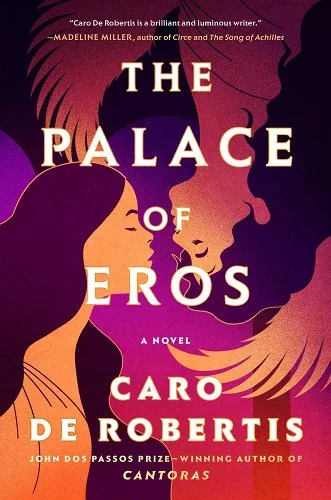
FICTION
The Palace of Eros
By Caro de Robertis
Atria/Primero Sueno Press
Published August 13, 2024


