In this age of sound bites, hot takes, and incendiary tweets, it is truly refreshing to encounter an informed opinion that takes longer than fifteen seconds to read. And a cautious or measured claim, let alone an eloquent one, can feel like a breath of fresh air.
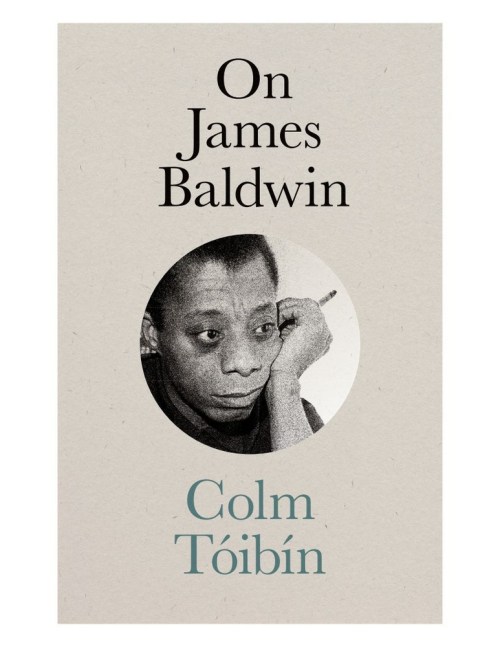
Yet that is what readers can rightfully expect from the acclaimed Irish novelist Colm Tóibín in his thoughtful new collection of literary criticism, On James Baldwin. Released this year by Brandeis University Press as part of its Mandel Lectures in the Humanities, the book of essays celebrates and interrogates one of the foremost American writers of the last century by subjecting Baldwin’s novels to a recursive, searching analysis that owes much of its style and method to Baldwin himself.
This decidedly erudite collection takes literary criticism seriously. Tóibín inspects Baldwin’s works and turns them over in his hands like precious stones. Each of the five essays explores a different publication by the famous writer. In “The Pitch of Passion,” Tóibín compares Go Tell It on the Mountain with James Joyce’s Portrait of the Artist as a Young Man and Ulysses and finds interesting symmetry between the two authors, each having lived abroad in self-imposed exile while their home countries devolved into war and strife. Tóibín has no compunction about making scholarly assertions that could easily appear in a graduate seminar. “What gives these pieces such life after all these years is the way in which Baldwin’s intelligence and prose style match each other,” Tóibín writes, indulging in a bit of Baldwin-esque grandiosity, an ironic gesture in itself that he reenacts throughout the collection.
These essays do wander; intentionally or not, I couldn’t always tell. They sometimes slacken and lose focus. In ”The Private Life,” comparisons between Baldwin and a trio of other towering writers (Mailer, Didion, and Naipaul) are made to illustrate Baldwin’s vulnerability and introversion, but I found these comparisons a stretch. Rather than drawing tenuous connections with the author’s contemporaries, Tóibín would have done well to recount more stories from Baldwin’s tumultuous life. I found the passages about his civic activism riveting, like, for example, in “The Private Life,” when Tóibín reveals the extent of government surveillance on James Baldwin and the laughably juvenile observations in his FBI file. In a memo from 1968, the FBI apparently reported Baldwin’s skin color as though it were news. The FBI’s eyebrow-raising naivete serves as a stark reminder of the challenges he faced in his time. I found such biographical tidbits more revealing than all the comparisons to other authors, and more relevant to Tóibín’s essay about the damage to Baldwin’s private life that resulted from his public activism.
To his credit, Tóibín does not shy away from constructive critiques. “In Giovanni’s Room,” for instance, he claims that “Baldwin is not especially interested in character.” One character is “all voice, all surface response.” But even here, Tóibín is unwilling to sustain his critique, adding that “this lack of focus on depth of character and backstory allows the novel to fixate on large questions of innocence and guilt, the possibility that the narrator himself is beyond redemption.” Tóibín is too bewitched by Baldwin’s prose to let his criticisms lie. This could be in part because he identifies with Baldwin the man—his sexuality, his genius, his sensibility, his cosmopolitanism. Tóibín is perhaps at his most engaging when he pauses his line-by-line explication of James Baldwin to divulge intimate anecdotes of his own experiences and impressions as a queer foreigner in western Europe, invoking Baldwin’s years in Paris.
I sometimes had to squint to locate Tóibín’s argument in these essays. Each examines a different book, but I would be hard pressed to identify clear-cut differences between Tóibín’s conclusions. Is the Baldwin of Giovanni’s Room like Henry James or like Ernest Hemingway? Oscar Wilde or William Gardner Smith? At times, Tóibín seems to analyze for the sake of analysis, rather than to argue for a new perspective on an author who has already been exhaustively analyzed.
It is hard to fault Tóibín—an incredibly accomplished author in his own right, twice shortlisted for the Booker Prize—for deriving such obvious satisfaction from the craft of fiction. I sympathize with his desire to squeeze all the juice from the lemon. But he lingers over nuances of tone and voice—“it is the third sentence that does most of the work here,” and so forth—when his essays would have been better served by stronger evidence for his claims or more thoroughly developed comparisons.

Tóibín is a writer’s writer, and this collection will be best appreciated by writers. On James Baldwin offers an antidote to the folksy wisdom of mass market criticism like Anne LaMott’s Bird by Bird, Elizabeth Gilbert’s Big Magic, or George Saunders’ A Swim in a Pond in the Rain. Tóibín settles comfortably into his armchair on the top floor of the ivory tower, from which vantage point he surveys canonized (mostly male) authors ranging from Henry James to E. M. Forster. To be fair, On James Baldwin represents a departure from the sweeping romance of novels like Brooklyn, not to mention his other fiction, and readers will benefit from adjusting their expectations accordingly.
Perhaps I am being too hard on Colm Tóibín. After all, On James Baldwin was brought into the world by a university press, presumably to showcase the contribution of a highly respected author to that university’s discourse on the humanities. On James Baldwin was conceived of, in all likelihood, with an academic audience in mind, and it conducts itself so, successfully. For that reason, it would politely decline to compete with the latest tweet, thank you very much, or the most liked book review on TikTok this week.
NONFICTION
On James Baldwin
By Colm Tóibín
Brandeis University Press
Published August 23, 2024