


“What does an African keen to survive and thrive do?” In The Lies We Tell for America, Ber Anena grapples with this question, exquisitely recounting an experience of endurance and triumph. When she is accepted into Columbia’s MFA program, nothing prepares her for the financial cost of pursuing her dream and the struggles she would face in leaving Uganda for a foreign country. Written with insightful candor and sharp wit, the memoir takes us on a journey of desperation and perseverance, sorrow and joy. It brings to light the intricacies of cultural shock and assimilation, how one’s sense of self fractures and comes undone in a world so jarringly new, alien, and on some days, unwelcoming. Anena interrogates notions of home, identity, the cost of survival, and the changes that happen to us and to the people we leave behind.
In this conversation, she talks about vulnerability and humor in writing, her creative practice, and her impulse for hybrid genres, among others.

Tryphena Yeboah
Memoirists are often known for their honesty and vulnerability in retelling moments in their lives. Would you say that reflecting on the past brings with it a kind of revelation? In writing this book, was there one thing you had to finally come to terms with?
Ber Anena
Absolutely. I came to terms with many things while writing the memoir. Something I think often about is the idea of home. I knew I would miss my family and friends when I left Uganda for New York in 2019. And I did miss my loved ones, so intensely it became a physical distress. I held onto recollections of conversations, places, food, people’s faces and voices. I yearned to return to all that. But when I went back to Uganda in 2022, home had not sat still and pretty waiting for me. My family home no longer matched the image I had carried in my head for close to three years. Mama now walked with a crutch. Grandma still laughed heartily but had lost some teeth to old age; the bond I shared with friends had changed, and in person, some didn’t know how to interact with me—now that I had touched the hem of the great America. Kampala, a city I had lived in for close to ten years before I left for New York, had smoother streets, taller buildings and more posh hangouts even though many things remained unchanged. The boda bodas still as rowdy on the streets, corruption was still a normalized part of everyday life, the president still the same guy, just older. Often, when we move to countries abroad, nostalgia makes us hold onto the place we left. We freeze it in our mind, not knowing time often has neither loyalty nor patience for our memories and yearnings.
Tryphena Yeboah
One of the things you explore in the book is the idea of things, the long-held perceptions we carry of people and places that, of course, shatter when we come face to face with the weight of reality. Suddenly one not only has to let go of the idealized version, but must also make room to accept what is. There’s a level of shock and disappointment that comes with that unlearning and acceptance. In a similar vein, would you say that you, too, had changed upon your return in 2022? Were they changes that were evident to you at the time?
Ber Anena
Ah, I love this question! I had definitely changed. First, New York City had clipped at my timidity and I spoke more audibly, I had more confidence, I looked people in the eye a little longer during conversations. Growing up, “politeness,” saying little, and keeping your voice down whenever you spoke, were virtues instilled in me. They were cultural markers of a good girl/woman. I had to disabuse myself of those beliefs swiftly in New York because those virtues worked against me. Audibility and self-assuredness can get you to the front of the line, and through the door. Fundamentally, I developed a deeper appreciation for Uganda. When we leave home, we focus on the failings of our country. Besides our loved ones, it’s often difficult to appreciate the home—and for good reason. We only realise the one-sidedness of our outlook when we get abroad and reality smacks us in the face: it’s not all glitter after all, and our home of birth, with its skeletons, has treasures too. And so, when I returned to Uganda in 2022, I was more deliberate about enjoying and appreciating everything that was working, and to give myself and my country grace on what wasn’t.
Tryphena Yeboah
You’re known for your poetry—on stage and on the page, and I enjoyed reading A Nation in Labour. Do you remember when you ventured into the world of nonfiction? Had you always thought about writing a memoir or was there an inciting incident that planted the seed?
Ber Anena
I entered the world of nonfiction through journalism. That’s what I pursued for my bachelor’s degree and for about four years after graduation, I was in the newsroom as a writer and editor. Since I was already writing poetry before college, my applications to universities should have been creative writing, but we didn’t have that in Uganda. There was literature, but the way our curriculum was structured didn’t really incentivise or provide for writing our own creative work. With journalism, I could write—even though it was a different genre. Through journalism, I learned about and joined the literary community in Kampala. The stories I collected while on field assignments also found their way into my poetry. I did some blogging as well but that was still very journalistically attuned. As my interactions with fellow writers grew, I began exploring the idea of a writing program with a focus on creative nonfiction. But even after getting my admission into an MFA, a memoir was not on the table. I had a different nonfiction project in mind, but that quickly changed.
And hence, the inciting incident: As you know, I brazenly fundraised for Columbia. The hurdles of raising money through GoFundMe, the shame and anxiety of approaching individuals and companies, stirred a curiosity beyond attaining an MFA. Why was an education scholarship in the States so elusive for an African woman in the arts like me? Why was it so difficult to get into the country that held the key to my writing degree? Were these hardships only a me issue, or were others dealing with the same? As I left for New York, I had a bit of hope that things would go more smoothly once I arrived. Well-wishers had told me so, and I believed them because, wasn’t this the United States we were talking about? Of course, things were anything but smooth—not for the first three years anyway. About a semester into the program, with Covid on our heels, and dropping out of the MFA a reality, I began writing the memoir.
Tryphena Yeboah
As I read, I couldn’t help but notice that the book, while it discusses unsettling relationships with classmates and roommates, also pays homage to several others who walked closely with you, supported you, and were light and calm in such dark and tumultuous times. It is both a moving narrative of hardship and alienation, and of friendship, hope, and love. How important was it for you to strike this balance?
Ber Anena
In truth, the balance came naturally. Being new to a place, building genuine friendships can take time, courage, or even luck. There are so many things to navigate, especially the different ways people relate to each other here as opposed to back home. There’s a superficiality, a business-like approach to many interactions, and if you don’t read the culture right and act accordingly, you may find yourself estranged instead. It’s not surprising that in some places, you will receive quizzical looks, or “what do you want?” when you go about dishing greetings like candy like we do back home. And so, when you find someone who is curious and open-minded enough to entertain your foreignness, you hold onto that gift. Those connections mean a lot, when all you have are dreams, hope and prayer.
Tryphena Yeboah
Speaking of things that came naturally, your sense of humor is unmistakable on the page, and often lands at unexpected moments. There were a number of times I laughed and then quickly held myself back because what was happening really wasn’t a comical matter and yet, it is written in such a witty way that one can’t help but chuckle at the absurdism of it all.
Ber Anena
Thank you, Try. Initially, I had no idea humor was a technique in the memoir. It was my workshop professor who pointed it out in one of his feedback notes. He said, Anena, do you know that you write with humor? I also got similar feedback from my classmates. That’s when I began to keenly examine what I was doing on the page in terms of language and style.
Growing up, I observed humor being used to ease difficult moments—mourning loved ones, a tense or awkward exchange between in-laws and spouses, a fight, etc. But humor also thrived in joyful moments. There was always the grandma, the aunt and the uncle we gravitated towards because whenever they spoke, we all doubled over with laughter. While writing about my tribulations, I must have subconsciously turned to humor to cope. Memoir being a very embodied genre, humor also became the stylistic device that helped me step out of myself and ease the weight on the page.
Tryphena Yeboah
It shouldn’t surprise me, but it did, knowing the conditions of your life at the time, and how you turned to writing, despite all you were facing. You write that your love for writing was born during a war, and this love seems to persist at all costs, even as you fought to survive different kinds of strife—administrative failure, depression, hunger, loneliness, homesickness. What did your writing practice look like then? What kept you returning to the page again and again?
Ber Anena
When I started writing, it was mostly to get out of my head; to try and comprehend the world I was living in—one where safety and peace were foreign. I still have the big, long book where I handwrote all my first poems. They were, still are, sacred creations meant for my eyes only, for my catharsis, however fleeting it was. Much later, when I embraced writing as a career, I didn’t bother reworking or publishing those first poems, except one—which is in the memoir.
Fast forward to the MFA, I learned to write within a structured setting, with timelines guiding my productivity, and developed a routine. Besides the writing assignments expected for my classes, I also had a writing buddy, Saida, with whom I met every weekend. This schedule meant I had to have new work every week. Once it became clear that the memoir would be my MFA thesis, I had an even bigger motivation to write consistently. I didn’t want to leave the program without having a rough draft done. I needed to get as much feedback on it as possible.
Tryphena Yeboah
Do you have a system for engaging with feedback on your work? If we had read the very first draft of this manuscript—before it went through what I can imagine was an arduous revision process—what would we have missed as readers? What would you have lost as a writer?
Ber Anena
When I receive feedback, especially for a book project, the first step is to prepare mentally. My anxious self will always think a lot of work is required. Once I gather the courage and read the notes, I’ll take several days to reflect on each suggestion and come up with new lines in my head. By the time I sit to revise, the writing flows a little more smoothly. With time, receiving feedback has become less daunting. I’m also learning to self-edit brutally before I send my work for feedback.
The very first draft didn’t have the last two sections, and because the publishing process takes time, I had to write new chapters to cater for the passage of time. An epilogue alone couldn’t do it. So much had transpired since we sold the manuscript. Those emerging issues were deeply relevant to the memoir’s storyline and I had to offer the care and space they deserved.
The memoir was also unconventionally structured—originally self-contained but interlinked chapters. The narrative was driven by themes rather than the chronology of events. The biggest and most challenging part of the revision then involved collapsing that structure to create a linear narrative. It felt like knocking down the walls of a house to start afresh with just the foundation anchoring you. But I understood that with standalone chapters, context can become repetitive and timeline jumbled, especially if you’re dealing with a memoir and not a collection of distinct essays. Overhauling the structure resolved those issues and I was very pleased with the outcome in the end.
Tryphena Yeboah
I was thrilled to come across some poems in the book! How would you say your poetic sensibilities come into play in writing the nonfiction genre?
Ber Anena
Ahh! I was equally thrilled. I admire the genre for the pressure it places on language; how every word has to earn its space on the page. In my poetry revisions, I usually ask myself if the diction is apt and concise enough to bounce off the page instead of spreading out. I had those sensibilities at the back of my mind as I wrote and revised the memoir. But I also loved that prose accorded me some wiggle room—space to reach for adornments such as humor and other literary devices. During revision, some moments in the narrative demanded poetic accompaniments. The poems that ended up in the memoir belonged to other manuscripts, but I thought, who am I to stand in the way of hybridity? While my first foray into creative writing was through poetry, the impulse for hybridity became apparent when I ventured into creative nonfiction. It may be my subconscious fidelity to a genre I consider my first literary love.
I haven’t figured out what drives my creative impulses when it comes to deciding whether a piece of writing should be a poem or prose. In some cases, it’s pretty easy to tell that what I want to write about will be better rendered in a specific genre. Other times, I write multi-genre pieces on the same theme/subject to see if one or both work. In short, I’ve learned that writing can be a gamble sometimes.

Tryphena Yeboah
This is also a memoir of survival and resistance. You’re like a child again, learning the code of conduct in a new place, questioning things you’ve known all your life, and making the courageous move towards adapting, evolving, and holding on to what you value. Looking back on the decision to stop the madness of learning an American accent and to go by your last name, what would you say led to this resolve and even now, do you still find yourself having to push back and insist on how you’re going to move through the world?
Ber Anena
In my pursuit to belong, I realized I was losing myself. Who was I without a badge, an identity— the name that spoke of where I came from, and the accent that paid homage to my mother tongue? The irony was that I was failing spectacularly at the accent training, and that was perhaps my Acoli ancestors saying, Child, we shall not be witness to this embarrassment. But also, being in a writing program, I read texts that exposed me to different world views and ways of being that I began to ask where I fit in that vastness. Embracing who I was through my accent and name was one way to reclaim who I was. The push and pull continues in other aspects of my life, and I don’t think it ends. What’s important, I believe, is that a part of my identity stays sacred and whole, even as I adapt to new cultures and expand the breadth of who I can be.
Tryphena Yeboah
“I no longer believed my African stoicism would save me from my mind; that my skin was thick enough to resist wounding from whatever bites I faced,” you write in reflecting on your perception of mental health and therapy. One of the things I appreciate about your work is how you explore the conflicting ideas of being an African in America, and really, how one experiences a shock to their systems, their ideas. Your thoughts about the politics of language hierarchy and colorism in African countries, the different approaches to education and the power dynamics between teachers and students, etc. ground the memoir in a broader conversation of identity, power, politics, and discrimination. What was important to you in tackling these political subjects?
Ber Anena
I wanted the memoir to exist beyond a retelling of my experience. How does getting patted down at the airport and having my grievances ignored by the school fit into larger discussions of immigration challenges for people from the global south or the bureaucratic indifference in academia? In reaching for the broader conversations and finding the connective tissues for the subjects I articulate, I hoped the memoir would resonate beyond my small world.
And, in one of my small worlds, therapy was not a thing we turned to—not the way it’s conceptualized and practiced in the West anyway. But as I struggled to survive each day owing to my mounting hardships at school, I gave therapy a try and it literally saved my life. Besides helping me overcome my mental health crisis, I learned who I was—a woman who had in large part been shaped by cultures and beliefs that needed to be scrutinized. That self-awareness helped me introspect on the themes I tackle in the memoir such as friendships, power and authority. It helped me confront and reflect on the realities and contradictions of my life on the page: I was comfortable bearing my soul to a stranger (read, therapist) instead of talking to my family and on the other hand believed in how close knit our families can be.
Additionally, certain things become starker when you arrive in a new place and your difference becomes automatically elevated. The colorism we dealt with in my childhood was now minute compared to racism. You walk with a shield up, wondering when your difference will be assaulted, and hoping when you’ll be alert enough to somehow protect yourself. This alertness can make you fail to live. It’s a life-wasting preoccupation we can’t fully escape because a system of supremacy fuels itself through our stagnation. It was important for me to acknowledge and introspect about these realities, but also the contradictions that existed in my own upbringing.
Tryphena Yeboah
You mention books like Behold the Dreamers by Imbolo Mbue, Promises by Goretti Kyomuhendo and Chimamanda Adichie’s Dream Count—all books that explore cross-cultural complexities, the immigrant struggle, and the impulse to survive. What are some of the books you turned to while writing the memoir?
Ber Anena
In working on my first draft, I was concerned about storytelling and craft in creative nonfiction. So, I read Heavy by Kiese Laymon, a memoir that moved me beyond words and made me appreciate in a new way, the power of narrative—how it can spring from the personal and expand to the “universal.” I also read The Situation and The Story by Vivian Gornick, a craft book about personal narrative. Leslie Jamison’s The Empathy Exams and The Recovering, provided early lessons in narrative introspection. Finally, I studied a lot of the essays in The Art of the Personal Essay by Phillip Lopate, an anthology I return to often for how edifying it is when it comes to the essay, and nonfiction in general, can function.
Tryphena Yeboah
Your writing does such a wonderful job of drawing the reader into the newness and culture shock of navigating a foreign country. Your disorientation through the streets of New York, your growing disbelief about the different way things are done in the classroom and in social settings. Indulge me here—it’s been almost seven years now since you walked into the JFK Airport and had all your senses assaulted. What are some of the most American things about you now? What would surprise pre-2019 Anena to discover about her future self?
Ber Anena
I love snow! As soon as it stops falling, I want to go out and sink my boots in, hear it crunch under my feet, watch its feathery whiteness stick on my pants. Ah! It’s ridiculous! Snow pulls out the child in me every single winter. And I now enjoy the yellow bananas I once found bland. It’s a part of my breakfast. Every single day. I once swore no yellow bananas were tastier than the ones my uncle Ocii grew on his farm. My pre-2019 self would be scandalized at how quickly I caved. My tongue succumbed. Traitor! Ha!
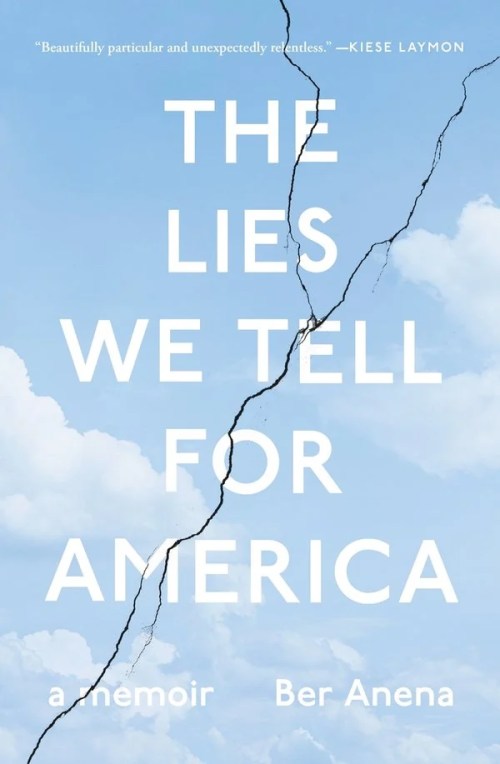
MEMOIR
The Lies We Tell For America
By Ber Anena
Flatiron Books
Published November 10, 2026


