


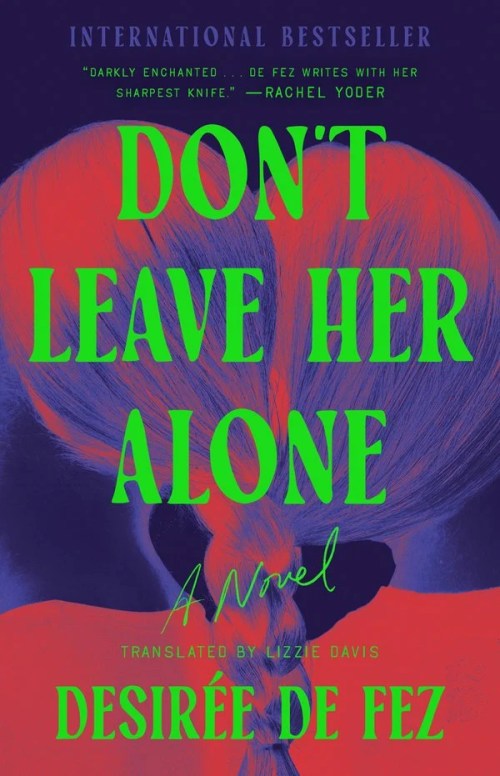
In international bestseller Don’t Leave Her Alone, expert horror film critic Desirée de Fez dives into her own story for the first time, her book translated from Spanish by Lizzie Davis. In her author’s note, she describes her muses for the work as David Cronenberg and her mother, and the stark combination of the dramatic banalities of motherhood and the classic realm of body horror mix into a bubbling, quietly suspenseful stew. In her novel, two sisters, Alba and Diana, are raising children, with the help of their own mother, Carmen. Both sisters have been discovering new ways to obsess, growing dangerously anxious about their children’s health and whereabouts, and (Diana’s husband believes) the three women are constantly enabling each other’s behavior.
Diana notices early on that her sister Alba can’t be left alone, refusing to leave the kids home without her, carting them and Carmen around to urgent care centers, school pickups, and the mall. Diana has her own compulsions, but nothing like her sister, who gave up pursuing her degree to be a stay-at-home mother and is obsessed with preparing for the upcoming holiday celebrations. When Alba finds herself alone and stranded in a mall on Christmas Eve, the three women all suddenly have the same terrifying wound, a band of blood across their stomachs, a seeming physical sign of their connection. As Carmen struggles and Diana frets, Alba watches tentacles emerge from her abdomen, and is forced to face her fears and her nostalgia in the visions that follow.
De Fez’s novel is surreal and eerie. Much of its beginning is dominated by conversation and racing thoughts, and so its turn into body horror and hallucinations is impactful in its contrast. Fans of other surrealist authors such as Mariana Enriquez will enjoy this work, which asks provoking questions but gives little away, leaving some ends loose, and avoiding explanations entirely.
The horror of the novel is a mask of sorts for Alba to ask other questions that many mothers have asked themselves over the course of decades. In nostalgia for her old campground, she thinks about her old self, and what she valued during the most independent summer of her life. More than once, Diana notices that her sister and her family always blur into one unit, one body, as if they aren’t individuals. Now, in waking nightmares, Alba sees other family units, linked together, walking around and performing their duties to each other near automatically, and is forced to consider who she is when not blurred together with her children and mother. The tentacles reach out from her abdomen, seeking someone to give to, as Alba realizes that she’s exhausted with doing nothing but giving, sacrificing, and pouring out energy for only other people’s happiness.
De Fez’s portrayal of the endless work of mothers, and women in general, is compelling on its obvious face, but also forces readers to ask what thoughts we’re avoiding in the noise of the world around us. When there is no music playing, no one to talk to, no TikTok to distract you from your inner self, no child to chase around the room and fret over, what will your thoughts come up with? What memories might dredge their way to the surface? De Fez portrays the anxious mess that is motherhood with real, sometimes comical chaotic energy, squeezing in digs for certain kinds of husband-fathers and probing at the ways, both needed and toxic, that women can find themselves leaning on and relying on each other. She also portrays the desperate, utterly serious problems with these relationships, and with the ways the three women avoid engaging their internal selves and emotions, both by avoiding tough conversations with each other and by avoiding tough questions for themselves. In a way, Alba’s work is an exorcism as much as it is a reckoning: by fighting through the internal wars within herself, she may gain something much more promising on the other side.

De Fez’s novel, then, is both campy horror novel and deep investigation of the perils of motherhood and the ease of slipping into a body that is unfamiliar and a mind that is suddenly out of your control. Horror continues to be a genre that helps us unlock deeper, frightening truths within ourselves, and fans in particular of Samanta Schweblin’s Fever Dream will enjoy De Fez’s delicate blending of slow, frustrated dialogue between characters unwilling to open up, and the bloody honesty that follows.
FICTION
Don’t Leave Her Alone
By Desirée de Fez, Translated by Lizzie Davis
G.P. Putnam’s Sons
Published on October 13, 2026


