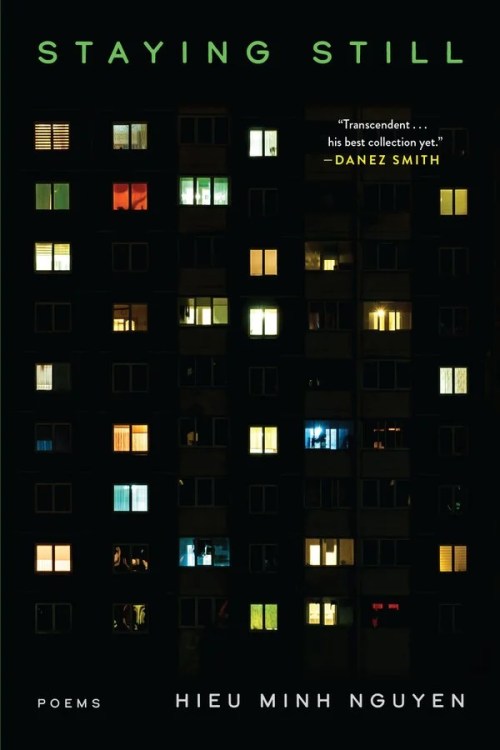
With Staying Still, the much-lauded poet Hieu Minh Nguyen returns with his third collection, a fraught and complex follow-up to Not Here that focuses squarely on the journey to self-actualization, the boundaries we set for ourselves, and the limits others set for us. Nguyen engages the title of his previous poem, “Notes on Staying,” to signal a collection that unflinchingly confronts the relationship between the author and his mother, their shared experiences with mental health crisis, and the unexpected desire to stay.
For those unfamiliar with “Notes on Staying,” it is a two-part poem that describes a mother and son, each wanting to die but both unwilling to leave the other alone in the world, culminating in an intense crescendo that acknowledges the importance of hope and forward progress. With his latest collection, Nguyen trades on those themes and leans into the connection implied by the title. Here, the phrase staying still refers to Nguyen’s commitment to stay alive, but also an ongoing sense of staticity and the frustration that comes with being unable to become one’s full self. Readers encounter moments of self-loathing and self-destruction, sometimes nostalgic and oftentimes traumatic memories with family, and a speaker desperately aware that being a son to his mother means carrying a part of himself in secret. Nguyen displays, yet again, a remarkable ability to capture the many layers of human experience in accessible, seemingly effortless language.
The collection opens with “Outbound,” a poem that is offset from the other sections of the book. Nguyen begins the poem with a litany of images connected by the word past, layering “the long lines / outside the Dorothy Day Center” and “the fathers straining in prayer” with “the defaced statue of a saint” before arriving at a leashed dog chewing itself free. The speaker asserts that “The opposite of hunger / is not satisfaction, it is birth.” As the poem continues, the speaker frames various moments as birth, propelling the reader toward a closing tercet that deftly alludes to the dangers of staticity while signaling the speaker’s refusal to succumb: “Everyone you loved refused to die in this town / before they died in this town. The woman beside you / on the plane wants to know where you’re going.”
With the first section, Nguyen presents speakers who surrender themselves, physically and emotionally, to strangers. “Passing Through” describes a man who uses his finger to hold the speaker’s mouth open before telling them to “Be good,” while “Away Message” opens with the memory of a man who tells the speaker that “being a poet means being far from the people you love.” Later in the poem, the speaker admits, “Though I am often, I am bad at being alone.” These scenes are juxtaposed with poems like “The Dress,” which chronicles a speaker whose desire to wear his mother’s dress causes the mother to cry, then throw away the dress. In a fable-esque nod, the poem closes with a hard lesson in the form of a question: “How was I to know beauty / was something I could ruin / for others by trying it on?”
The second section features a single poem, “Come On Over,” that spans sixteen pages and offers an incomplete narrative. The text begins with cousins putting lipstick on the speaker so that he is included in a family ritual and closes with the actualization of Pam, the daughter and woman whom speakers throughout the collection long to embody. The fragmented structure of the poem amplifies both the length of time it takes to embody Pam and the fractured memories that correspond with trauma. Family is a constant until it isn’t; the speaker isn’t alone until he is. But at the end of the story, a woman in the mirror. “Come On Over,” then, operates almost as a microcosm of the collection as a whole, or at least its central arc.
The sections that follow are unflinching, often haunting, as speakers warn time and again of the violence they can inflict. Still, these sections offer glimpses of humanity that insist we see the darkest revelations against an ever-present light, hope a possibility that pervades as often as it evades. As the collection draws to a close, speakers reflect what comes next, literally and spiritually. “At the Blue Nile Open Mic” includes a speaker who admits, in the absence of B, to whom the poem is dedicated, “I like to imagine, / when I arrive, finally, to where you are, you will come out & get me.” The speaker in “SoMa” explains, “More & more it means something to me to be alive. / It’s important that I write this now before I forget,” a realization that occurs in a moment so secure that the speaker does not notice their lover gone until he returns with a glass of water. Even heaven, in “Saint Paul,” becomes a nuanced collection of memories with different friends and different gods before culminating in the speaker’s assertion, “the heaven I choose is a heaven I can leave.”

Hieu Minh Nguyen echoes his previous work without feeling redundant, instead allowing readers to witness the messy path to, if not joy, at least the sudden and surprising desire to live, Staying Still with intention, not obligation. This is a collection masterful in its approach to mental health, identity politics, and family legacy. More importantly, Nguyen insists upon the humanity of it all, empathetically portraying a son longing to be a daughter alongside a child willing to send his own cousin over a cliff, or a speaker who trades his collection for cocaine alongside one surrounded by sisters in drag helping him become the daughter he longs to be. Though it may find its footing in darkness, Staying Still moves ever closer to hope, to a stillness that moves beyond persistence to calm, however brief.
POETRY
Staying Still
By Hieu Minh Nguyen
Tin House
Published September 1, 2026