


Edwidge Danticat is legendary for many readers, including myself. A prolific writer, Danticat published her adult fiction debut at 25 and has since published six more novels, as well as short story collections, several works of nonfiction, young adult novels, and children’s books. Her writing is evocative and centers Haitians and Haitian Americans. She is constantly probing readers to think about universal themes of displacement, history, the meaning of home, immigration, inherited trauma, mother daughter relationships, and so much more. She is an expert at weaving history into her novels and demonstrating the ways politics (and politicians) affects the daily life of her memorable characters.
Her latest novel, Dèy, continues many of these themes, but it is also a bit different. Set in 2018 and primarily in Miami it follows Magnolia, who is struggling with many kinds of grief. She survives a mass shooting at a shopping mall and she has separated from her long time partner. She is also balancing concern over her aging parents who returned to Haiti and live under the constant threat of a different kind of gun violence as gangs increasingly take over cities and villages.
I embarked upon a Year of Danticat during the early Covid years with several other Instagram pals and now aspire to be a Danticat completionist. It was an absolute pleasure to chat with her over the phone about Dèy. The conversation ranged from the similarities she sees within her novels to the many kinds of mourning, gentrification in Miami and her love of Chicago.
This interview has been edited for length and clarity.

Ariana Valderrama
Your debut, Breath, Eyes, Memory, centered on a complex mother-daughter relationship and that’s remained a theme throughout most of your adult novels. What is it that draws you to exploring this kind of complicated relationship and what drew you to complicating it further in this novel by making Magnolia both a mother and someone whose mother has a chronic illness
Edwidge Danticat
Two of my first memories of my mother was her taking me to a kind of kindergarten when I was three. And then her leaving Haiti when I was four. For eight years, from four to twelve, I was not with my mother. My parents were undocumented in the U.S. so they couldn’t travel back and forth between Haiti and the U.S. They came back to Haiti when I was seven to fix their status. Then I didn’t see them again until I was twelve because it took a while for us to be approved to join them. All this to say that as a young woman growing up without my mother, I became obsessed with mothers and motherhood and the complicated choices mothers must sometimes make and how these choices might affect them and their children. I’m very interested in fallible mothers, mothers who are doing the best they can, mothers who have to do so much besides mothering and working while also taking care of their parents and other family members, mothers who are in the gap, if you will, the “sandwich generation” mothers who are raising small children and doing elder care at the same time, some within the complicating factors of immigration and separation. In Dèy, Magnolia and her mother are dealing with all these issues and much more, like so many mothers out there, but they also benefit, thankfully, from community and surrogate mothers, those aunties and godmothers who fill in the gap.
Ariana Valderrama
I really appreciate that you named surrogate mothers as well. In some ways Dèy reminded me of Tayari Jones’s recent novel, Kin. I think you both write about surrogate motherhood beautifully. I really love that you have this village approach to how you write about motherhood.
Edwidge Danticat
One of the things that I loved so much about Kin and also about Toni Morrison’s The Bluest Eye–and so much of Morrison’s work really–is how the idea of “being outside” is rejected by the community. No matter what’s happened to you or what you might have done, there’s a community that’s there for you, a community that won’t allow you to be left outside. The people who take you in may not be perfect but you know you have some place to go. I remember when I was a girl and one of my older cousins who was a widow died. Right after the funeral there was a family meeting about where her children would go. People were more open to taking in her daughters and I remember some elder in the family saying multiple times, “Who’s going to take the boys?” Eventually the boys ended up with a family member. I think most kin-minded people don’t see it as a choice. They know they have to step up.
Ariana Valderrama
This novel felt modern, in a good way, with songs (Rihanna’s SOS a few times) and clothing brand references. Similarly you name drop real places in Little Haiti. It definitely gave an idea of who Magnolia was, or at least the armor she’s putting on with her clothes but it felt like a departure a bit. What made you want to include those elements this time?
Edwidge Danticat
I agree that it is a departure, something a bit more contemporary than I’ve done in the past, even though some of the stories in Everything Inside were also more recent. I wanted this book to be part of a journey that began since Breath, Eyes, Memory, actually even further back with one of my children’s books called Anacaona: Golden Flower, which was written long after Breath, Eyes, Memory but takes us back before 1492 to the Tainos and Arawaks and one of their fierce leaders, Anacoana, to writing about Magnolia who’s named after a rare plant, a magnolia emerginata that has not been seen in Haiti for 100 years. That’s kind of the journey I feel I’m on, if that makes sense, with all of the other women I’ve written about in between.
If I’m telling a very long story about my lineage, my ancestors, the country of my birth to my daughters for example, this is the story I might tell them with the different books I’ve written so far as individual chapters. I feel like this story would start with Anacaona and go through the women leaders and resisters in the Haitian revolution and beyond, go through the migration stories starting with Breath, Eyes, Memory and Magnolia’s. And who knows what might come after?
As I was writing Magnolia, I kept thinking what Martine and Sophie from Breath, Eyes, Memory and the women in Krik? Krak! would think of her. There’s a whole new generation emerging in my family–my daughters, my nieces and nephews, whose lives are so different from how I grew up with my parents in Brooklyn and how my parents grew up, yet they share blood and lineage and come together for weddings and funerals and share common family stories. I really wanted to write about them as an older person might see them. Magnolia in a way represents that generation and you see them in the family gatherings organized by her partner’s mother, Madame. I wanted to acknowledge how this family has changed, how they’ve gained a lot but have lost plenty. I’ve always wanted to capture that, focus on it closely in a novel and thankfully this story has allowed me to do that. As for the real places in Miami, I lived in Miami for over 20 years. It’s an incredible city that’s given my family and I so much. My daughters were born and grew up there. As we were moving back to New York, I wanted to honor all these places and people that we had seen change so much over the years and that were so very important to me and my family.
Ariana Valderrama
Our main character Magnolia is referred to in different ways, her mother tells her she was named after the magnolia tree. But she is also called “Ma” as in mother and then later on we learn Ma has a double meaning, in Kreyòl it means “the rest” or “what’s left” (101 in We’re Alone) which really struck me since she is a mother and one of many survivors of a mass shooting. Was that intentional, did you start or with her name?
Edwidge Danticat
Until you said that I hadn’t thought about the Ma as what’s left or the rest for Magnolia. I knew I wanted the character to be named Magnolia because I wanted to bring in the 2022 discovery, after 100 years, of the magnolia emarginata by the Haiti National Trust in the mountains of northern Haiti. For people who want to keep following up on that I recommend following, on Instagram, Anne-Isabelle Bonifassi (@nisaexplorer) who is now the Executive Director of the trust. This past summer she was in search of another magnolia. I became obsessed with this very unique magnolia, the emarginata. I went down every rabbit hole about magnolias and I knew I wanted my character to be named that. In a lot of Haitian families, you’re going to have a nickname and so her nickname is Ma. Nicknames often indicate a certain level of intimacy and how people know you. You know you’re in trouble when your parents start saying your government name, right? So I really wanted her name to be tied with the different ways in which she’s seen and loved by the people in her family. It so happens that there are so many mother-linked names in the book, including the armed group that eventually drives her parents out of their homes in Haiti who in the book we call the “San Maman” or Motherless.
Ariana Valderrama
I loved seeing wozo pop up on the page again. I remember it as an essay topic in We’re Alone. Was that intentional or did the character of Victor pull that out of you?
Edwidge Danticat
Indeed, wozo pops up a lot–and maybe I’ll give it a rest soon– but it does because it’s such a legendary plant in Haitian folklore in nature but also in songs and stories, a plant that can grow against all odds. Magnolia in addition to being named after a plant is a kind of reluctant gardener and her father is an agronomist so there are a lot of people in this book who, like me, are intrigued by plants. Magnolia’s family, both in Haiti and Miami try to recreate a kind of Eden for themselves by gardening. In the essay in We’re Alone that addresses mass shootings–Dèy opens with a mass shooting–I announce the novel a little bit. I really wanted to, as math teachers used to say “show my work”, show how this novel came to me and everything that’s built up to it, not just with this actual incident but also with different things that I’d been thinking about that I now I have a place to put this in this novel, including the caves. In 2020 I wrote a short story whose central image was caves. I used some of that story. The professor’s reflections on home in the novel is something I wrote some years ago after traveling to the border between Haiti and the Dominican Republic at a time when Haitians and Dominicans of Haitian descent were denaturalized in large numbers. I really wanted all these threads to find a home in this novel including things I have tried to work through in nonfiction.
Ariana Valderrama
Going to the caves…this was very new to me, I’ve never been in one. This was a motif that came up repeatedly. I want to avoid spoilers but I really loved learning about what caves symbolized and that many were named. What drew you to caves initially and have you visited any in Haiti or elsewhere?
Edwidge Danticat
I have visited some tourist caves in Curacao and Barbados. There’s also a cave, we call them grottes, near my mother-in-law’s house in the south of Haiti. One of the things that always fascinated me about them, in Haiti, is that there are often candles and other religious items left at the openings. And also food and beer cans because young people might hang out in the upper layers for example. I was often told that maroons used those caves to escape from plantations, to plan revolts or travel to different parts of a province or that even Cacos who were resisting the US occupation of Haiti between 1915 and 1934 used them as well. The cave mentioned in the book, the grotte Marie Jeanne, is the largest one in Haiti and has so many layers, one of which looks like a cathedral. I also fell in love with caves, these natural structures that have existed for millions of years and that in their own way tell the story of not just people but of the entire earth. There are some spectacular caves in Haiti that are deeply embedded in the stories told in one of the character’s, Harrison’s, family and that is the primary way that he remembers his father.
Ariana Valderrama
That’s so beautiful and I will never look at caves the same! I thought of them as scary entities.
Edwidge Danticat
They’re pretty amazing. I will never be among those who go deep inside a cave. I have enough fears, but I’m endlessly fascinated by them. One of the beauties of researching characters’ interests is that in trying to understand their passions you might acquire some of them as your own.
Ariana Valderrama
This is my own bias but I didn’t think I would enjoy reading a novel about a realtor but of course you completely changed my mind. And specifically it was very creative how you used this profession as a way to talk about climate change and gentrification in Miami. Could you talk a little bit more about this, were you writing from what you saw or talking to those still there?
Edwidge Danticat
During the two decades plus that I lived in Miami, from 2002 to 2023, it changed a lot. We were living in Little Haiti which has seen a lot of gentrification in part because neighborhoods like Little Haiti, Overtown, and Liberty City have a higher elevation and with extreme weather and with climate change those places started to attract folks with more money. Historically Black and Brown communities were gentrifying very quickly. A trailer park not far from us was brought by a developer pushing out a lot of people. Some of our neighbors who’d been living there for decades had their children convince them to sell their homes to move into condos. Magnolia being a realtor allowed me to not just talk about some of what I had seen in Miami but to also travel a bit across different neighborhoods through her eyes. I also realized that maybe I long to write about a place more after I’ve either left or about to leave it. I finished the first draft of this book right before I moved back to New York from Miami.This is a very Miami book. Magnolia is able to move all over the city and show it to us both as a resident and a realtor, someone who really knows the city very well. Also I really loved her approach to being a realtor. She thinks of homes as stories. At the same time she’s a business person and lives with that tension of doing her job while also realizing that she’s contributing to a specific kind of turnover in her community.
Ariana Valderrama
I used to work for a gun violence nonprofit so as someone who used to work in gun safety advocacy I really appreciated that you covered what it’s like for someone to survive this kind of situation and that you named true solutions to ending gun violence in the U.S. How did you find the right balance between naturally including that information and not being didactic?
Edwidge Danticat
That must have been painful and difficult work. I was living in Miami during the Parkland school shootings, which is also discussed in the novel. I went with my children to those March for your Lives rallies. I thought that realistically there was no way that Magnolia could be going to vigils and watching discussions about gun violence on television and not have people talking about all aspects of it. I didn’t want to be didactic but I wanted to include that part of the conversation in the same way ‘Run hide fight’ and those active shooter drills and protocols are part of the story and in some ways part of daily life. At the same time Haitians living in Port-au-Prince and the surrounding areas are now daily affected by gun violence. Armed groups are taking over these neighborhoods and massacring people and destroying institutions. It’s a constant conversation for us Haitians in Haiti and Haitians in the diaspora about the source of these guns. How did they get to Haiti? How does the ammunition get there? Who’s supplying these weapons?

Ariana Valderrama
I can’t imagine the fear or trauma that lives in your body knowing that your family faces this constant threat of violence.
Edwidge Danticat
For a lot of Haitian families it’s a daily occurrence. That’s the duality that so many of us live with us, including this character Magnolia. And when you talk about that sense of the book being modern I think that’s also part of that. The book is not set in the present. It’s set in 2018 rather than 2026 but close enough to the present of us experiencing those issues simultaneously.
Ariana Valderrama
I was really struck by the care you took to describe the funerals of each person killed in the mass shooting. It was a beautiful way to show communal and individual grief. That’s not really a question but!
Edwidge Danticat
I think because you’ve done this work you may understand it at a different level than other people because like Magnolia these folks have become members of communities that they’re extremely reluctant to join. Whether it’s motherless daughters, sudden orphans, adult orphans or survivors of this kind of event as Magnolia is. At the same time Magnolia doesn’t want to fully claim the experience but she also feels that she owes the folks she’s been through this experience with her witness. Like the Robinsons, the couple whose restaurant she was in during the shooting, she feels like she was at the end of these people’s lives and it’s important to be part of their communal mourning. Even the larger community joins in with the bereavement murals, for example. I saw these types of murals during covid. It’s a very vivid way of a community’s mourning.
Ariana Valderrama
Most of your work takes place in Haiti, Brooklyn, or Miami, but you’ve visited Chicago several times. I recently read that Chicago has around forty-thousand Haitians. Do you ever see yourself exploring the Haitian diaspora in other places? Or do you prefer to stick to the places you know intimately or as you said earlier places that you’ve left?
Edwidge Danticat
I love Chicago! You know if you had a dime for every time a Haitian brought up Jean Baptiste du Sable, a man of Haitian descent, being one of the first non indigenous folks who settled there–we love to cite that. There’s a Haitian American Museum in Chicago that I have visited a lot. A couple of years ago I was in residence at DePaul University and got to meet so many members of the community. However, I don’t think I would be able to do Chicago justice on the page yet. I’d have to spend much more time there. The wonderful thing is that we now have a growing group of Haitian American writers and artists. Not just Haitian Americans, but a growing diaspora of writers of Haitian descent who will end up in these cities and who will be writing their stories, who are writing them now.. There’s a big group coming after, la relève as we like to say, that will do it.
Ariana Valderrama
Overall when you decided to name the novel Dèy (mourning) what was the guiding question behind it?
Edwidge Danticat
I don’t know if I necessarily had a guiding question but in addition to telling a really good story, I was trying to explore the precarity of life, particularly the precarity of Black life, Haitian life. And once again the idea of home, what home is when you’re not wanted in so many places. How do you make a home for yourself? And within yourself? How do you find your community? It’s a powerful moment of maturity in one’s life when you realize that you don’t have to survive alone. And Magnolia thankfully comes to that conclusion. I have all these people with me, living and dead. I’m part of a lineage, a flow. I have this community around me, they’re not all going to love me but they’re still there. I think that’s part of a journey that’s still happening for me in my 50s but maybe those were some of the questions that you’re making me realize I might have been trying to explore through Magnolia. How do you live with uncertainty, precarity? How do you still find joy? How do you still accept and acknowledge that there’s love in your life even when you feel you don’t deserve it?
Ariana Valderrama
August is Women in Translation month so I have to ask as we close do you have any favorites you recommend?
Edwidge Danticat
Everything translated by Kaiama Glover, who is a Black Studies scholar at Yale and has translated many Haitian novels. I wrote an introduction to one by the great Rene Depestre who is turning 100 this year, a novel called Hadriana and All My Dreams that was translated by Kaiama. She also translated an iconic Haitian novelist, Marie Vieux-Chauvet, her novel set in the late eighteenth century before the Haitian revolution Dancing on the Volcano.. Vieux-Chauvet’s most famous triptych of novels, Love, Anger, Madness has been translated by Rose-Myriam Rejouis. Nathan Dize, a professor at Washington University has also translated Haitian women novelists, including a great novel, I Am Alive by the Haitian novelist Kettly Mars.
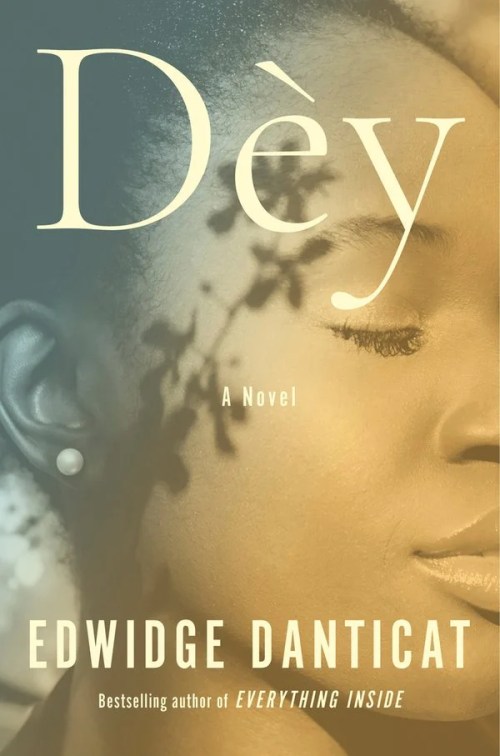
FICTION
Dèy
By Edwidge Danticat
Knopf
Published August 25, 2026


After reading this interview, I am even more excited to read Dèy!