


Heart Eater: A Memoir of Immigration, Belonging, and How We Find Ourselves in Language is the twelfth book by author, poet, and somatic worker Sun Yung Shin and her first memoir. It couldn’t be more timely as Shin explores immigration, adoption, borders, and the sociopolitical acts that instigate them.
“All I want is to be part of the conversation,” she writes in Heart Eater, “to participate in the world of ideas in the spaces that affect me and my communities the most… I’m looking for meaning.”
We spoke in person in her Minneapolis living room, filled floor-to-ceiling with books and plants and broadsides. Her table held a bouquet of pink begonias from a recent gathering of artists. Hers is a house of flourishing.
“Language is the medium I am best made for, for better or worse, Shin writes. “What I’m always trying to do as a writer is understand what has happened to me and the people who made me, what is happening to all of us, and what we could imagine and make better together out of the ashes of our past.”
We talked about belonging, hospitality to our readers, spelling-bee fails, and more.
This interview was edited for clarity and length.

Jennifer Eli Bowen
Let’s start with the title of your book. Heart Eater comes from a Korean folktale about a fox. Like the fox in the myth, you imagine the immigrant writer taking out her own heart, examining it, taking a bite, and finding some bitterness. That’s so moving to me. There’s a beautiful defiance in it that carries through the entire book. Where would you say that boldness comes from?
Sun Yung Shin
Once I started reading immigrant writers in college, their books offered a different, more complex, historicized relationship with English.
Jennifer Eli Bowen
Who was the first immigrant writer you felt welcomed by?
Sun Yung Shin
It might have been British writer V.S. Naipaul, who was born on the island of Trinidad, and writers such as Isaac Bashevis Singer, a Polish-born writer in the U.S. I don’t know if I felt welcomed, necessarily, or would have even thought I was entitled to feel welcomed, but I think I could say I felt my sense of English in the world was definitely expanding.
Jennifer Eli Bowen
Did you think of yourself in early college years as an immigrant, or did that recognition come later?
Sun Yung Shin
I did because of how clear my adoptive mom was about it. My immigrant status was complicated by having an American name (French first name, German last name) that didn’t match my racial or ethnic identity, and the fact that I spoke and wrote English without “an accent.” Different situations constantly revealed, hid, or blurred different aspects of my immigrant-ness.
I will also say that my first year of college at Boston University was very distinct from my three years at a small liberal arts college in Saint Paul, Minnesota, in terms of region, city demographics, size, and type of school, etc. As a person of color, and as an immigrant (whether anyone else knew it or not), I generally felt inconspicuous in Boston. I felt a sense of urban belonging that I carried with me from Chicago, but I felt quite conspicuous in Saint Paul, and generally experienced a distinct lack of belonging in Saint Paul, the “Twin Cities,” Minnesota, and the “upper Midwest” generally—racially and culturally.
Jennifer Eli Bowen
Yeah, your mom was deliberate in helping you understand your heritage, repeating the exact phrase over and over.
Sun Yung Shin
Your ethnicity is Korean, your race is Asian, and your nationality is American.
Jennifer Eli Bowen
Heart Eater looks at belonging in such nuanced and complex ways. You write that being “an adopted person, person of color, immigrant, and naturalized citizen demands a lifetime of performances. It always requires gratitude. It bequeaths the adoptee a longing for pre-memory that, in most cases, can never be fulfilled. Ultimately, like all human experiences, in its contours and contradictions, its constraints and freedoms. It reveals the shape and cost of belonging.”
You found belonging in and through language. What has that belonging given you, and what has it cost?
Sun Yung Shin
Nationalism asks that of everyone, right? Belonging in language has given me a creative community that I never even knew to imagine wanting. There’s a lot of hope in creative work; creative communities are so responsive to the world. I’m impressed with people throughout history who haven’t accepted the languages that we’re given, or the images, without questioning them. This is one deeply human way of working together to try to understand what else could be possible.
Jennifer Eli Bowen
That’s beautiful. You just won the Kay Sexton Award, which is given to a person who shows “long-standing dedication and outstanding work in fostering books, reading, and literary activity in Minnesota.” You’re very devoted to your community. And yet, I wonder if you’d say your entire body of work concerns itself with being outside of something.
Sun Yung Shin
I think that’s right. Outside and inside a lot of things, too. I hope that I am really aware, in a good way, of the access that I do have. I remember something from my early baby-poet days, when I was beginning to read Asian American poets; there was an interview with Chinese immigrant American poet Li-Young Lee. He said that all of his values were at odds with American values, but implied that he didn’t necessarily agonize over it, and made his work regardless.
Jennifer Eli Bowen
There’s tension in that, but freedom, too.
Sun Yung Shin
You don’t have to always be longing for the whole culture to reflect your own values in order to express yourself on your own terms.
Jennifer Eli Bowen
That seems really healthy. Is that a permission you find yourself giving your students a lot?
Sun Yung Shin
I hope so, because I believe that everyone can write, speak, connect. I believe that language belongs to us, and it’s important to practice it to understand how it has affected us collectively and individually. I find this to be true with adults who have had other professional lives; I know you know this, too. They’ve often become accustomed to a more utilitarian relationship language, and often benefit from encouragement and experiences that help them find or recover trust in a more personal, intimate, often idiosyncratic way of using words.
Jennifer Eli Bowen
You use the term, “accidents of literacy,” to describe your life as an immigrant writer. That term feels both scary and bountiful, like a lottery that you almost didn’t win, right?
Sun Yung Shin
I think about “literacy” in that sense as paired with “legibility,” and how understanding the language of race, nation, place, etc. has allowed me to become legible to myself, literate in the language of my Korean-adopted immigrant self, which means understanding my whole community, and our part in the Korean diaspora, and our place/s in unfolding American history. In terms of literal literacy in the English language, I am grateful for my Gen X-era public school education; we were taught prefixes, suffixes, and roots, which revealed that the English language has evolved, and much of what we use is from Greek, Latin, Anglo-Saxon, German, Norse, French, and a wide variety of Native Nations languages. And being a spelling-bee nerd taught me that we as people are in a wide and deep river of language.
Jennifer Eli Bowen
“A river of language” is a beautiful way to think about the confluence of words that make us. What word gave you your biggest spelling bee victory?
Sun Yung Shin
Well, I remember the word that I lost on. Dependent. That final “e” or “a.” Sometimes I still have to look it up. You?
Jennifer Eli Bowen
I went out on donut: d-o-u-g-h-nut.
Sun Yung Shin
That’s a legitimate way to spell that word. You were robbed.
Jennifer Eli Bowen
Thank you! I think so, too. You write, “Eyeing words, earring words, bringing them into the mind, the body metabolizing them. They become part of you, they feed you, and you live.” I love the sustaining physicality that you attribute to words in this book. You talk about the gift of someone “inviting the body into these hard conversations,” which maybe isn’t radical to younger folks, but to Gen Xers and older, it’s a fucking discovery. Does your work as a craniosacral therapy practitioner influence your work with words, and if so, for all of us writers that forget we have bodies, can you say a little about the mind-body connection in writing?
Sun Yung Shin
I have learned, been taught by others, and experienced in my own healing that it can be very helpful to have language to name bodily sensations. That can be liberating. If we just talk about our feelings, “I’m mad/sad/stressed,” we can tend to get stuck in our own suffering, but if we can notice without judging “my chest feels tight,” then we can remember that’s just something happening in my body, and actually, that’s the body doing what it’s supposed to do. It’s more complex than that, obviously, but language is so abstract. And as writers, the more we notice what is going on in the complex sensorium of our bodies—honestly, precisely, and non-judgmentally—I think, sometimes, it can be a path to a deeper authenticity in how we use our words on the page.
Jennifer Eli Bowen
So when you work with writers, do you try to help them involve the body in their process in any way?
Sun Yung Shin
I could always do a better job, but I try. Poetry especially lends itself to these discussions and opportunities because pacing, rhythm, and sound in general are usually so prominent—and so pleasurable—at the line level. For nonfiction, I find myself talking about orienting readers to the spaces being described, evoked, or implied within scenes, summaries, and flashbacks. I give examples of writers who are taking care of the reader by letting them know the who, what, where, and when in relation to the characters. Heavy by Kiese Laymon stands out to me as a tremendous gift to writing teachers and mentors, for so many reasons, including his consistent practice at the beginning of every chapter of clearly orienting the reader to time, place, people, action, purpose.

Jennifer Eli Bowen
Hell yes to HEAVY. This feels related to something you call a necessary “hospitality,” which suggests writers need to “let the reader go gently.” How do you balance that imperative when the writer is telling a story that isn’t gentle, that may in fact be brutal and hard? What does hospitality on the page look like in that context? This is both a moral and a craft question.
Sun Yung Shin
I take lessons from music, horror movies, anything with a lot of emotional modulation; how does durational art pace audiences or readers through an emotional experience? At the most basic level, I think of a wave. A wave of water has a shape; it goes up, peaks, and then falls; in nature, you can’t have all crescendos, or all high-key moments; in narration, in something temporal, you have to give people a break.
Jennifer Eli Bowen
That’s interesting. I wasn’t thinking of it at all as modulation, which makes a lot of sense. I was thinking of it as a counter to this thing we’re taught as CNF writers, which is, it’s not your problem if your story unsettles a reader. This is your truth, and you have the right to tell it, and people will feel better, or not feel better, but maybe someone will feel seen through it. The idea of modulation makes room for that, and it makes so much sense.
Sun Yung Shin
I have never been taught that! But I spent a lot of my suburban childhood and adolescence in both the arts and sports, and a lot of the principles seem to be the same to me. The human body has many “mechanical” limits, many more than the imagination. Respecting our emotional, psychic limits enlarges us rather than diminishes us, or the artwork, I hope.
With the idea of hospitality for the reader, I often like to talk about a story, a poem, or a personal essay as a building (stanza is one of several Italian words that mean a kind of room or chamber, so I’m not being original here). As a person-body, if you approach a building, you are doing many things to orient yourself in space, in motion, and to this structure, and you’re using multiple senses. A poem usually has a title, then a space/pause, then a first line, a line break, there could be couplets, or stanzas, or punctuation, etc. etc. Approaching a city house you traverse a city sidewalk, then a walkway up toward the house, maybe some concrete or wood steps, and a landing or a porch, and then maybe a storm door, then a heavier door. You pause. Is there a knocker? Is there a bell? A Ring camera? How do I enter this?
If the door opens, there’s the threshold. Once you’re in, there are rooms, nooks, hallways; maybe stairs, floors, etc. etc. If you manage to keep the reader traveling through the house (poem, story, essay…) and you have given them an experience that combines a fruitful combination of known and unknown, or predictability and novelty, how do you want them to exit the house, especially if you think, like I do, as the exit as the back of the house? If you’re asking them to experience, or empathize with, significant amounts of pain, how do you let them re-enter the ordinary world outside the artwork? What’s the middle path, where they don’t feel cut adrift, abandoned?
Jennifer Eli Bowen
Or manipulated.
Sun Yung Shin
Right! Children, animals, plants; most people understand that living things have rhythms that should be respected. Readers are living things. They/we don’t exist to satisfy a writer’s desire for an audience. I like to think of art, including writing, when it’s serving its highest purpose, as a place to connect, fundamentally, as equals.
Jennifer Eli Bowen
Thank you for that. I love the way you write about being “made of paper.” The layers of meaning are so moving in the context of your life and work. “A child, or any subject in a bureaucratic world in which writing on paper is the legal tender of identity, can be overwritten to meet the needs or wants of the adults who have control over her—they can paper. ’Paperwork’ is a form of bureaucratic magic that can effectively rewrite a person, over and over again, truly without limit.” Paper dictated your narrative in your earliest days, and now you remake yourself and narratives in books, on paper, sometimes through refusing narrative despite behemoth, entrenched systems. Can you talk about times you’ve experienced the power of language to subvert harmful bureaucracies?
Sun Yung Shin
This is an excellent and big question! I want to share that having taught high school English for 15 years, with a lot of public education being inextricable from harmful bureaucracy, meant that every single day in and out of the classroom, I was working to answer, ‘How do I justify what I’m teaching?’ How do I convince these young people, who are required to be in school, ‘Why is this important?’ Most of what I asked them to do was reading, writing, speaking; it was almost all language; for so many reasons, I wanted to have a very good answer for why we reading this, why are we reading, period?
My answer most days was that the writers we were reading had been trying to awaken something in readers; many of the authors I was privileged to teach were challenging the status quo—socially and aesthetically—in remarkable, sometimes shocking, ways. I also tried to teach that the fact that all artists also work with conventions and the limits of their own times, places, and minds doesn’t diminish the potentially liberating role of art in society. One brief-ish example: I taught the novella The Metamorphosis by Franz Kafka for several years; it is a quasi-tragedy with darkly comic elements; while it offers a sharp critique of bourgeois values and the bourgeois family, especially its pompous patriarch, the story also uses images of female sexuality that mostly reinforce a view of girls and women as objects for male apprehension.
Jennifer Eli Bowen
Heart Eater is your twelfth book, and you have two more on the way, and you’re just unfucking stoppable. You say you’re “still in love with language trained by books and brand names.” How do you keep a love affair with words alive, especially publishing under capitalism?
Sun Yung Shin
I have realized it’s not a choice; as long as my brain works the way it’s been working so far, I will find language alluring! I think it’s an interest in symbols and ideas in general; the imaginative structures that are part of what help us make certain kinds of human culture. I don’t think of writing as more important work than any other, but I generally approach it as a job, almost as a duty.
I also feel I need to practice it as political self and communal defense, even if I didn’t try to place my writing in the public as a “writer.” There are just too many ways that we are constantly being subject to material violence and degradation that is justified by language. I’m angry at past, present, and future abuses too numerous to mention here. How dare they. Who do they think they are, gods? I reject it.
Jennifer Eli Bowen
So, let’s say you stumble into wealth. Life-changing wealth. Think you’d still make books?
Sun Yung Shin
Yeah, I would still write books. I don’t have a choice. From birth, I’ve just had a lot to say.
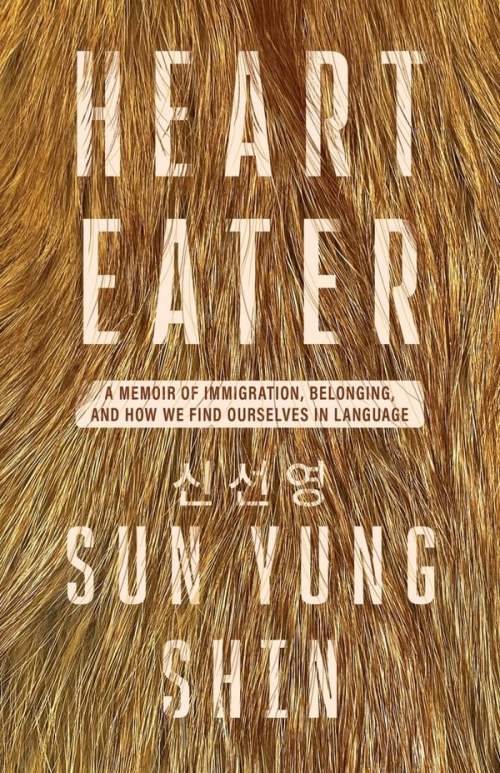
NONFICTION
Heart Eater
By Sun Yung Shin
Black Lawrence Press
Published July 28, 2026


