


It’s not exactly a mystery why the word “enshittification” has recently entered the lexicon. These days, everything is 40% more expensive and 20% worse. With no end in sight to runaway capitalism, shrinkflation, profiteering, and habitat destruction, Courtney Maum’s latest novel, Alan Opts Out, is a timely critique of American consumerism. The novel follows Alan Anderson, a prominent advertising executive who undergoes a crisis of conscience, and takes up residence in his suburban backyard playhouse. Alan’s newfound asceticism threatens to jeopardize his wife Vivian’s ambitious climb to the upper echelons of their affluent Connecticut suburb. The novel is a wry indictment of the privileged classes cosplaying the opt-out lifestyle like it’s some sort of noble escape hatch.
It’s fitting that I was sitting on the grass with an animal the first time I met Courtney. We were at AWP in Baltimore, and I was waiting with my elderly dog to get into my hotel. I’d followed Courtney’s Substack for a while, and read most of her work, so I felt like I knew her. When we spoke about her novel earlier this month, I recounted my teenage aspiration to become a hermit in the woods. I’d dressed like a 19th century person, sermonized against techno-futurism, and looked forward to Y2K. (“Yeah,” Courtney said, “none of this is surprising.”) I’ve since come around to technology, mostly. Courtney and I spoke over Zoom about dual narratives, living off the land, and trend forecasting.
This conversation has been edited for clarity and length.

Arturo Vidich
As the novel progresses, it feels less Alan’s story than Vivian’s. Could you talk about why you structured the novel as a dual narrative?
Courtney Maum
The first draft already had the dual narrative, but Alan had 80% of the story, almost like a first-person account, his manifesto. Once I did a couple more drafts, I was like, this is unreadable. But I had to write it to get to know him better. From a socioeconomic standpoint, he’s not actually in the 1%, just close to it. So, there are no stakes if the whole story is just like, “ha, ha, I moved into my backyard.” That’s when I realized I needed to use Vivian more. I needed to be brave and uncomfortable, because her values are so against mine. Writing Alan’s parts were fun and easy for me, because I have this background in advertising. It was viscerally difficult for me to write Vivian for the first seven or eight drafts. I hated her, condescended to her, judged her, and it took a lot of building up of backstory to find sympathy and compassion. I didn’t want to write her as a vehicle for nastiness. It was important for me that Vivian be complicated, but her values set. I hadn’t gotten to know her yet. [Laughs.] I was very judgy.
Arturo Vidich
Moving into the middle of the novel, Alan undergoes massive changes that are incompatible with Vivian’s “deeply feminine work of archival homemaking.” Her ambitions depend on Alan staying rooted in the world he’s withdrawing from, and a marital dystopia emerges.
Courtney Maum
Marital dystopia. I like that.
Arturo Vidich
The novel is rich with opposites, the most prominent being ultra-luxe prepper culture versus sustainable permaculture, as implied by Alan’s journey. How did you arrive at this contrast in particular?
Courtney Maum
I was aiming for the people who are aspirationally back-to-the-land, like the trad-wife. I’ve lived in the countryside for twenty years, so I’ve met a lot of people who started off as gentlemen farmers and didn’t know what they were getting into. People are so removed from the way it actually works to kill an animal that they’re like, I shall hunt a deer and provide venison for my family. Which you can absolutely work toward. But you need a real setup and an understanding. You cut the wrong way, you’re going to mess up the meat and then you can’t eat it. The learning curve is a lot steeper than people think. And I’m not positing Alan at all as someone who’s even climbing a learning curve. I mean, he forages in his wife’s fridge. He’s fishing quite a bit, but he doesn’t really know how to do anything. Which is fine. I think he’ll learn.
Arturo Vidich
I imagined two outcomes for Alan: Green New Deal 2.0 lobbyist, or he steps on a nail, gets tetanus, and dies.
Courtney Maum
I was trying to posit his daughters as, like, one these ladies could make it. That was partly inspired by the show Alone, which I referenced in the book, and which I depended on to get me through the pandemic. I noted that it was not always the women who won, but it was the women who tended to last the longest, partly because they had emotional intelligence and mental stamina and imagination, you know?
Arturo Vidich
Their assumptions and expectations were probably different than a man who’d maybe have a more entitled outlook, like, I’m a man, this is what I was meant to do. There’s a character, Whitby, who is the leader of the Queen Anne Club of Belleport (a “finishing club for menopausal women,” as you’ve described it elsewhere). Whitby is drumming up investors for her ultra-luxe apocalypse bunker village she’s building in the Adirondacks, which is the largest contiguous protected land in the country. How did you settle on the Adirondacks for Whitby’s end-of-days village?
Courtney Maum
We have family connections to the area, and have vacationed there quite a lot. It was an area that my father was completely obsessed with, the great camps Adirondack-style, or, you know, the upscale version of it. Rockefellers. It was very WASPy, at least in the culture of wealth that I grew up with, this discrete wealth—well, not even discrete. It’s like, yes, our family happens to have money, but if we lose electricity, in our ancestry we have people who worked the land, and we have this sort of know how in our DNA, which is generally not true, but they like to have structures that suggest it’s true. The people I’m writing about in this book, in Greenwich, Connecticut, would never live in a Home Depot bunker. The aesthetics aren’t correct. If the world’s going to end, they want to be looking at nature and possibly trying to live off the land. And so the Adirondacks felt like a natural fit, where people could have a great camp, and then there’d probably be a bunker under it. But the vibe would be capability and competence in the great outdoors.
Arturo Vidich
With a personal chef. Could you talk about how your past as a trend forecaster played into the writing of Alan?
Courtney Maum
I think even if I hadn’t worked in trend forecasting, I already had that proclivity because I’m a writer and a creative person. Deeply creative people are able to tap into the current of a moment, and feel called to present an opinion about it. For example, Dadaism came in response to an unfathomable war and cruelty that no one could make sense of. Makes sense, right? The absurdist movement comes out of war.
By that same token, I’ve ended up applying all of my trend forecasting skills and marketing and advertising. The company I worked at in Paris was not— We didn’t use any computers. We used no statistics. We used our hearts and our minds, and we would go out into the streets, travel a lot, and just kind of observe. It was very witchy. This was in the early aughts, like 2001, basically the beginning of the century. Because all of our clients were looking for forecasts that were about seven-to-ten years out, I specialized in looking at trends that were going to hit in about a decade. And so for better or worse, my books tend to hit the same amount of years early. This one seems to be aligning, I hope, a little more correctly with the cultural moment. Touch, my second novel, should be coming out now, but it came out in 2017. We’re in it, you know? You don’t need to be a novelist to see the overconsumption and almost unnamable rift between the haves and the have-nots. You just need to go to the gas pump.

Arturo Vidich
For regular people like you and me, as in not the 1%, how do you see opting out trending in the future? We can’t all become hermits. It isn’t sustainable.
Courtney Maum
No, no, especially with the price of life right now. Unfortunately, most people need to work. I think we’re already starting to see some of the ways that people will opt out. Rejecting AI, or at least taking steps to be more thoughtful about when and where they’re using it. I’m very anti AI, and it’s nice to see some ChatGPT boycotts. I think people are starting to wake up that like, yeah, is my desire to get this like shampoo overnight more important than humanity? Labor unions are where the revolution is going to happen. Jeff Bezos has an amount of money that people couldn’t spend in generations and generations, and then, you know what? Workers are peeing in bottles.
The thing that has me excited right now is gas prices. I mean, it’s hitting me personally in the wallet, because I’m against smart cars, so I bought an ancient Mercedes station wagon that takes premium gas. Gas is the number one way to wake up people on the right because they can’t get gas from anywhere else. You can’t opt out of gas prices, but you can opt out of this la-la-land thinking that everything is the left’s fault. Racism is not going to change the price at the pump. You have to do some deeper thinking. So, I think that as painful as it is the—I guess are we in a recession?—I don’t even know what to call it. The pain of the current cost of living will force people to stop over-consuming, like hopefully they just can’t afford more stuff, and will recognize that, in fact, they do have things in their closet to wear. Their current water bottle is just fine. Their yoga leggings—you don’t need pastels for summer. The car you have is fine. Know what I mean? We’re going to have a major movement of reprioritization, because the pillars of the American Dream have termites in them. Higher Education—
Arturo Vidich
I was just going to say trade schools.
Courtney Maum
Oh my god, it’s— You think AI is gonna fix your toilet? AI is not going to pick up the hoof of a 1,200-pound horse and put a new shoe on it. These almost medieval, old-school trades that are so specialized are going to be the architects that keep opting out. I think one silver lining is that books will make a massive resurgence. It’s like, okay, you know what is actually a good investment? A book.
Arturo Vidich
In fact, you wrote that in 2017 in Publishers Weekly. “Many people will opt to buy a special book in an actual book shop, where actual people work.” I love that forecast, and I feel like it’s been coming true, with recent news that the number of brick-and-mortar bookstores increased in 2025.
Courtney Maum
Yeah, indie bookstores are doing pretty well because it’s just not cool, especially if you’re kind of a lefty intellectual, like, it’s embarrassing to be buying things on Amazon. People literally forgot that books and reading are recreational activities that are very low-cost-slash-free, if you’re going to a library. It’s sort of hysterical. They’re remembering— Books are a hot accessory right now. Being seen reading is hot and I’m very for it.
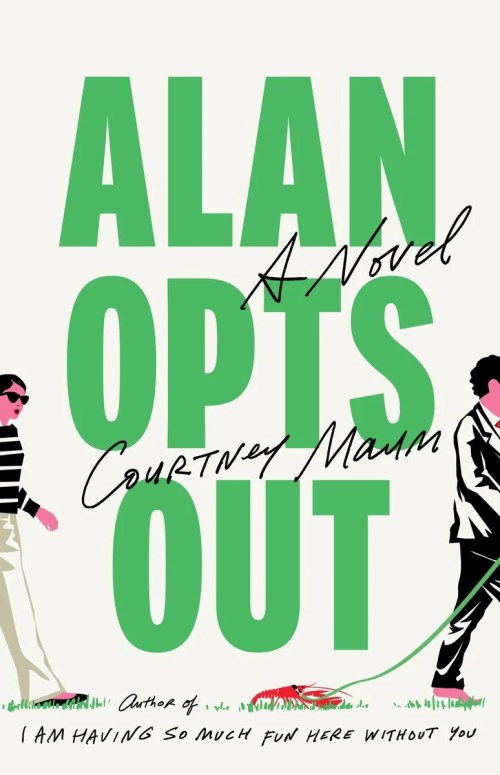
FICTION
Alan Opts Out
By Courtney Maum
Little Brown and Company
Published June 2, 2026


