


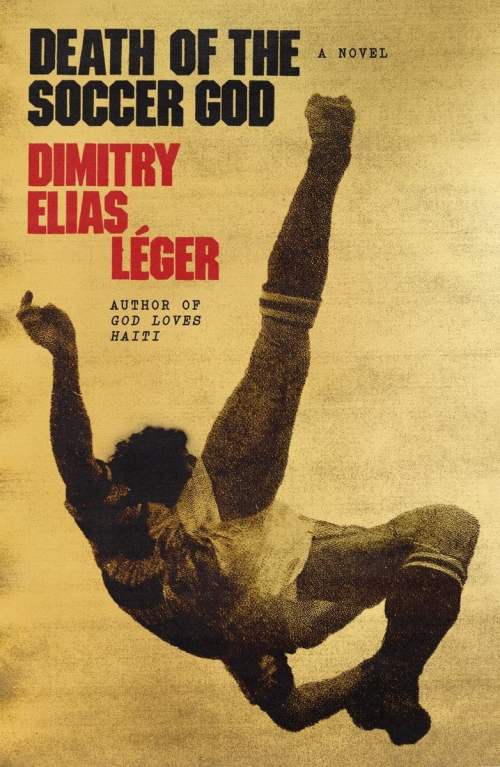
All narratives about sports are inherently tragedies, because the nature of athletics always implies an end. Prowess on the field diminishes, age catches up, and these bodies once used to adrenaline and constant movement must find new occupation. Or else, the mind diminishes as well. This is the common throughline of most sports novels, but Dimitry Elias Léger’s Death of a Soccer God approaches tragedy in a more concrete sense. As Gilbert Chevalier, the novel’s protagonist, considers his chaotic life as Haiti’s soccer star, he does so at the cusp of life and death, facing a literal firing squad. In an opening line that pays homage to Garcia Marquez’s One Hundred Years of Solitude, we are introduced to this greatest of all tragedies. This opening sentence stretches on for nearly the entire opening page, and so we are introduced to this messy, complex novel about a messy, complex national hero. Is this, and the entirety of the novel, an exercise in melodrama? Undoubtedly yes, but the best sports novels often are.
However, to call Death of a Soccer God a sports novel would not be entirely accurate. Much of the actual athleticism consists of Chevalier’s youthful memories, and apart from his World Cup goal, we see little of his competitive career. Much more time is spent establishing Chevalier’s relationships, obligations, and loves, surrounded not by soccer as a scaffold, but Haiti itself. The nation, the “volatile love of his life,” is the novel’s true protagonist. As Chevalier grows and changes, so does the nation, from US occupation to dictatorship. Although he leaves the nation soon after turning eighteen, he is inextricably tied to the country as a whole, and when it enters a new regime, Chevalier is subject to political forces and cultural movements far beyond his understanding.
At his core, Chevalier himself is a high-flying, passionate young man, caught between his two great loves: football and a young Haitian woman named Aurelie. Other forces, like injury risk, familial pressures, a newfound love for jazz music, and his Nazi wife, threaten Chevalier’s well-being. Nazi is meant in the most literal, historical sense here, as the novel surrounds the aftermath of WWII and their alliance is of financial rather than romantic benefit. The novel is equal parts underdog story as it is dark comedy, although these comedic elements at times detract from the work as a whole.
While Chevalier is entirely fictional, he is surrounded by versions of various historical figures. Most notable are his collegiate roommate, Miles Davis, and a young aspiring soccer player named Edson Arantes do Nascimiento, also known as Pele. Miles is a freewheeling young trumpeter with a penchant for drugs, and Pele is barely eight years old and newly orphaned. These aren’t meant to be realistic portrayals, and merely exist to ground Chevalier in various places and times, but the overall effect is distracting, creating a Forrest Gump-esque tone to what could be a very incisive social commentary. On the other hand, the novel never neglects opportunities for humor. Everything from Elizabeth’s transformation from Nazi to island girl, to Chevalier’s youthful transgressional memories at the very moment of his death, contribute to a sly satire of the typical underdog athlete story. The fact that we barely gloss over most of Chevalier’s athletic career ties into this as well.
Léger’s novel can join the canon of tongue-in-cheek novels about the sports world, a small group of novels to be sure but an illustrious one. The Legend of Pradeep Mathew by Shehan Karuntilaka, The Natural by Bernard Malamud, and now Death of the Soccer God, just as much a portrait of the athlete as it is the world that created him.
FICTION

by Dimitry Elias Léger
MCD
Published on May 12, 2026


