Anyone associated with foster care knows simple answers rarely happen. Instead, and often, complexity reigns—complex histories, complex trauma, complex car trips for care workers navigating between kids’ appointments or complex calendars full of appointments for caregivers. Rachel León captures this nuance deftly by naming her debut How We See the Gray. She should know, she’s a social worker by day. I should know, I’m a foster mother.
My copy of her book contains a rainbow of color-coding highlights: green for “good to know about the other side of the foster care system table,” pink for “foster youth perspectives,” yellow for “language and flow,” and finally blue for “key moments.” Regrettably, gray doesn’t exist as a color selection in the highlight palette. And yet, that might be exactly the idea that undergirds the story at large. There are no villains or heroes here.
León deftly depicts characters with flaws and intricacies that have brought them to social services—whether as employees, wards of the state, or biological (bio) parents. The rendition of characters demonstrates León’s compassion. Ebony, a foster youth in the story, still rents space in my head in the way that a character you come to care about doesn’t cease to exist after you close the book.
I spoke with Rachel over Zoom in mid-April about false endings, the waiting game of foster care, the importance of multiple points of view when telling stories involving foster care, and the necessity of humor.
This interview has been edited for clarity and length.

Annelies Zijderveld
Who is the main speaker at the start of each chapter? Is it the faceless institution of foster care? Why was it important to establish ground rules at the beginning of each chapter?
Rachel León
That’s such a good question, and it shifted a lot throughout the revision process. The “we” didn’t even originally exist. The novel was written in third person, but a reader pointed out that the narrator was really opinionated about the system, and I decided to lean into that and let there be an opinionated narrator. So, the “we” was formed. Several readers have read the “we” as kind of the system itself, but I think of the “we” as this group of workers at this specific agency. But I like that it can be read both ways.
Annelies Zijderveld
In the foster care system, sometimes one party feels more heard than another. Is this why you landed on this multi-point POV of social workers, bio parents, and foster youth?
Rachel León
Yeah, absolutely. It started as a dual-POV novel about a social worker and a bio parent, and the story went through a lot of iterations, but multiple perspectives did feel important because of the fact that certain parties in a case might feel more heard—might seem to get more attention, or have things bend in their way in certain instances. I really wanted all sides represented.
Annelies Zijderveld
It was originally a dual point of view—Kayla, the bio mom, and Meredith, the social worker?
Rachel León
No, actually, the original bio mom was named Meredith and the social worker was a totally different character. In a giant early rewrite, I decided to combine them into one. So, it was essentially about the social worker who lost her son to the foster care system in that version— she became a client. I just completely merged those.
Meredith, the social worker, was born through that draft. It wasn’t until I decided that felt too on the nose and that it was missing perspectives that I was like, “Okay, this needs to get bigger.” It was thirteen POVs! I had an attorney as one of the points of view that I needed to cut in revision, but that is when Kayla came in—when the story widened.
Annelies Zijderveld
Let’s hang with Kayla for a second. Tammy (Kayla’s mom and the foster caregiver of Kayla’s kids) is acting in what she thinks is the best interest of the kids, but she has her own interests in mind and is a bit of an antagonist. How did you write Tammy’s character and why is she important for giving Kayla, the bio mom, more definition?
Rachel León
I know it’s a tricky undertaking, whether it’s a relative or a non-relative caregiver, what sounds like an impossible task—this idea that we’re asking our caregivers to love these kids like their own. But we don’t know how long that’s going to be. Because the goal of foster care is return home, and we always try to work that reunification goal. But we don’t know what’s going to happen. And if it’s not safe to return the kids home, then we do need a safe permanent place for these kids. In Illinois, at least, that’s typically the caregiver that’s been taking care of them this whole time. I know that varies in different states, but that’s how it works here.
I have met a lot of caregivers, whether related or not, that have the challenge that Tammy does, where she really loves those kids—but antagonist is the right word in terms of the dynamic with Kayla. It’s really complicated. There were versions of the novel where Tammy came off as more of a villain than I wanted her to. I wanted to make sure she didn’t read as flat or that she was driven by her own interest because I believe she’s really driven by love and concern for the kids. It’s the lens in which she’s looking at the situation with Kayla. She doesn’t believe Kayla’s fit to take care of them. And, you know, that’s something I personally disagree with, but that’s the lens that she’s seeing it.
Annelies Zijderveld
Drugs often play a role in kids coming into foster care, whether as a coping mechanism or addiction. They do for Kayla, and then we begin to learn more about Meredith, the social worker who has demons of her own, including abandonment and a mother who’s an addict. You didn’t have to write the social worker having problems with addiction and how tenuous the line between client and caretaker can be, but you did. I’m curious to hear about your decision to write Meredith in this way.
Rachel León
The first version of the novel, now that I think about it, didn’t have anything to do with addiction. The social worker wasn’t struggling with that, which might be why that novel didn’t work.
I started working in foster care as a single parent. At the time, I was working at least six days a week, but more often seven. It was day and night. I did drink to cope with the stress and addiction runs in my family. I think it might say it in the novel, or maybe it’s in a short story I wrote, that most of us come to this work because of our own traumas and backgrounds. And that was the case for me, though I also kind of fell into the work. But I think it’s fair to say that’s one of the things that has kept me in the work.
But my addiction aside, from the moment I started in foster care, I really felt like there wasn’t this big line between my clients and me. I felt like it was my privilege that separated us, that that’s really what the difference was. Even just having family support is what kept my child out of the system—having someone that I could leave my kid with and get drunk.
So, I think that is something that I was reckoning with on a personal level, immediately upon working in foster care. That’s why I don’t think that the first iteration of the novel works because I don’t think it could come from a personal place without “going there.” I was trying to deal with this, maybe from a safer distance. My coworkers and I would go out and have what we called 5:01s after the work week, drinking and letting loose after the stress of the work week. But that looked really different for me as a single parent doing that versus my coworkers who didn’t have the same kind of responsibilities that I had.
Annelies Zijderveld
The triggers of trauma are not always obvious, as one telling scene with Ebony, a foster youth, demonstrates. How can we write about trauma in a way that is being authentic and true and real but also not overdone?
Rachel León
That was a definite concern during my revision process. I did an emotional outline, mapping the emotional beats and the darkness and the lightness. Because anytime something was really heavy, I wanted to follow that with something lighter. I wanted this braid of hope and warmth after something hard. I’ve worked in foster care for almost twenty years now and there’s a lot of heaviness that I reckon with daily, but I don’t see it as all depressing. I see so much love and hope and just amazing people that are stepping up—like you—and I think that’s often what I go to, mentally, first: the good over the hard.
Portraying trauma was important, but that doesn’t define someone’s experience. It doesn’t define this work by any means, or this field; there’s a lot of complexity here. So, the way that I tried to handle that was by being really mindful of how much heaviness—how much I’m showing or how deep I’m going with some of that. Then, moving away from that and also trying to bring some humor to situations that maybe aren’t really funny.
Annelies Zijderveld
The role of humor, and sometimes dark humor, comes up in the social workers’ need to process at 5:01 clubs or among themselves. How does humor help as a survival instinct and tactic in writing about heavy subjects?
Rachel León
Humor is so important in this work and in life. We were just talking about how heavy things are right now, and humor is a survival tactic for sure. One of my coworkers—I started before she did, and she has not left foster care. I’ve had to dip out a couple of times, but I always come back. But she and I have been at three different nonprofit agencies—and she was just talking about how a person can’t do this job without a sense of humor. My team, we’ve all been in multiple roles in foster care, and the thing that has kept us in it is our sense of humor and our ability to laugh at things that maybe don’t seem funny. At all. I talk about the revolving door in foster care. And part of that is because that kind of humor is hard for some people to access, or even be okay with, but I really don’t think you can do this job without laughter. The hardest thing about my role now is seeing the caseworker struggling and wanting to help but also trying to stay in my lane and advocate for foster parents.
Annelies Zijderveld
Newspaper blurbs, reportage, case files, straight narrative—tell me about your decision to incorporate different forms into moving the story along.
Rachel León

That came later. There’s two pieces to that. One: the newspaper clippings were really meant to capture the place. They do more for setting and situate the reader—not just place but also time because the novel does take place over a specific period of time. Some of the things that happen locally where the novel’s set in Rockford, Illinois, do affect some of the narrative in that way. The case notes and some of the other case file documents—I end up using those to help tell the story and, maybe in most or all instances, to convey information that would probably be boring; it’s not really a scene. But it was a device to convey information to the reader that felt pertinent but not to deliver it in a more interesting way and to give the reader a sense of paperwork, because that is a huge, huge part of the job.
Annelies Zijderveld
Exactly. In mentioning place, Rockford, Illinois, plays such a strong role in the book. How did you come about crafting place as a character? Do you have a relationship to Rockford?
Rachel León
Rockford is my hometown. It’s where I live. This is where I grew up. Rockford’s made national headlines for not-so-good things like “most miserable city to live in,” “worst place to live in America.” We have more crime per capita than Chicago. For a long time, I had a lot of shame about my hometown. And so, for a long time, even though it was set in Rockford, I did not name Rockford. I did a novel revision fellowship through Stony Brook University called Bookends and was paired with Karen E. Bender as my mentor. And she had commented when she read a draft that there was no setting at all—it was just like these people were floating, and it wasn’t until she pointed that out that I realized how much I was shying away from putting Rockford in. So, I tried to lean into putting Rockford in.
Part of that program [at Stony Brook] is an agent reads it at the end, and the agent was essentially like, “Get Rockford out of here. Make it generic. Make it feel like it could take place anywhere.” I got that feedback from other agents too. So, I did this dance of trying to take Rockford out, but also wanting [the novel] to have a vivid setting. I finally got to a place where I felt like it was too important to shy away from. Foster care varies from state to state, even county to county. I can really only speak to how foster care operates here in Rockford. That’s where my career has been.
And the story feels very “Rockford” because I feel like Rockford has a very can-do attitude. It has this underdog flair. I just named all those bad headlines that we’ve gotten, but they’re not what defines the city. What defines the city is, like, there’s so many people willing to do the work—willing to just take a chance and make things better. I think of Rockfordians as dreamers and doers, people who are like, “This would be cool,” and then they just make it happen. So, it felt important to the story. When the novel landed with Northwestern University Press, Megan Stielstra, my acquisitions editor, was like, “I want more Rockford.” And I was like, “Great!” So, I was able to really lean into it and bring that to life.
Annelies Zijderveld
Large blocks of time pass before we catch up with the characters. Is this trying to capture the long timeline within foster care and how long it takes for something to happen?
Rachel León
Yeah, absolutely. If cases were only a year. . . . The goal is “return home” within a year, but kids are in care for a lot longer than that. But a lot can change in a year. With foster care, something needs to change in order for the case to close. The parent needs to be given the opportunity to change. And change takes time.
It’s not just like, “Okay, I’m changed because of this experience,” even though the experience is going to change a person, but there’s a process to that. It takes time. The story is set over a year, but then there are these jumps and you kind of have to catch up to the characters. Like, at the end of fall, Kayla’s getting a job. And then in winter when you meet Kayla again, she’s in the job and her life looks different than it did.
Annelies Zijderveld
At the end, you have a false ending: “This isn’t the end, it’s the resolution.” How do we get used to seeing the gray? For people who have no contact with the foster care world, what would be your hope for them as they read your book?
Rachel León
That false ending—that’s something that I’ve thought about with case closings, whether that ended with an adoption, with a kid going home, with a kid aging out of the system. However that case closed, that’s not the end. In many ways, it’s a beginning. That’s something I’ve thought a lot about. So yes, that’s definitely in there.
I hope that readers are able to take a step back and recognize they’re only seeing things from one angle—whether that is about the foster care system or not. The people that we come into contact with, we’re typically only getting one side of the story. We’re seeing things out of one lens. And I want this novel to complicate that idea, to help people see the limitations we all hold with our positionality and what we see, and position can be privilege for sure. . . . I hope readers walk away a little kinder to other people.
A friend read the novel and it made her give somebody another chance. That made me really happy, that it had that effect of someone giving somebody more grace. One thing that unites everyone is we all make mistakes. No one is perfect.
And yet, there’s a trend to cut people off: “This person did something; I’m done with them.” And I think that not only is not the kindest approach, it robs us of this growth that we can have from working through a problem, finding healing. There’s so much growth that can happen from that. And it doesn’t mean putting up with an abusive situation, but as a culture, many of us are quick to just—what’s the expression? “Bye Felicia”—just, I’m done. So, I do hope the novel lets people consider taking a step back and giving people grace and reflecting on how we all mess up. Most of us are just doing the best we can at the end of the day. We’re all just trying.
FICTION
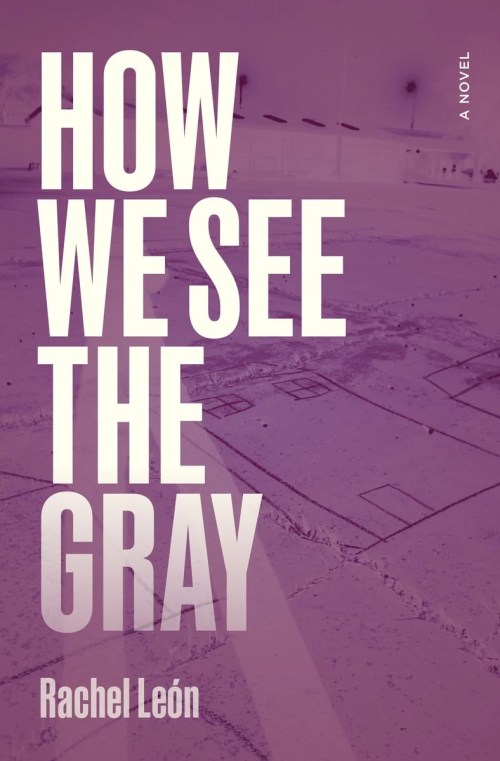
How We See the Gray
By Rachel León
Curbstone Press
Published May 15, 2026