


Directors Alfred Hitchcock and David Lynch have an uncanny ability to draw us into their strange worlds, filled with engaging yet often unlikable characters. They manage worldbuilding beautifully with a touch of the uncanny. And then there’s a moment when everything they’ve built topples like a deck of cards. Nothing is what it seems. It’s wonderfully disorienting.
That’s what it felt like reading Body Double by Hanna Johansson. Its protagonists, Naomi and Laura, accidentally meet at a shopping mall. Despite or maybe because of the strange interaction, it sparks a romantic relationship, leading Laura to move into Naomi’s home. Naomi isolates herself from her friends, while Laura leaves her life behind. In time, Laura starts dressing like Naomi and impersonates her.
Interwoven into this strange relationship is a nameless transcriptionist who works for a ghostwriter. She transcribes the life stories of his clients, which he then forms into life stories. But when she hears a strange message on one of the tapes, her entire life becomes upended.
I had the chance to speak with Hanna Johansson via email about her enigmatic and unsettling book.
This interview has been edited for length and clarity.

Elisa Shoenberger
What made you want to tell this story?
Hanna Johanson
The story of Body Double actually appeared quite late in the writing process; at first, I was mostly interested in experimenting with a certain kind of vibe that I identified as “late 20th century European co-production thriller, not necessarily well made.” I had also been interested in the figure of the Doppelgänger for a while, and I approached it rather childishly or literally. Like, I was not so much interested in it as a metaphor for a psychological condition but more as a cliché — something I was drawn to aesthetically. So I had that as a starting point, and then these broad themes began to emerge, like authenticity and artificiality, lightness and shadows, truths and lies…and after that I started constructing the story, like a sculptor.
Elisa Shoenberger
The story feels very cinematic. It’s been described as Hitchcockian. You also narrate movies, and one character admits to being a body double. What drew you to interweaving narratives and camera shots into the story?
Hanna Johanson
Yes, and there is also a continuation error! This all has to do with my intention to write something that would leave the reader with the sense of having watched a fascinating but technically imperfect movie. Within the context of the novel, I think it’s also a way to explore how the characters experience doubt about what’s real and what’s not, and how they view themselves from the outside, as if they were characters in a movie.
Elisa Shoenberger
There seem to be some recurring images and sounds: lipstick, the coat, the BANG of the ticket, sparkling water, and the CITY newspaper. It reminds me of a René Magritte painting about how the most important things in our lives are the ones we use daily. It feels that these mundane things are what define us: Laura’s brown lipstick, the transcriptionist’s slip of paper, and Naomi’s hair.
Hanna Johanson
And these sorts of objects often take on meaning with time that they didn’t necessarily have before. There’s a passage I keep returning to in “An Arab Melancholia” by Abdellah Taïa, one of my favorite novels, where the narrator goes through a box containing little things he’s held on to from a past love affair — totally mundane things that for anyone else would probably look like trash, like a candy wrapper and a ticket stub for the movie Beau travail, but for him, they carry great significance. And he calls these things “not souvenirs, but proof,” which ties into something Body Double plays with as well — namely, the suspense genre, where objects take on such significance because they might be clues to solving the mystery of the story.
Elisa Shoenberger
I find the discussion of liminal places fascinating, especially with respect to the department store, as we see women’s identities slip away. Could you talk about this element of the book?
Hanna Johanson
The first parts I ever wrote of Body Double were the segments where the transcriptionist just moves through the city. The spaces the characters occupy are often liminal places, as you note, like the subway, the department store, the movie theatre, in a sense, too — places where you can take pleasure in being anonymous, in disappearing into a crowd of people. But that could also be frightening, of course. They’re places where you’re very visible but not necessarily being seen, and I guess that is something I wanted to explore with this story — the desire and fear of being seen.
Elisa Shoenberger
So much of the story seems to be about the stories we tell of our lives and what happens when we lose our sense of selves. Could you talk about why this is so important?
Hanna Johanson
This relates, I believe, to the question about the objects we attach significance to in order to solve the mysteries of our own existence. I also approached this theme in a very literal, even a little silly way, like: what if you actually disappeared when you lost your sense of self? What if it were physically dangerous?
Elisa Shoenberger

It feels like there are three interwoven stories: the transcriptionist, Naomi, and Laura, and the person telling their story on tape. What made you decide to structure it like this?
Hanna Johanson
Naomi and Laura arrived very late. I had written a version of the novel that only followed the transcriptionist, but I found that some things were not accessible through her gaze, I guess you could say. I always wanted this to be a novel you read quite fast, maybe a bit too fast, and I found the pacing worked best when the different stories were arranged in a sort of braided pattern.
Elisa Shoenberger
What do you want people to take away from this story?
Hanna Johanson
I’ve mostly thought about this question with regards to feelings, or sensations — I would like readers to have been entertained, and also a little frustrated and unsettled.
Elisa Shoenberger
What else do you want me to know?
Hanna Johanson
Some Swedish reviewers made a big deal of the fact that the title of the novel comes from a Brian De Palma thriller, which I was aware of when I chose it, but I actually hadn’t seen the movie when I wrote the novel — I just wanted there to be the possibility of hearing the title and thinking “wait, isn’t that the name of something else?” — which also actually sums up how I would like the novel to be read, with that sort of dreamlike doubt.
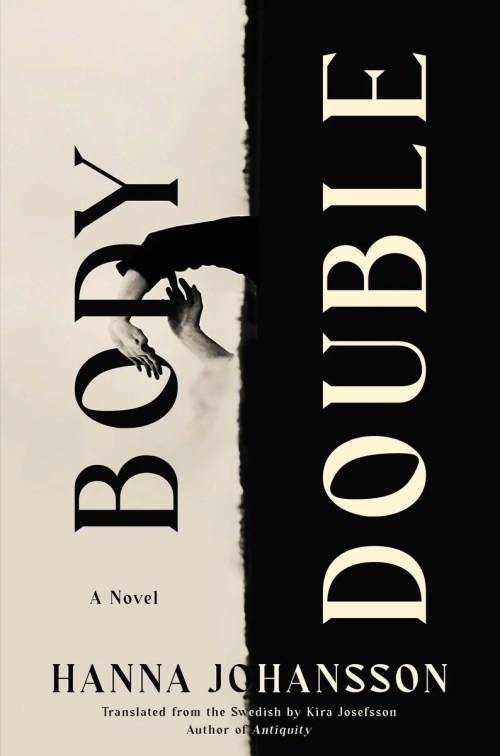
FICTION
Body Double
By Hanna Johansson
Translated by Kira Josefsson
Catapult
Published April 7, 2026


