


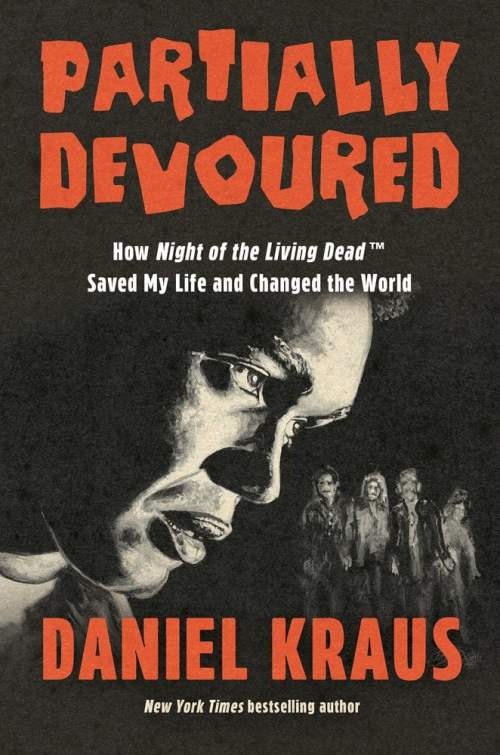
Originally released in October of 1968, George A. Romero’s Night of the Living Dead is one of the most remarkable debut films of all time. Created on a shoestring budget by a group of friends in Pennsylvania, the film has gone on to gross over $30 million worldwide, and stands as the originator of the “modern zombie” — the shambling, flesh-eating, fearful member of a mass that almost everyone thinks of when they think “zombie”. It inspired countless copycats, countless parodies, countless alternative (but loving) interpretations, and a relatively countable number of sequels. Unfortunately, the cast, the director, and even the producers, would reap very little of the benefits that the movie’s massive gross produced. Why this happened is just one remarkable story—among many others—that Daniel Kraus’ latest book, Partially Devoured: How Night of the Living Dead Saved My Life and Changed the World, explores.
Daniel Kraus is a renowned writer of film, TV, and novels. He helped form the idea for the Oscar-winning film The Shape of Water with Guillermo del Toro, acted as an associate producer on the film, and went on to write its novelization. He co-authored 2020’s The Living Dead, with George A. Romero, and has in total published twenty-two novels. He lives in Chicago.
In Partially Devoured—a title taken from the film’s script—Kraus takes us through Night of the Living Dead in fascinating detail. Instead of chapters the book has timestamps, indicating which scene, or even frame of the film, Kraus will dive into next. Due to a copyright accident, Night of the Living Dead immediately entered the public domain upon release, quickly proliferating across the world in a variety of formats. Today the film can be easily located on YouTube or the free streaming platform Tubi, and the invested reader—it will be hard not to be invested—can follow along with Partially Devoured’s timestamps. (The entire film can even be found embedded on its own Wikipedia page.)
Partially Devoured is more than just an analysis of the film, however. Kraus takes time to talk about the film’s production and the lives (and afterlives) of the film’s cast and crew. As the book’s subtitle suggests, we also get autobiographical snippets of Kraus’ own life, and the influence Night of the Living Dead had on his childhood and adolescence in rural Iowa. Kraus is a certified expert of the film (if not literally, he is the closest thing to), with an extensive knowledge of everything Night related. He discusses the various formats Night of the Living Dead has been released on—down to VHD and Super 8—references obscure material such as the novelty book Scream Queens Paper Dolls and a fotonovel consisting of nothing but film frames with added captions. Kraus discusses the history of the conventions that Night inspired, and academic works that discuss the film.
Partially Devoured remains entertaining throughout, feeling something like an eloquent and charismatic friend talking about one of their favorite things. The timestamp structure keeps us moving through towards a clear goal (the final few wrenching seconds of the film) while Kraus’ observant and commenting spirit is free to move through past and future.
Occasionally Kraus’ comments get a bit too subjective, and fall a little flat. At one point he compares a protagonist of the film to a member of his family, and extrapolates that the protagonist must also dislike city life — an inference not rooted in script or action, but on the character’s facial expressions while visiting a rural graveyard. These more reaching interpretations, however, are relatively rare, and are nonetheless still interesting. They are to be expected from what is, besides an extremely well-researched work, also an autobiographical statement.

Whether you’ve seen Night of the Living Dead ten times, or have never seen it at all, Partially Devoured makes for excellent reading. Even if the reader is not a fan of horror films—but can handle a few icky descriptions from Night—the book is well worth reading for its biographical explorations of the cast and the societal musings relevant not just to the 1960s but to our own times. In 1998, Night of the Living Dead was selected for preservation as a culturally significant film with the Library of Congress’ National Film Registry. The 1968 touchstone well deserves it. Underneath the blood the film is a work of art, a creation of undying significance. It deserves to be returned to again and again, reinterpreted, and continually discussed by books such as Partially Devoured.
NONFICTION
Partially Devoured: How Night of the Living Dead Saved My Life and Changed the World
By Daniel Kraus
Counterpoint
Published March 10th, 2026


