


At age 77, Jonathan Galassi stands for more than himself and his own celebrated career as poet and translator. Unarguably, he is an icon of the book publishing industry, a luminary of the literary world at its most thoughtful and urbane—a man who has edited such diverse talents as Pat Conroy, Louis Auchincloss, Anne Sexton, and Galway Kinnell, in addition to launching Scott Turow’s 1987 mega best-seller, Presumed Innocent.
Galassi attended Harvard College, where he studied English with Robert Lowell and Elizabeth Bishop, later becoming a Marshall Scholar at Christ’s College, Cambridge. His distinguished publishing career began at Houghton Mifflin in Boston. After spending some time at Random House, in 1986 he settled into a longer life at Farrar, Straus & Giroux (FSG). In 1988, he was named FSG’s editor-in-chief, and served as president and publisher for twenty years. He is currently the company’s chairman and executive editor.
Galassi has published four translations of the work of Eugenio Montale and three collections of poetry. His new book of poetry, The Vineyard, is comprised of three poems—one, the titular, is an approximately 80-page investigation of the beauties of a beloved place, he and his husband’s summer home on Long Island’s North Fork. With regular inspiration from Virgil’s shepherd, Tityrus, and a host of friends, lovers, gardeners, past Island inhabitants, colleagues, neighbors, Galassi centers the action on his next door neighbor’s vineyard, tracking the seasonal changes of its landscape, noting the inexorability of time and aging, as he watches from year to year the grapes wither and grow and wither again. This interview was conducted over Zoom and has been edited.
Ryan Asmussen
Let’s start with the first line of your title poem: “The vineyard was always better than the grapes.” As much as your poem celebrates the specific, active joys of wine, of a great deal of earthy living, it often leans toward celebrating certain places and times. A broader view appears. This first line carries a lot of weight as a reference to this.
Jonathan Galassi
That line is based on Hemingway. You know, “The country was always better than the people.” Green Hills of Africa. I think a lot these days about how our country is beautiful, but troubled. I always think a vineyard is such a beautiful thing, but the wine it produces isn’t always so good. That’s true of the wine on the North Fork. So it’s a bit of a joke.
Ryan Asmussen
Oh, I missed that allusion! Your poem suggests that as much as we celebrate specific pleasures, it’s really the places and eras we inhabit that seem to have more substance.
Jonathan Galassi
I think that’s true. I always think of the vineyard as permanent, but it’s not. It’s only about 30 years old, and who knows how long it will last? But it feels eternal because it was there when I arrived. It has that sense of enduring presence.
Ryan Asmussen
Could you give a brief history of your time there?
Jonathan Galassi
We’re on the North Fork of Long Island. Long Island has two forks: Montauk is on the South Fork, which stretches further into the ocean. The North Fork is shorter; that’s where we are.
Ryan Asmussen
And how long have you been in the house?
Jonathan Galassi
Since 2014. Not that long.
Ryan Asmussen
Long enough to feel rooted, though, I imagine.
Jonathan Galassi
Yes.
Ryan Asmussen
The poem gives the sense you’ve been there much longer. It’s an education in plant and flower life, the fauna of the area, especially the voracious deer! When you began writing
“The Vineyard,” were you consciously aiming to detail your world so lovingly?
Jonathan Galassi
I wasn’t much of a planner. The poem started during COVID. I was out there at the house a lot, jotting things down. James Schuyler, who wrote nearby on the South Fork, has meant a lot to me. He writes about nature symbolically. I don’t write like him, but he was an influence. The poem accumulated over time, some things cut, some expanded. It ends up having narrative flow, but it didn’t start that way.
Ryan Asmussen
You’re well-known and well-regarded for your translations of Italian poets. I hear echoes of that tradition here. Did Montale or others shape this book?
Jonathan Galassi
Certainly Montale; he has beautiful landscape pieces. The book is also influenced by Virgil, by pastoral poetry. The main character, Tityrus, comes from Virgil’s first Eclogue. There’s that sense of being in a country place, having an idyllic experience. The Latin and Italian landscapes are related, so yes, that influence is there.
Ryan Asmussen
There’s also a sense of pre-loss in the poem, a feeling that eventually the North Fork could change or even disappear under the Atlantic. Where does that emotion come from?
Jonathan Galassi
I’m in my 70s, so loss is a present concern. And where we are could very well be underwater one day. There’s impermanence in that. It’s an objective correlative for the human condition. The poem is about what’s gained and what’s lost in living.
Ryan Asmussen
You write, “We’re squatters too, invaders.” No one really is a native.
Jonathan Galassi
Exactly. There are “real” people and “summer people.” We’re summer people. Beyond that, nature is impermanent. Glaciers formed that landscape. Hurricanes reshape it. I think I write, “Isn’t a little temporary permanence enough?” The seasons, human life, that coming and going, that’s the vibe. Those motions are part of the music.
Ryan Asmussen
The poem moves through so many of your beloved people. Is there someone you’re especially happy to memorialize?
Jonathan Galassi
The poem is dedicated to my husband; he’s the center of my life. He’s not much of a gardener, though. He stays indoors at the piano, that’s part of the joke. There’s also Charles, a real gardener and a kind of spiritual guide for me in the garden. He’s one of the protagonists.
Ryan Asmussen
They come across as delightful, practical people.
Jonathan Galassi

They help make the place what it is. But a garden isn’t permanent either. Plants live and die. That’s what gardening is, a momentary stay against confusion. “You should have been here last week! It was perfect!” That’s always the refrain.
Ryan Asmussen
You write, “Majesty survives, but where you find it.” What does majesty mean to you?
Jonathan Galassi
There’s so much beauty in transition, in loss and gain. You have to catch it. The rhythms of life and death, that’s what gardening is about.
Ryan Asmussen
Like literature training us to see life more directly.
Jonathan Galassi
Gardening does that too. It’s a lesson all the time. Sometimes plants you thought were gone reappear years later. That’s always a surprise.
Ryan Asmussen
A broader question: what do you see as the future of literary fiction and poetry publishing?
Jonathan Galassi
If you look at the early 20th century, serious fiction never had huge sales. Publishers live on popular books. Poetry has always been a stepchild of commercial publishing. But there are always new poets, new lists. It’s ongoing. I was amazed my publisher did an audiobook of this poem. That was brave, and I learned a lot reading it aloud. I also think people are less afraid of poetry now. Self-expression is popular. It will keep going, up and down. As Helen Vendler used to say, ‘The poets of tomorrow will decide who the poets are of today.’
Ryan Asmussen
Is there anything you’d like to tell us about the other two poems in the book?
Jonathan Galassi
They’re all about ecology, though not overtly. They’re about living with nature in its current predicament. The project actually began with “Orient Epithalamium,” written for the wedding of friends. That led me to think more about the place. “The Vineyard” is central; the other poems comment on it from different angles.
Ryan Asmussen
Are you working on something new?
Jonathan Galassi
I’m translating Montale’s later poems. I’ve been at it a long time. I have other projects in mind, but nothing ready to speak about.
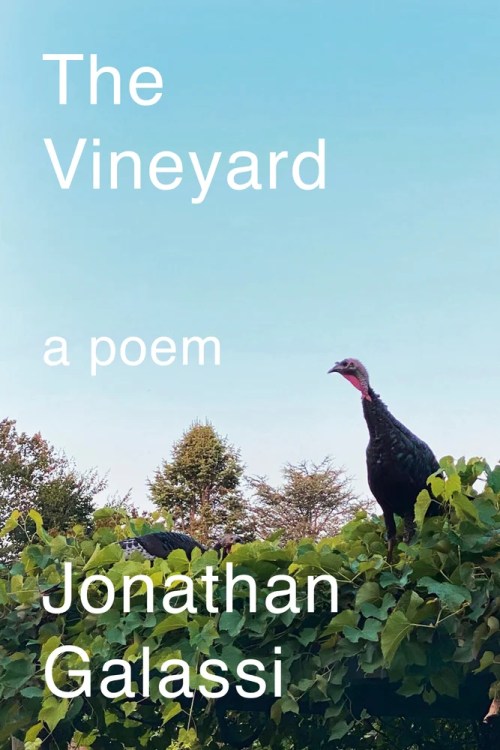
Poetry
The Vineyard
By Jonathan Galassi
Knopf
Published March 3, 2026


