


There are many names for very short prose pieces in the literary world: flash, short shorts, sudden, micro. In 2017, Beth Ann Fennelly published a nonfiction collection titled Heating & Cooling: 52 Micro-Memoirs. So what exactly constitutes a micro-memoir? In Fennelly’s hands, it’s a species of extremely short personal essay—ranging anywhere from a single sentence to a few pages—that makes use of tools from a variety of genres: the compact lyricism of the prose poem, the dagger-like sharpness of the aphorism, and the setup-punchline structure of the joke.
In these brief pieces, Fennelly offered vivid, compact glimpses into her marriage, family, daily life, and memories. “Married Love, II”—part of a series that ran through the book—read in its entirety: “There will come a day—let it be many years from now—when our kids realize no married couple ever needed to retreat at high noon behind their locked bedroom door to discuss taxes.”
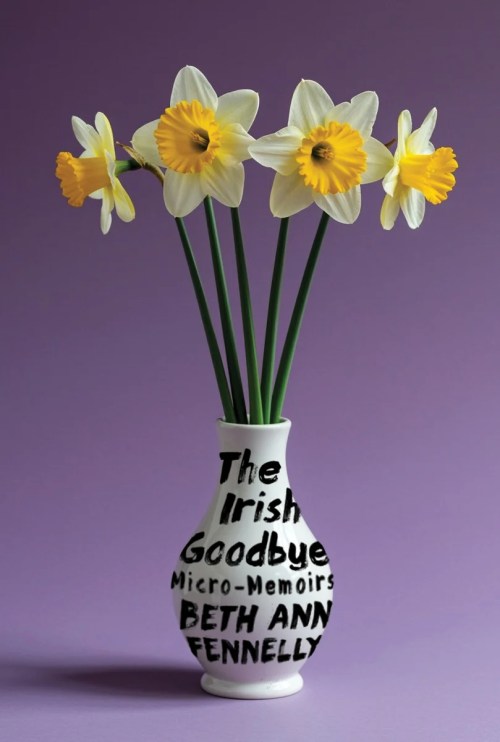
Fennelly’s newest collection, The Irish Goodbye: Micro-Memoirs, is not exactly a sequel to Heating & Cooling, but it certainly showcases the form that she refined in her previous book. “Married Love: Sweet Music,” a new entry from the series that originated in Heating & Cooling, uses the same single sentence structure: “When, on our twenty-fifth anniversary, to present me a ring, he drops to one knee, it cracks.” Through the image of one creaky joint, Fennelly shows how the ultimate promise of a long-term romantic relationship is a shared agreement to fall apart together.
While many of her micro-memoirs in the collection take advantage of this kind of wit, Fennelly also uses the brevity of the form to navigate the pain of loss. The “Irish Goodbye” of the book’s title refers to Fennelly’s sister, who died before the age of forty. Multiple essays feature the author navigating that loss, including “Two Sisters, One Thinner, One Better Dressed,” which, after describing the sisters’ intertwined love for each other and rivalry with each other, concludes:
I’m still aware of how I look when I visit her. I live in a different state now, so it’s not as often, but when I’m back in Illinois at our mom’s house, I always end my run by visiting her. I stand panting in the grass at my sister’s feet. I’m aware of how she sees me, huffing clouds from my lungs, my legs strong, my skin bright with sweat in my new running clothes. Still showing off, I suppose, as she’s stuck wearing the navy suit I chose the last time I styled her, a suit now thirteen years outdated, though fashionable enough when they closed her casket.
These essays are peppered throughout the book, and their form mirrors how we live with grief—how it pops in and out of our lives, often at random, less like a sea we must traverse and more like a patch of bad weather we can’t predict.
Ultimately, the book’s micro-memoir subtitle is a bit of a red herring—some of the memoirs in The Irish Goodbye aren’t very micro at all. And these non-micro-memoirs (also known as regular-sized personal essays) are some of the highlights of the book, preserving all the keen observations and winning charm of their micro cousins, while adding narratives that enrich the collection with new breadth and depth.
In one of those full-length essays, “The Stories We Tell About the Stories We Tell,” Fennelly describes her time living in the Czech Republic, where she had taught English in the early nineties after graduating from college, and a subsequent return two decades later. Her younger self thought living abroad in post-Communist Central Europe would be romantic and full of adventure:
In the Czech Republic, these uprisings appeared especially sexy, as they were led by people my age, students, workers, and actors, inspired by a persecuted poet-philosopher-playwright, Václav Havel… I’d do my part to nurture the Velvet Revolution, help freedom triumph over tyranny. I’d be able to give back a little. And I’d have a bit of a lark while I was at it.
Fennelly’s destination in the Czech Republic, however, wasn’t as sexy as she’d hoped. Instead of Prague with its cafés full of artists and expats, she’s sent to Silesia, a coal mining region on the Polish border that was “depressed, industrial, and still heavily Communist.” She loves teaching but is the only English speaker in the city. Because Czechs have trouble pronouncing her name, she’s called Američanka—“American woman”—which Fennelly notes is pronounced unflatteringly as “Amera-CHUNK-a.”
As the months go on, she battles the dual weight of “feeling both ignored and scrutinized.” Her Czech colleagues are distant. She returns to the United States a year later, unsure what to take from her experience. On her trip back, twenty-one years later, to give a reading at the U.S. Embassy, she takes the long train trip to Silesia, only to find her formerly standoffish colleagues are warm and pleased to see her. Her visit gives her the opportunity to reconsider that formative year abroad and her own memories of the past.
The chance for that kind of contemplation wouldn’t be possible in a micro-memoir. And a big part of Fennelly’s felicity with short forms is understanding when not to use them. A novel form can offer new artistic paths, but sometimes the old paths are just as good too.

NONFICTION
by Beth Ann Fennelly
The Irish Goodbye: Micro-Memoirs
W. W. Norton & Company
Published on February 24, 2026


