


When American poet John Berryman (1914-1972) published His Toy, His Dream, His Rest in 1968, it was, as far as anyone knew, the capstone to his idiosyncratic collection of “Dream Songs”—free verse set in a form of his own devising (three six-line stanzas, irregular rhyme scheme) concerning the pained, potentially suicidal existence of a character (white, middle-aged American) named Henry, who may or not be the poet in disguise, and his unnamed friend who speaks in Southern black dialect, occasionally dons blackface (along with Henry?), and for some reason calls Henry “Mr. Bones.”
For those unfamiliar with these anguished, brilliant poems—yes, it’s a lot.
Before the Dream Songs of Toy there were the 77 Dream Songs, the initial offering that won Berryman a deeply-appreciated Pulitzer Prize. Today, the position of the poet and his Songs in America’s 20th-century literary canon is, well, tricky. Berryman’s books have stayed the course among poetry-reading people, even garnering spotlight attention from HBO’s hit series Succession, each season finale lifting its title from a phrase in his famous “Dream Song 29”: “There sat down, once, a thing on Henry’s heart…” However, what might be cultural appropriation, even out-and-out racism, is not an easy aspect of the poems for some readers to glide past; it’s a striking component calling for a host of cultural and aesthetic questions.
Award-winning poet Shane McCrae (New and Collected Hell: A Poem) adds his name and editorship to 152 formerly unpublished Dream Songs now gathered under the title Only Sing. The American epic that McCrae believes the Dream Songs en tout should be understood as will undoubtedly go on perplexing and provoking as long as it’s in print. McCrae himself believes its polarizing racial element is not a personal failing of Berryman (along the lines of, say, T. S. Eliot’s ‘squatting Jew’) but an “essential,” conscious, artistic statement. Berryman, he contends, “did not allow [his own] whiteness to be the [poem’s] default position.”
I had the great pleasure recently of interviewing Shane McCrae on Zoom. Our interview has been edited for length.

Ryan Asmussen
Why has it been the case that so many of Berryman’s poems have been allowed to sit, unedited, uncollected, in boxes at the University of Minnesota?
Shane McCrae
You know, when I’ve thought about this, I’ve thought about that two-volume edition of the poems of T. S. Eliot that came out about ten years ago. Volume II consists of a lot of poems Eliot included in letters to friends, most of which, I think, can be ignored. But, Volume I includes a great number of poems he seems to have taken quite seriously that were just never published. They’re not necessarily up to the standards of his best work, although I like some of them quite a bit. The way things should have happened was that as soon as Eliot died [1965] someone should have started editing that work together and within five or so years we should have gotten all his complete poems, as opposed to getting all this unpublished work in the 2010s.
Now, I love Berryman. I think Berryman is a major American poet. But Berryman is not T. S. Eliot, a poet who had a civilizational impact upon the English-speaking world. So, if it takes decades after Eliot’s death for his complete work to get published—and I have no doubt, actually, that it’s still incomplete—then it doesn’t shock me that there are so many unpublished Berryman poems this long after his death. It largely has to do with poetry’s position in our culture and with the way readership has changed in recent decades. I think that the distance in time between a poet’s prominence and their vanishing can now be incredibly short, whereas in the past it took a good deal longer for such a thing to happen. If poetry were more central to our culture, if more people in general read, and if more people enjoyed the pursuit of difficulty, Berryman’s and Eliot’s complete works, the complete work of any number of other poets, would be published more quickly.
Ryan Asmussen
Your editorial attitude to his poems was one of delicate respect. You mention in your introduction you didn’t want to impose your will on them individually, as well as on their overall order. Can you tell me why you felt so strongly about stepping back this much?
Shane McCrae
As I was sitting around waiting for some of these Songs to be published individually in advance of the published book, occasionally I would get a response from a journal to which I had sent the poems. It would be something along the lines of, we’ll take the poems, but, you know it’s our house style to punctuate something this way or to capitalize lines in a way that’s uniform, etc. And my thought was always, well, no, that’s not what he wrote. Reproduce the poem exactly as he wrote it. If Berryman were alive to see this poem into print, I have no doubt there would be a collaborative process between him and any number of editors. But since he’s not alive, there’s no more room for movement. The poems can’t be changed except in the case of very obvious errors. They are what they are. Berryman picked up certain punctuation habits overseas that aren’t the American style of doing things, but you must do them the way he wrote them. At least once, I encountered a word that I couldn’t find any source for. I thought it might be a typo for a pair of words, but because I couldn’t be certain since it could have been a nonce word that meant something I didn’t understand, I had to reproduce it as he wrote it.
There’s at least one poem that almost certainly ends before the last line he has on the page. That last line is dropped down and almost looks like it’s a note towards something else. Berryman was very careful about his typescripts, and the poem I’m talking about is in typescript, and in the typescript we have what seems to be the ending, and then this fragment of a line dropped below. There is no evidence that you should do anything other than include that with the poem. So, I included it with the poem. Some editors might have a heavier editorial hand. They might remove that line. But, I don’t feel comfortable doing that. I feel that my job is to honor the archive as closely as possible. And so, along with making very, very, very few changes and only in the case of very obvious errors, I put them in an order according to first line because I wanted an order that, once I set it going, would simply produce itself until it got to the end, and I wouldn’t then have to make choices about where things should be. I wouldn’t try to assemble a narrative that maybe Berryman didn’t intend. Interestingly, and I don’t know if you had this experience reading it, I do feel that it starts where maybe it should start, at a place that feels like a beginning, and ends at a place that feels like an ending.
Ryan Asmussen
Let’s talk about the issue of race, about blackface and Mr. Bones and Southern black dialect. You write convincingly that Berryman regarded race relations as perhaps the central problem for white America, the obstacle that his epic hero, Henry, must pass through. But, for some readers and critics, Berryman’s appropriation of this kind of minstrelsy is a genuinely contentious, even offensive, aspect of the work.
Shane McCrae
I think it’s difficult for contemporary readers of a certain age—I want to say people 30 and under—to conceptualize, certainly if you haven’t much engaged with American history or read books that are 100 years old or watched older movies, to really understand how much space the racial-other occupied in the white imagination in America, particularly in the early part of the 20th century, in a casual way. Often, just in conversation, in perfectly ordinary letters, white people would use words that we would no longer use under any circumstances. This kind of language, racial slur, mockery, joke, peppered into everyday conversation. The presence of racial difference seemed to take up a lot of space in the white imagination. To my mind, knowing Berryman’s personal history, I think there’s evidence that, when Berryman utilizes blackface, he’s not doing it for sonic effect or anything like that, but because he’s representing that huge space in the imagination that the racialized-other takes up.
Particularly when you’re dealing with a psychological epic, if the imagination is the poet’s source, then it makes perfect sense for that source to speak in the language of an “other” that occupies considerable space in that imagination. I think this is Berryman’s attempt at an honest representation of the white mind, a representation of the mind of the figure he’s trying to represent. And I think that laying that bare means he’s trying to find how to show the struggle through such questions and concerns, to show how much room that struggle occupies. He’s not writing as if racism isn’t a thing. He’s not ignoring anybody who isn’t white, which any number of his peers did, who, when they did mention non-white people, it was often in thoughtless and off-handedly offensive ways.

Ryan Asmussen
You argue that his Dream Songs in their entirety make up an important American epic. I have to admit, when I first read this take, I was a little baffled by the argument. I’d never seen the Songs that way before. For me, they burn too individually. Now, I understand your point. How do these Songs qualify in this way?
Shane McCrae
Our conception of what epic is, in a cultural sense, very outdated. I think that for the most part it’s not a dead genre, but it is a genre that’s almost dead. The only way we can write comparable poems in the genre of epic, the way that the Songs choose to do, is to write them in ways that are contemporary. The epic was shattered culturally probably by Ezra Pound’s “The Cantos.” One of the interesting side effects of certain modernists’ work was that the propositions of their poems were presented in such a way that other poets felt irresponsible not to write them according to the terms the modernists presented them. Ezra Pound’s definition of an epic as a poem including history, and his cantos like a huge, formless grab-bag of history, contributed to the 20th-century poet thinking, well, if I’m going to do an epic, it has to be fragmented, it has to come in small parts because this is what Pound and Eliot did. Those poets suggested that culture itself is fragmented. And so you get the successful 20th-century epics as piles of fragments.
I think that Berryman’s epic is very successful. One tends to think of an epic as culture- or nation-founding that features a hero and his struggles. The struggles of that hero can be in any number of set pieces, but the thing that matters isn’t that the hero is struggling towards some foundational thing. Berryman’s epic is very much a 20th-century epic, not only in that it’s fragmentary, but also in that it’s, in some sense, a psychological epic. The struggles of the hero, Henry, are internal struggles dealing with his various kinds of suffering. He is struggling toward something like the establishment of a foundation for a future life, which is one of the reasons why I think the poem ends the way it does with a reference to his daughter. The point from which the future must take shape is always the next generation.
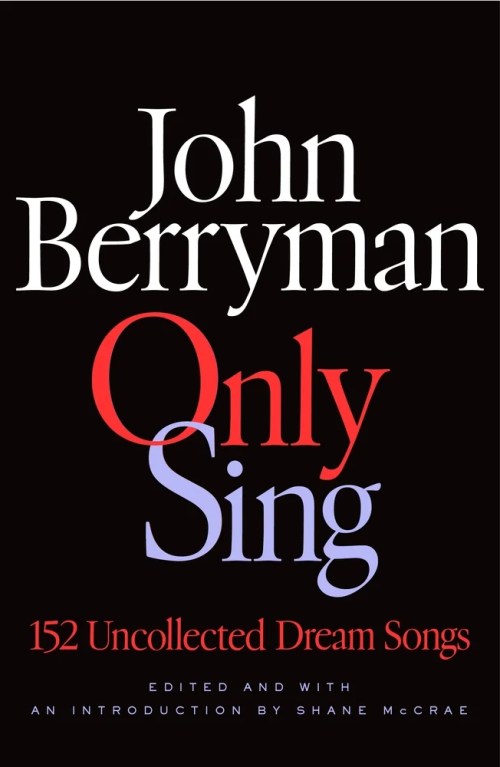
by John Berryman
Edited and with an Introduction by Shane McCrae
Farrar, Straus and Giroux
Published on December 9, 2025


