


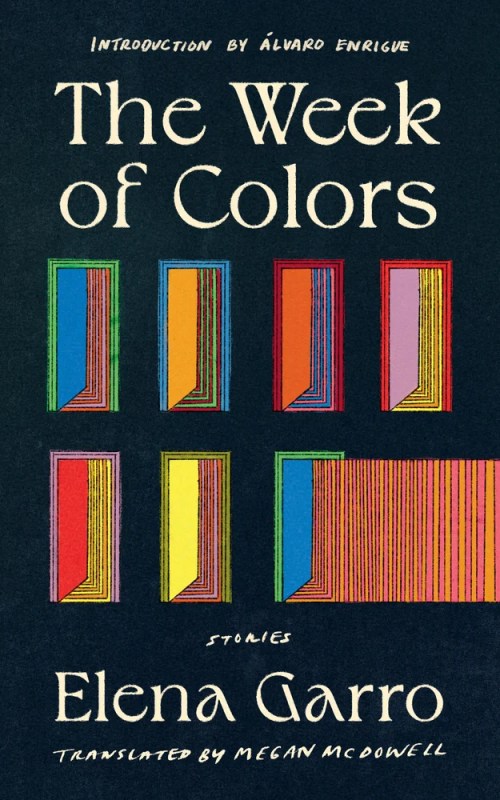
Elena Garro wrote among the milieu of Jorge Luis Borges, Adolfo Bioy Casares, and Gabriel García Márquez. An early crucial figure in the then-burgeoning genre of magical realism, her works have gone under-translated and under-appreciated. The Week of Colors, originally published in 1964 as La semana de colores, is finally translated by Megan McDowell here.
Álvaro Enrigue introduces this collection. In sharing context for the stories that follow, Enrigue explains that in 1968, Garro would be accused of being an instigator of the famous Mexican student uprising that threatened the upcoming Olympics and that the government was determined to stamp out, leading to the disastrous Tlatelolco massacre. Following this accusation, Garro denounced leftist intellectual ideas and gave up lists of names to politicians; she would run from this act for the rest of her life, in self-imposed exile, disliked by all sides. This collection was published four years before this momentous turning point in Garro’s life, and yet fascinatingly, the figure of the traitor, and the mood of the exile, permeate Garro’s stories.
In “It’s the Tlaxcaltecas’ Fault,” Laura, a woman slipping between two marriages across time, tells her servant Nacha, “I’m like them: a traitor.” She asks Nacha if she too is a traitor, hopeful: “If Nacha shared her traitorous nature, she would understand, and Laura needed someone to understand her that night.” “The Tiztla Theft” features a young girl whose lies to a maid lead to an attack on her family’s estate. After the attack fails to unearth anything to steal, the maid is beaten by her fellow conspirators; she and the girl end up agreeing not to give each other up. But the girl is castigated both by the maid for her lies and by her family and the police for hampering an investigation.
Both sides, in these stories, attack the traitor; there is no way to win, no place to find refuge. This feeling of being lost, in-between, permeates many of these stories. In one of the most powerful tales, two sisters play in their garden. One of the sisters eats a poisonous leaf by mistake, and panicking at the thought of going somewhere without her sister, convinces her sister to eat one too. Her family is horrified by her attempt to kill her sister, but the context is missing completely from their judgments: it was an act not of cold blood but of a fierce longing.
Love in these stories is a difficult thing, overflowing with feelings of betrayal, with anger and harsh words and even violence, yet impossible to cast off. A woman waits for her lover at a hotel, insistent every new day that her lover will arrive that night; a charitable woman battles her lover in an absurd series of events. Magic overlays the world, particularly in a series of connected tales featuring the two sisters, Leli and Eva; a protective layer, in some cases, against the horrors of reality. An old man thinks of a woman in the city who may need him; he sets back out for that refuge. The children let their days split in two; in one day, they’re dogs, playing alongside their family pup, while in the other, a violent act stresses the household.

The magic gives the reality a gloss, a hope of avoidance, a powerful act of trying to make the world and its harsh realities more manageable. At several points, the horrors hiding in the spaces between the sentences of the text are stark; the readers are given a peek into them, and that peek is plenty. Garro uses magical realism to its fantastic early strength, giving every tale an extra charge of starkness, of honesty, precisely by obscuring it with the surreal. Characters feel and yet also bury their shame, fear, and anger under this layer of strangeness, and so are able to continue their lives, one step after another. Garro would go on to be castigated by both sides of a political battle; caught in-between, pushed back-and-forth, constantly running from an unseen force. Her writing seems to see into this future, playing with the in-between, ambiguous, and fog, and better illuminating the harsh realities her characters face in the process.
Fiction
The Week of Colors
By Elena Garro
Translated by Megan McDowell
Two Lines Press
Published November 11, 2025


