


Daniel Burnham’s famous 1909 “Plan of Chicago” imagined grandness, prosperity, and all kinds of loveliness for the burgeoning city. Wider streets. Civic enterprises. Expanded railroads and harbor facilities. He said, in essence, “Close your eyes. PICTURE this!”
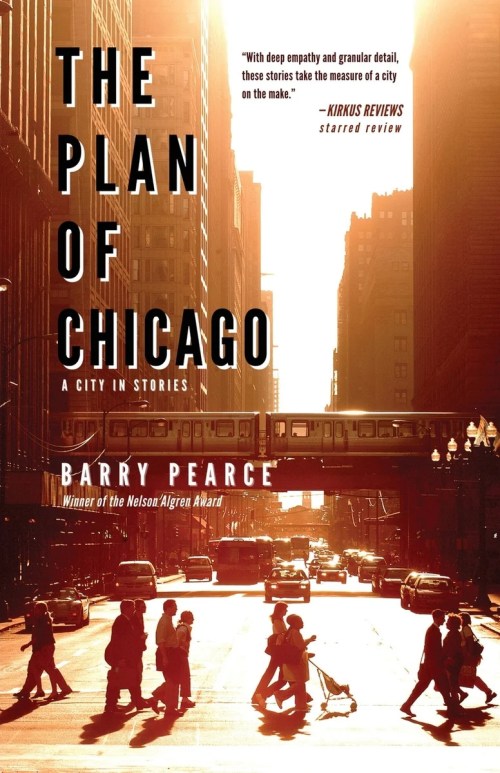
Barry Pearce’s The Plan of Chicago: A City in Stories assesses more than imagines the city. He does this through the city’s landscape, but also its people. Pearce picks up Burnham’s dream more than a century later, stringing together nine lengthy short stories that shatter the illusion of urban bliss. He says, in essence, “Open your eyes. LOOK at this!”
Pearce’s protagonists take us on a tour of a city filled with quiet desperation, an ice pond whose surface conceals ever-expanding micro cracks. These characters—many first- and second-generation immigrants—grind out their existences as census workers, contractors, undergraduates, grifters, claims adjusters, rape victim advocates, and waiters, all the while meeting jagged obstacles to any kind of upward mobility.
This is Nelson Algren territory, or at least Algren circa 2025. Pearce clearly comes from a long, illustrious line of Chicago’s gritty urban realists, including Stuart Dybek, who wrote a flattering blurb making just such a comparison. He wrote, “Pearce’s book rises from the foundational sense of Chicago as [a] city of neighborhoods. Neighborhood is the level where the great urban themes—race, ethnicity, minority culture, assimilation, inequality, democracy, the American Dream—that elevate the work of writers like Algren, Brooks, Bellow, Terkel, Cisneros, and Kotlowitz have been expressed, a lineage to which this book belongs.”
The poor and criminal, in Pearce’s collection, as in much of Algren’s fiction, star in these stories. The extraordinary “ordinary,” as in Studs Terkel’s books, also appears on the call sheet. So too do the immigrants, as in Sandra Cisneros, and the dignified, as in Gwendolyn Brooks. There are characters with the intelligence and guts of a Saul Bellow creation. But to characterize any of these fictional creations as heroes is an overstatement. Racism, misogyny, homophobia, alcoholism, and garden variety ignorance inform the plight of these characters, as does a social construction in which the underdog stands little realistic chance. The “haves” operate in a world insulated from the “have nots,” and though the two sometimes cross there is little interest in a real collision.
Each of these nine stories is, of course, an entity unto itself, and each is excellent in its own way. “Enumerator” tells the story of Polish immigrants unable to rise above the scuffling life they found when they first arrived in Chicago. Margaret, abandoned by her husband, traverses the city seeking out, for official census records, unaccounted transients. Margaret’s haunting impression of a hidden Chicago population speaks to Pearce’s interest in the despair buried beneath the surface. She narrates, “I saw what was not there because difficult work on a dark night awakened my imagination, because I encountered so many with so little between them and the street. It was hard to see them, and even harder to see how little separated them from me.”
All nine stories invoke, more than reside in, particular neighborhoods. We never make it to a lot of the neighborhoods highlighted in subheads like “Schorsch Village” and “South Shore,” though for the protagonists these particular places are embedded in the fabric of their beings. Pearce’s portraits of these various neighborhoods demonstrate the interrelationship between place and circumstance, but also show a fluidity in how characters navigate the city. In the second story, “Out of Egypt,” 13-year-old Izzy recovers from an injury incurred during a father-son scam gone awry. As he lies in a hospital bed, the adolescent Izzy mentally toggles between his mother’s simple East Side residence in the low 100s and his con man father’s place in Schorsch Village, which “sat on the edge of Schiller Woods, between two malls—HIP and The Brickyard—with perfect lawns and houses laid out neat as the plastic ones on a Monopoly board.”
That’s the thing about Pearce’s “a city in stories”: it’s a bunch of unique locales within the same locale, and we need not leave its boundaries to experience a spectrum of lifestyles. It’s telling that Izzy’s mother works two minimum wage jobs—she cleans houses and draws blood—while her father cheats and gambles. The collection examines life at both margins, but finds little middle ground (or maybe middle class). Choices in these stories tend to be lose-lose, except in the case of the privileged. “Chez Whatever,” a Nelson Algren Prize-winning piece, contrasts affluent Lincoln Park (as well as Lake Forest) and poor South Shore; two female lovers, one white and the other Black, outwardly seem to share circumstances (young, artistic-minded, educated) but really operate in entirely different universes.
That said, the stories, together, represent a broad range of Chicago voices. Pearce, through his narrators, inhabits the interior lives of characters female and male, gay and straight, poor and rich, Black and white and brown. Don’t think that “Chez Whatever,” or any of these stories, exists as a progressive polemic on race or the working poor or any such well-trodden territory. Pearce seems more interested in how place shapes or fails to shape the stories of people rooted in doomed histories. We see a lot of characters who need help, and a lot of characters who try to help, but what lies between is what makes the difference between status quo and progress.
“Chez Whatever,” a study in points of view, is as much a piece about the nature of storytelling as anything else, an exploration of how our personal narratives come to shape and reshape our experiences. “The distant perspective brought the girl into focus, but it made her uncomfortable, as if she was watching herself, or someone else, through the wrong end of a telescope.”

Maybe what impressed and interested me most about this collection was the way Pearce plotted, in a kind of tangled web, the interior and exterior stories. In most of these nine pieces, I found myself quickly settled into a narrative whose arc seemed sure, even predictable, only to find that my assumptions were wrong. “Lost and Found,” a story subtitled “Gold Coast,” ingeniously gives us access to a Somalian refugee cab driver and an intolerable, older wealthy woman. We get inside the fear and danger on both sides, and how prejudice—even among those fighting hard to rid themselves of it—undermines, maybe punishes, simple kindness. In such a world, we see how outside, or societal, influence might overwhelm both the powerless and powerful into doing other than what they feel is just. “Swing Night,” set at Bucktown’s “Green Dolphin Street,” promises scintillation, but ultimately leads us down a path in which fatigue as much as curiosity results in sexual experimentation. In “Creatures of a Day,” we understand the source of a couple’s tension only when, movement by slow movement, we understand a backstory in which a seemingly moral, charitable, and sensitive man sexually assaults a woman—the interior plotting is such that we palpably sense how that single moment has informed every subsequent action, and how it will continue to do so.
These stories are smart and precise, and persistently imbue the reader with a sense of the fragile ecosystem that impacts our quality of life. The Rogers Park condo in “Creatures of a Day” takes on its own personality in defiance of its lake view and private beach access, as if the history of a building somehow infiltrates its occupants’ marrow. In “Chief O’Neill’s,” a modest defiance of prevailing (nay, unanimous) bigotry overturns a comfortable, safe existence, the anti-hero Sully cast out from the only community he knows. Pearce excels at portraitures of people in situations outwardly acceptable but inwardly on the verge of collapse.
These stories build one upon the other. Better yet, they support one another. Pearce’s Plan of Chicago, unlike Burnham’s, shows a city consciously excluding one class from another, deliberately erecting invisible barriers and confusing detours. Despite the serious, often somber, tone of this collection, Chicago still comes across as a place to love, to be, only with maddening conditions and pre-conditions that leave us with a feeling that we might need a new plan, or at the very least admit it’s time to tweak the old one.
FICTION
The Plan of Chicago
By Barry Pearce
Cornerstone Press
Published November 11, 2025


