


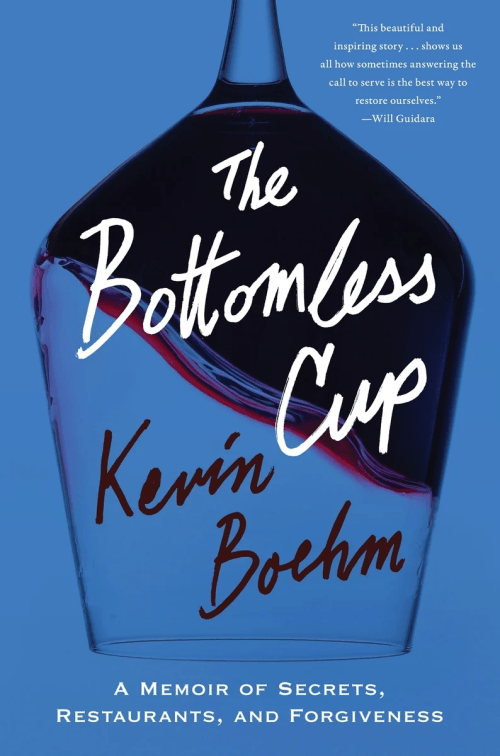
We love restaurants. Culturally, we’ve come to worship at them, following chefs like cultists follow gurus. For three decades, restaurants and the chefs behind them have been the center of competitions, from Iron Chef to Top Chef, to Netflix’s off-brand cooking competition shows. The common thread throughout this love affair with dining out has been the back of house staff. There’s mythologizing the line cooks who work their way up the brigade, building careers one reality show win at a time. In Kevin Boehm’s memoir, The Bottomless Cup, we are served up a refreshing look at what it takes to succeed in the restaurant business, but from the perspective of the front of house and business side of the industry.
Boehm is currently a partner in the Boka Restaurant Group, a Chicago-area business operating almost two dozen restaurants, mainly at the high end of dining experiences. He won a James Beard Award in 2018, and his numerous restaurants have won best-of titles. But Boehm hasn’t always been on top, and if there’s anything to take away from his memoir, it’s that the restaurant business is a roller coaster.
Boehm began his career in the sleepy beachside of Florida’s panhandle. He lived and worked just outside of Seaside, famous most of all as the set for The Truman Show. Saving up his earnings as a bartender and server, he launched a casual beach cafe. Eventually he sold this and moved on to Nashville, before returning to his home in the greater Chicago area.
Incredibly, the more interesting thread woven through this memoir is not the success and failure of his restaurants, but the complicated relationship between Boehm and his fathers. The book opens with a confession. His mother’s long-time friend, Woody, informs the 18-year-old Boehm that he is actually Boehm’s biological father. This fact has been successfully hidden by Boehm’s mother, both from Boehm and from Larry, her husband and the man Boehm considers his father. Suddenly, the difficult relationship Larry and Boehm share seems to make more sense, another complication that follows Boehm through the memoir.
Nevertheless, despite this centralized thread, Boehm works hard at suppressing big emotions in the book. There’s a frenetic energy that allows only a superficial reflection on the events transpiring, and it feels like an intentional way of avoiding some of Boehm’s bigger feelings. There’s one evening when Woody shows up at Boehm’s then-successful restaurant, where Boehm introduces him around, seemingly showing off his success, but there’s not much of a deeper probe into how learning about his biological father impacted him.
Boehm also doesn’t confront Larry. Their fraught relationship is further strained when Boehm’s mother passes, and when Larry blows off his grandchildren, but we never see either of them really confront the conflicts. In a deathbed gasp, Larry offers something of an apology, but it’s a neatly packaged, Hollywood, feel-good ending.
The pacing of the memoir never allows enough space to become bogged down with Freudian analysis. The narrative, and no doubt Boehm’s actual career, has an endless energy. There’s a constant need to sate the dopamine with building something new, taking on a new challenge, or recovering from a business failure. This action does propel the story forward in an ever faster spiral. In so many other restaurant memoirs and biographies, this kind of manic tizzy would lead to overdosing and detoxing. Although Boehm acknowledges a realization that he drinks too much, there’s no rock bottom or redemption arc. If anything, there’s a sense that as he finds success, he matures into a more stable force.
The evolution of Boehm as a character begins as one of youthful lusting, aspiring to build a career, but by the end, if Boehm is reflective of anything, it’s the realization that his career is perhaps less meaningful than some of the relationships and people in his life. “I’ve been the happy side guy for most of my time on earth,” he concludes, summarizing a subtle vibe throughout the book. From the outside, everything seems to be going great for him, but there’s no doubt a deeper conflict he’s suppressing. Even when his restaurants are winners, his personal relationships are often not. He introduces them with passion, and then they sizzle out when he moves on to the next project—and then disappear from the narrative.

In some respects, the memoir remains unfinished. Boehm was clearly writing the final chapter right up until his publisher’s deadline, referencing a dinner party he threw sometime last year. There’s a sense Boehm has plenty left to unearth himself. He writes about his wife and three children, and in the final chapters, references to his wife fall away. They filed for divorce earlier this year, no doubt after the deadline for the manuscript had passed. But while we do see the inevitable conclusion of the story of his parents, his internal conflicts with these still seem unresolved, almost as if this memoir is part of that process.
What Boehm has achieved professionally, and documented in The Bottomless Cup, is that a great restaurateur can be someone other than a celebrity chef. Surrounded by cultural references that idolize the cooks behind the food, it’s easy to overlook the importance of front of house service (at least until the Top Chef contestants make it to the “Restaurant Wars” episode). Boehm has done the profession a service, both illustrating the importance of hospitality, and reminding us that even with hard work, sometimes good luck goes a long way. The Bottomless Cup offers a fast-paced look at the restaurant world from a fresh perspective, even if Boehm has some unresolved family trauma.
MEMOIR
The Bottomless Cup
By Kevin Boehm
Abrams Press
Published November 4, 2025


