As a child, I used to trace the dark lines of my church’s stained glass windows as pastors droned on about that week’s biblical lesson. Though I tried to learn the names of Lutheran prophets or the order of the biblical books, I was always more enthralled by the fact that such absurd and extraordinary stories could bring so many people together. Maybe, then, it makes sense why I love books so much and, even further, why I was drawn to Kaethe Schwehn’s new novel, The Gospel of Salome.
The Gospel of Salome is anchored in 38 CE Alexandria. The titular character, Salome, is an incredibly talented sixty-year-old physician with a traumatic and somewhat cloak-and-dagger-like backstory, who’s now grappling with dementia. When John Mark, a Christian follower sent to spread the word of Yeshua (Jesus) to Alexandria’s Jewish community, arrives, he soon realizes that they are being segregated from the rest of Alexandrian civilization, beaten, starved, and consigned to poverty. John Mark, terrified and lost, relies on Salome and her lived wisdom to make sense of the violent and chaotic world around him.
In scenes from Salome’s childhood, she loses her mother and is left in the care of a neglectful father. After a series of harrowing events, Salome is then enslaved to a wealthy Roman family and experiences the cruelty, exploitation, and plights of first-century womanhood firsthand. While enslaved, however, she trains as a physician and healer, and as she gains her freedom and enters into adulthood, her ability to heal becomes central to her life’s purpose. Soon, Salome gives birth to a son, Yeshua, and meets Mari and Josef (biblical Mary and Joseph), drastically upending her life once again.
Essentially, there are two simultaneous plots unfolding throughout this novel: the events of Salome’s aforementioned life story and a six-day period of chaos within the New Jewish Quarter of the city of Alexandria. Salome’s memories are interspersed non-linearily within these few days, all orated first person. As a juxtaposition, the present-day plotline is narrated in third person, alternating between Salome, John Mark, Salome’s trans roommate Asha, and other orbiting characters.
Personally, I appreciate multiple POVs in a story, and I love a dual-timeline plot. Utilizing multiple narratives and time periods weaves together a really vivid tapestry of stories, and The Gospel of Salome is no exception. However, it would be remiss not to mention that the numerous perspectives on top of thenon-linear timelines did take me a while to really absorb and piece together.
The Gospel of Salome hits its stride, however, with the introduction and Salome’s narration of Mari, Josef, and Yeshua. Perhaps these biblical legends ground my understanding of the story a bit better, but they also deepen Salome’s character. Mari exacerbates a unique possessiveness and envy in Salome, Josef allows her a safe space and new understanding of comfort amongst men, and Yeshua represents unconditional love, devotion, regret, and faith. Schwehn does a superb job of drawing these traditionally unequivocally pure and holy biblical characters just as flawed as Salome and the rest of us.
While The Gospel of Salome is about the complex nature of being human, the novel’s emphasis on bearing witness as a form of both interpersonal and intrapersonal healing is extremely topical and moving. As violence and hatred towards the Jewish people in Alexandria come to a climax in the story, John Mark asks to transcribe Salome’s memories. Once Salome begins to recount to John Mark the commodification of her youth, struggles with motherhood and purpose, and ultimately her biggest mistakes, she begins to feel lighter. In finally sharing the heaviness of her regrets and transgressions—in letting someone see her amidst all she has done—Salome is able to forgive both herself and those who have scorned her.
I’ve been thinking about a specific scene since I finished the novel. Towards the end of the book, there is an intensely horrifying moment where John Mark witnesses the public torture of Jewish Alexandrians. He doesn’t know how to help the elders being persecuted and asks Salome what he should do if he cannot save them. Salome’s answer is revelatory:

“Go and see.”
Now, I’m sure you didn’t come here to hear a lecture about the madness of today’s world. With school shootings, genocides, and a general sense of empathetic emptiness running rampant, sometimes our first reaction is to turn away. But what a privilege it is to feign ignorance, to completely abandon those who need to be seen most. John Mark, though terrified, broken, and disgusted beyond comprehension, stays and bears witness to the agony of those in front of him. It may feel like we can’t do much to change the state of the world, but like John Mark, the least we can do is be with another person in their pain and pay respect with recognition and solidarity.
Stylistically, Schwehn’s shimmering prose sets a dreamlike movement throughout the piece. Her characters—though abundant and sometimes overwhelming in number—are each intricately crafted, refreshing takes of previously divine narratives, all vital to the overall point of the piece. Equal parts profound and ethereal, amorphous and grounded, The Gospel of Salome is an ornate mosaic of survival, faith, and the importance of being the savior god of your own story.
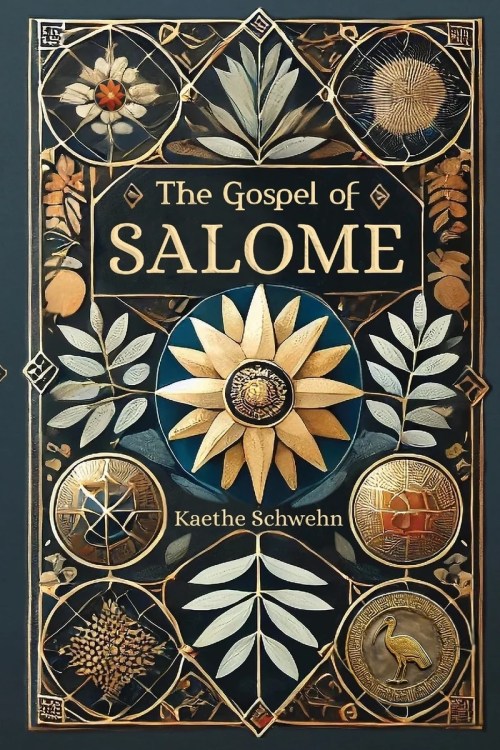
FICTION
The Gospel of Salome
By Kaethe Schwehn
Wildhouse Fiction
Published October 15, 2025