


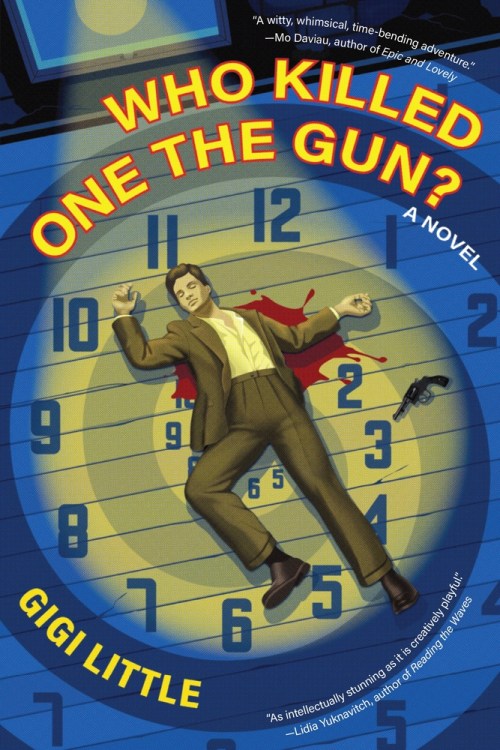
It’s Groundhog Day meets Philip Marlowe in Gigi Little’s Who Killed One the Gun?. For fans of private investigators, crime noir, and radio dramas, this delightful homage and critique of those genres is for you. Each character is named for a number and a rhyme, like One the Gun, Two the True Blue, Three the Goatee, and Four the Door.
The book recaptures the over the top similes often found in the genre like “She has got the kind of beauty that could melt the butter on your baked potato … there’s something in [her eyes] that’s seen enough of the world to turn their twinkle into something more like the dull shine of a tarnished teakettle.”
Private Investigator One the Gun is on the case to solve the death of Five the Dive, now known as No Longer Alive, who was killed in his own bar. Even as a third-rate PI, something is different about this case. He keeps reliving the same day over and over again, which gives him the chance to find out new clues. Also he’s pretty sure someone may have ambushed him the night before and shot him to death, so now he’s on the hunt for his killer.
Author Gigi Little has been a circus clown and worked as a book designer. I had the chance to talk with her about her colorful past, creativity, and wonderful new metafictional detective noir over the phone.
This interview has been edited for length and clarity.

Elisa Shoenberger
Where did the idea of the story come from?
Gigi Little
I’m obsessed with film noir: Old Time Radio detective shows and mysteries and all that. That was just sort of in my head. Through old journals, I can pinpoint the exact evening the book was born, and that was on the road with a circus in 2002, specifically on the road between Buffalo, New York and Columbus, Ohio. My ex was driving and I was frantically writing notes in a spiral because I’d just had this idea and I knew if I didn’t get it all down by the time we pulled into Columbus, I’d lose it.
[It was] the idea of characters with names that were numbers with corresponding rhymes. The first name that popped into my head, One the Gun, well, he had to be a classic noir detective, and Two the True Blue, she must be his trusty assistant. The number-and-rhyme names just streamed out as we were driving down the road, and with those names, characters, and then the notion of a story just emerged. There was something really organic about it, how I found the story in the numbers and names.
Elisa Shoenberger
What made you decide to employ your over-the-top metaphors? It’s like an homage to Raymond Chandler’s Philip Marlowe?
Gigi Little
I think Raymond Chandler was probably the one who started writing this way. But where it really comes from for me is those Old Time Radio detective shows that I listen to. They’re full of that stuff. The language is so particular and full of crazy similes and over the top old slang. I love it so much, and I just wanted to infuse a book with it. I wanted to play in that playground. I just gave myself permission to play with all of that language, and take it where it wanted to go. Radio was playing off of literature, but I’m basically taking it from radio and then folding it back into literature.
Elisa Shoenberger
What made you decide to add in the time loop aspect to the story?
Gigi Little
I think the only time loop I knew about was Groundhog Day. When I started thinking about doing some sort of a time loop story, I thought, Can I really do that? Because isn’t that just me trying to do Groundhog Day. Then I saw [the television show] Russian Doll. When that came out, I thought, I definitely can’t do the story, because now there’s two of them. Then all of a sudden I realized that it’s a whole genre. There are so many time loop stories. Once I sort of settled into that, I felt it was as much a genre as time machines.
Elisa Shoenberger
It sounds like you had this idea twenty years ago. How was it to write the book?
Gigi Little
I had this idea so long ago. I had the idea for the numbers for the names and the noir kind of setting. I started to write this book and it was terrible. It was a terrible young person book. Some of the people had different names and they were in a different story. Five and Six were in a different story. Anyway, I wrote that book, put it in a drawer, and didn’t do anything with it.
Around the pandemic, I was working at Powell’s Books. I work in their marketing department and their office used to be in the warehouse. It was within walking distance of Forest Park in Portland, which is this enormous park that goes through the city. On my lunch breaks, I used to walk up to Forest Park and I started thinking about the story again, but I just started thinking about the idea. I would take a walk and plot something out and come back to my desk to write it down. Every day I did that and made a kind of loose outline for the story.
I don’t know why I started. I think I loved the wacky naming convention so much that it’s always stuck with me. I’ve written other books and stories and various things, and it was always just sort of in the back of my mind and I always wanted to come back to it.
There was something about the pandemic that made me just want to do something that’s fun to bring joy to myself right now. So I stopped worrying about what book I might write that would be marketable. I just started playing with the ideas for myself. I went back to my roots, which were that funny naming thing that I came up with 20 years ago, plus my interest in film noir, plus my obsession with Old Time Radio and my interest in campy Twilight Zone stuff. It all came together as this way to find joy.
It’s funny, because I really needed to learn how to be a good writer. I’ve always had a rampant imagination but the actual skill of writing the book was a long-time coming. It took me moving to Portland and studying with Tom Spanbauer, who was a famous Portland writer. I actually presented him with a mystery novel when I first met with him to see if I wanted to study under him. He read the first chapter and he said write me ten pages of something you don’t quite remember. What he was saying to me was “thank you for submitting this, but I want you to write something different.”
His teaching was all about really going inside and going to your own sore places and what makes you human. That’s definitely not about murder mysteries. So it took me years and years when I studied with him to finally come back to what I had written before and to be ready to write what I think I had wanted to write before.
Elisa Shoenberger
So I read that you used to be a circus clown? Could you talk about that experience?
Gigi Little

I was a circus clown for fifteen years. I married into it, but I was not a funny clown. I used to live in Baraboo, Wisconsin. I used to live in the carriage house of the old Ringling mansions – that was our apartment. We had a storage unit in the basement, but it wasn’t in the basement. It was actually an elephant stall.
I spent a lot of time in Chicago. In fact, I once twice slept overnight in Medina Temple [now the Bally’s Casino]. They used to do the circus there for the Shriners. I would always play Medina Temple during a certain period of my career. We would always get a blizzard and so the clowns would sleep overnight in the temple because they had to wake up in the morning to do some sort of TV show that happened every year. I love Chicago.
Elisa Shoenberger
How do you think your circus and cover design careers impacted your writing?
Gigi Little
In some ways, my writing was an antidote to my clowning. The circus was a colorful world but I never really felt I fully belonged in, to be honest. I never felt I was funny as a clown or that my own colors were bright enough for the circus. When I wrote kooky stories about old-timey detectives with numbers for names, I could be funny, imaginative, and colorful. I could use humor to say things that felt important to me. I built worlds in fiction as a way to do for myself what the circus should have and didn’t.
As for graphic design, I know that my favorite design projects are the ones where I get to use my design work to emulate something else such as creating a look that mimics an ancient illuminated manuscript, a 1920s movie poster or a 1950s pulp paperback. That’s kind of what I’m doing with Who Killed One the Gun?, too. I wrote a book to mimic the language of late-40s Old Time Radio. It’s recreating something I love and doing it with care and authenticity. I could say that when I wrote my novel, it was the same thing I love the most when I’m working on a design.
Find out more about Gigi Little at her website and check out her incredible book designs.
FICTION
by Gigi Little
Forest Avenue Press
Published on October 7, 2025


