


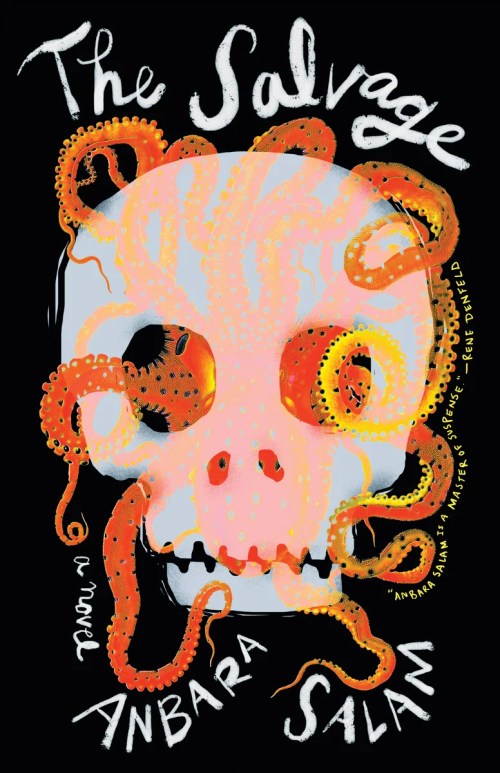
Generally speaking, my niche of books I review doesn’t extend to mystery-type stories. I find that they are hard to execute on a “literary” level, by which I mean a story that encapsulates a thoughtful or imaginative commentary on the human condition. (While there are certainly many definitions of literary fiction out there, this is what I hold to be my own.) Thus, choosing The Salvage by Anbara Salam was something out of my wheelhouse, but I ultimately felt called to it for its “gothic thriller” marketing (what better to read for the fall season?), which after finishing the book late last night I feel qualified to discuss here.
Set on a small Scottish isle in the year 1962, Marta, a singular—and notably female—marine archaeologist is hired to excavate the remains and belongings of island legend Auld James, a religious fanatic and whaleship captain who ultimately perished with his ship when it became lodged in ice in a winter past. It is immediately clear that something is not right with the ship and even the island itself, as Marta sees a foreboding and spectral figure of a man lurking in the shadows on land and sea. After photographing the items for excavation, she returns to find that all the items have been stolen. With her job on the line and a haunting past she’s trying to outrun, Marta sets off on a mission to find the missing items before her boss discovers they’re gone. On this seemingly wild goose chase of a hunt, Marta is hit time and again with coldness from the islanders, except, that is, from Elsie, a hotel worker and Marta’s romantic interest. As Marta and Elise fearfully and begrudgingly, respectively, try to track down the items, the happenings with the ghost become stranger and clearer, making its presence harder and harder for Marta to rationalize.
This book is, without a doubt, a fabulous read. I was up late repeatedly reading it, eager to find just one more twist or turn in Marta’s journey. Salam possesses great talent in her writing; her descriptions of island life are stunning and all-encompassing. It is clear that her command of language is something stellar and I’m eager to read more of her work.
To speak to The Salvage specifically, this book directly faces many things that I think it’s easy for authors to run away from. Firstly, a deeply problematic main character. Marta, for all her positive traits, bears the telltale signs of a manipulative, self-absorbed person. Instead of owning up to her past, she tries desperately to hide it, going so far as to try to infringe on the communications of others to insure they can’t discover her secrets. She cares only about her treasure hunt, consistently disregarding the needs of others in order to save her own skin. And finally, she seems blind to these inadequacies or worse, continues to make excuses for her behaviors. Somehow, some way, Salam has managed to still make Marta tolerable, dare I say likable even, because she made her a sympathetic figure—one that we can all see ourselves in in our worst moments. I felt consistently compelled to hang on to the hope that Marta was learning, growing, being forced to look at herself from a new perspective that would change how she moves forward in life.
The second thing that this work doesn’t run away from is leaning hard into a bold, nearly-suffocating setting. The island that this story takes place on is in-your-face at all times, from the weather to the villagers to the lore that inhabits the place, and it all only serves to garner intrigue towards what could have happened to Auld James’s things. The villagers feel authentic to island culture, which is to say the lack of acceptance of outsiders, but Salam strikes a keen balance in still showing their humanity and the ways in which they can save one another. The inclement weather that breaches the shores of the island for a terrible winter adds to the fearful foreboding of the ghost and forces the characters into interactions they may otherwise have been able to avoid. The setting raised the stakes in a way that I think really propelled the plot forward.
My only real complaint about this work is that repeatedly, time after time, chapter after chapter, we would hit a terrifying high point where Marta was having a scary experience with the ghost or something similar, just for the chapter to end and the next one to start day(s) later with little to no addressing of the experience she was just having. My issue with this is twofold; firstly, it stopped the momentum of the story in a way that made me annoyed as I felt like I was being pulled out the moment right at the best part continuously. The other reason I think this ill-served the book is because it took away the reader’s chance to really understand what Marta was feeling in those moments. She would briefly touch on them in the next chapter, but not getting to experience her reactions and feelings within the moment itself felt like we weren’t allowed to see Marta fully.

Despite these drops in momentum, The Salvage is a fast-paced-yet-intricate read that I’d recommend to most all readers. The language alone is miraculous, and Salam’s knack for creating a mysterious and compelling setting is enough to mark this as a favorite read of the year. The Salvage is a journey both eerie and inspiring to embark on.
FICTION
Salvage
By Anbara Salam
Tin House Books
Published October 07, 2025


