


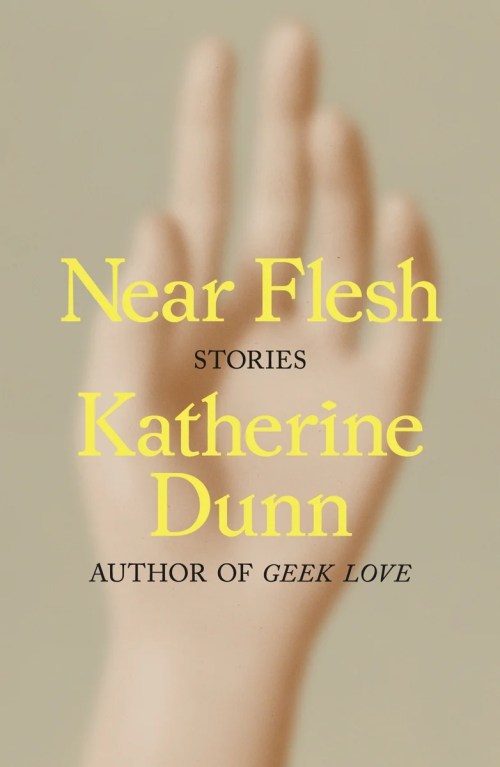
An author can live on through their writing well beyond their deaths. Publishers releasing new works posthumously has become something of a sport. Joan Didion’s journal, Notes to John was recently published, and Harper Lee, who’s Go Set a Watchman only seemed like it was posthumously published, is set to have a collection of writing out later this year (though Salinger’s mythical vault remains unopened). Similarly, Katherine Dunn, who passed in 2016, is set to have a second posthumous book published, Near Flesh, a collection of stories.
Dunn’s third novel, Toad, was written in 1971 but rejected by her publisher at the time. It was shelved for decades. In 1989, her novel, Geek Love became a finalist for the National Book Award, and a cult favorite, paving the way for Dunn to have enough significance to archive her work at Lewis & Clark College. Still, the manuscript for Toad sat for years, finally surfacing in 2022 with an introduction from Molly Crabapple. The book was successful enough that now, three years later, Dunn’s publisher has collected her stray stories into a new posthumous collection, Near Flesh.
The stories offer a wide array of style and substance. One of the dangers of collecting the works of authors, especially dead ones who cannot consult on the ordering, is a mashup of disparate narratives. There’s violence sprinkled throughout, and if pushed to identify some common thread, there are stories of desperate women living lives of quiet desperation. Several characters fall from balconies, but this feels less like a recurring trope and more like an easy out for stories never intended to be displayed side by side. Characters falling to the ground aren’t necessarily a bad narrative choice, and in each of the stories, these deaths are unpredictable and surprising, and it’s hard to fault an author for reusing a successful plot point in stories that were never intended to be collected together.
Early stories in the collection have an austerity of language that’s common in the latter twentieth century. An easy comparison is Raymond Carver’s minimalism, but also not a perfect match. Dunn’s prose comes with a cadence, a badum-badum rhythm in these parsed down texts. There’s also other structural techniques like word repetition that are reminiscent of the literary fiction of the later postwar era. But these are collected stories, not a collection, and the sparse minimalism of these earlier stories gives way to more elaborate prose, and longer narratives.
The title story, “Near Flesh,” stands out for the right reasons. Thelma Vole is set to celebrate her forty-second birthday with a quick, weekend getaway. Before departing she reviews her four sex robots wondering which model should join her on the outing. The story is weird and alluring, a little bit perverted, a little bit cynical. Thelma Vole feels like a modern character, like someone we could encounter in the stories of younger writers like Bora Chung, or Mary South. She lives in a world where sex robots are common, and her colleagues are eager for her job. It’s dystopian, but familiar too.
“Near Flesh” is the most entertaining story of the collection, but borrowing its title for the collection feels misleading, a promise of a collection more situated in the near future than the past. As a story, “Near Flesh” stands out from the others in the collection in part because it captures a more modern sensibility about it, a world disturbed and unsettling. Whether it’s because of Dunn’s style, or simply because some of the stories are decades old, reading others from the collection creates the sense we’re reading out of a time capsule. That’s not to say the stories lack relevancy, but it’s hard not to acknowledge that the works are at least a decade old.
Dunn does show, if not an obsession, an affinity for disembodiment. Multiple people fall to their deaths, but also characters lose limbs and others are impaled. In the opening story, “Pieces,” John’s entire family is afraid of missing pieces of their body, believing they are required to ascend into heaven. And so throughout the story, detached body parts are stored. This short narrative does set our expectations for the rest of the collection; expect the unexpected.

The stories in Near Flesh, generally hold up despite revealing their age. There does seem a haphazardness to pulling them together, but it’s inevitable with a posthumous collection of stories. It’s the last chance at life for most of these characters, and their differences aren’t so great in the end. Dunn’s characters suffer, but there’s no universal truth among them; some are punished, some find an exit, and others end up on the sidewalk below. For the enthusiasts who have created Dunn’s status as a cult icon, no doubt this collection will fulfill their desire for a complete body of work. Individually, the stories are tightly edited narratives exploring a variety of themes, but they lack the cohesion we’ve come to expect in story collections.
FICTION
Near Flesh
By Katherine Dunn
MCD
Published October 7, 2025


