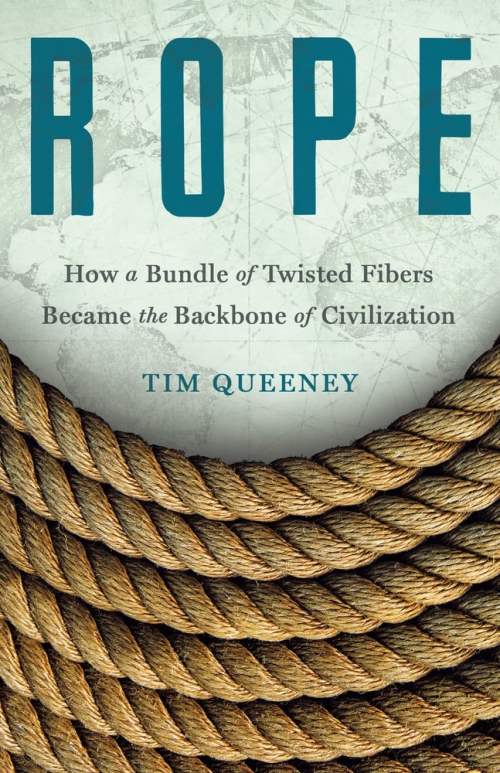
History through the lens of an ordinary object has become a common framework for nonfiction narratives over the two decades since Mark Kurlansky’s Salt popularized the genre. A wide range of these books now exists dealing with items like Eyeliner (Zahra Hankir), Rats (Robert Sullivan), Debt (David Graeber), Ice (Amy Brady), and even Paper (also Kurlansky).The latest in the genre is Tim Queeney’s Rope: How a Bundle of Twisted Fibers Became the Backbone of Civilization.
Rope begins at the dawn of civilization. Queeney launches the narrative with a fictionalized account of the last moments of life of The Iceman, the 5,100-year-old, frozen body of an early human who died in the Alps while fleeing pursuers. The Iceman was discovered in 1991 as a melting glacier pulled back the layers of history. Queeney imagines the scene of his death, how he became the victim of an arrow. Arrows, an early human tool, are propelled by the force created by pulling a rope strung up in a bow. In this scene we are reminded how essential rope is to civilization, and how it’s a fundamental tool we often take for granted.
Queeney tells the broad story of rope through small vignettes like The Iceman, highlighting the usefulness of the object through moments in history. The book is organized both through time and by rope’s function. The use for rope often evolved simultaneously in different cultures, and the chapters highlight the parallel evolution. It’s an essential tool in boating, fishing, sailing, punishment, ranching, climbing, and many other areas of life, both commercial and recreational. Queeney begins the journey through history in the ancient world of pyramids and ends in the near future of space elevator technology.
Rope does explore the materials braided together to form the title object and how they have changed over time. The early natural fibers made from products like wood and hemp give way to modern materials like rayon and carbon fiber. However, this is less a history of rope making than an examination of how rope impacts the world, and there’s not much in the way of explaining how humans first learned to turn fibers into rope. As Queeney points out, the fact that these early fibers decompose makes studying them difficult.
As time progresses, alternative ropes including steel, petroleum-based fabrics, and graphene are discussed in terms of their adoption by certain industries. Here it might have been helpful to see more in terms of how the production of materials came into use in part because that would have contextualized the historical uses. However, in terms of manufacturing the product, this is a shallow dive rather than a deep one. There is some discussion about how rope making impacted industrial areas near ship-building facilities, where long ropes required long buildings, and the dangers that rope production brought to cities. But mainly production takes a backseat to function. The shift from natural fibers, especially hemp rope, towards the petroleum-based fibers common today feels like it warrants a bigger discussion. In this regard, Rope is light on some background in the interest of moving forward to further explore the functionality.
Where Queeney excels is in finding individualized and intimate narratives discussing rope as an object and tool. One of the best of these comes from the age of sail. Sailing vessels rely on rope rigging to operate, to control how the sails interact with the wind and water, and even to anchor the ship in place. It’s here that Queeney finds a great way to infuse drama into the story of an inanimate object.
At the outbreak of the War of 1812, the USS Constitution, captained by Isaac Hull, is sent toward New York to meet up with the other ships in the fledgling American navy. But on his way north, Hull mistakenly encounters five British warships looking to intercept the Constitution. Outgunned, Hull decides to run.
The ship turns away from the British. In turning, Hull loses the wind in his sail, setting the stage for rope’s dramatic role in the ship’s escape. Besides the rigging of the ship, Hull uses rope attached to small dinghies to pull the larger ship out of range. They also use the anchor to help drag the ship along by dropping it and then pulling the ship toward the anchor. The dramatic escape illustrates how essential rope in the era was. And rope, while fundamental, is rarely thrilling, but somehow Queeney manages to create drama and suspense.
Another of the more interesting narratives involves an ancient Andean record-keeping tradition. The Inca Empire devised a system of ropes and knots for the purpose, referring to the resulting device as a khipu, translated from Peru’s Quechua language as knot. There’s not yet an equivalent of a Rosetta Stone to translate the ancient khipus, but there are contemporary khipus that might help. While not quite as gripping as the dramatized escape of a sailing frigate, Queeney has nevertheless found an intriguing, if unanswered, mystery to build suspense around rope.

The narrative feels global, with examples drawn from across time as well as across the world. We are given stories of Vikings using ships lashed with rope to cross the Atlantic, mirroring rope’s use in Polynesian canoes in the Pacific. Rope is used for stone construction in Egypt’s Pyramids and China’s Great Wall, and Gothic Cathedrals in France. If there is one complaint here it is in the lack of any connective narrative. We never see rope in conversation with various epochs. Lingering still are questions of how the knowledge around rope usage passed along through time and evolved. Yes, we can understand how essential rope was to construct the Cathedrals of France, but were these skills developed to suit the projects or passed on from ancient civilizations? Queeney is more concerned with exploring rope in isolation rather than in finding a wider narrative. And maybe there isn’t one. Maybe rope skills simply develop independently as needed, but we also aren’t told that.
Rope follows the story of an essential tool of humanity, and traces rope’s uses from the earliest examples of civilization. It’s a great introduction to rope, and draws on some entertaining examples to provide the subject with a boost of excitement. But there is a sense that plenty remains to explore. Queeney has provided us a wide but not necessarily deep look at rope’s importance. Perhaps the best measure of this book’s success is evident in how I began thinking of examples of where rope is still essential today, from tying my shoes to hanging clothing out to dry to stitching bound books.
NONFICTION
Rope: How a Bundle of Twisted Fibers Became the Backbone of Civilization
By Tim Queeney
St. Martin’s Press
Published August 12, 2025