


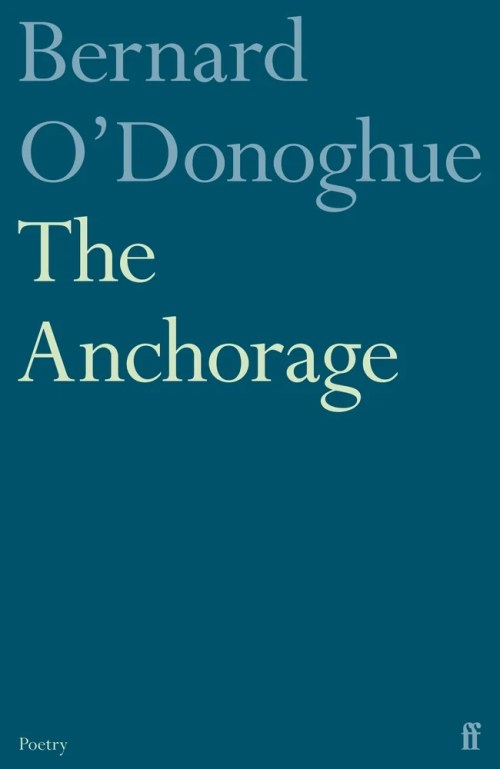
Bernard O’Donoghue’s latest collection, The Anchorage, rests squarely yet precariously on a paradox. In his own words from our interview: “[The] things that anchor you to life and the world are a surety but also a kind of hindrance.” In order to arrive at this level of understanding, a poet’s vision must be clear, unwavering, honest; it must be rooted in both the concreteness as well as the transience of things.
O’Donoghue, a large presence in Irish poetry since the 1980s, possesses an eye rooted to the individual moment, and a sure feel for nature, in all its rhythms and metamorphoses. A study of his poetry reveals a man invested (like Frost or O’Donoghue’s great subject of literary study Seamus Heaney) in the here and now, though a present shot through, as it always is, with the past. He is unconcerned with the overarching gesture, the Stevensian abstraction. Finely detailed micro-portraits reminiscent of painter Holbein the Younger’s work are his forte, his stanzas reading like finely wrought postage stamps. Whether his poem’s setting is rural County Cork or Oxford or elsewhere, he picks out the flinty contours of a particular time and space, extracting mineral veins of meaning. In the poem “Beara Skylines” from this collection, he make us see what he detects traveling by the Skellig islands by car:
If you choose the right vantage point,
around the corner northwards on this coast,
then move up the road in second gear,
the lesser Skellig will move across the greater
so it disappears as by a sleight of hand:
then slowly reappears, a pale spirit,
inviting a polite round of applause.
The mystical, the earthbound, the special visual angle, the poem and poet in motion—all elements of the work of a poet with a grasp of the lie of the land in one hand, and a feeling of disappearance in the other. Time and place are palpable, then disperse like smoke.
Bernard O’Donoghue, winner of the Whitbread Poetry Award, the Cholmondeley Award, shortlisted multiple times for the T.S. Eliot Prize, was elected a Fellow of the Royal Society of Literature in 1999. He taught at Oxford University 1971 to 2011, concentrating on Old and Medieval English literature, specifically Chaucer studies, and contemporary Irish literature. His critical work includes Seamus Heaney and the Language of Poetry and an editorship of the Cambridge Companion to Seamus Heaney. Our interview was conducted over email.

Ryan Asmussen
“Rough Plaster” and the title poem, among others, detail a frozen past, an unimprovable moment or situation, looked back upon by the speaker. The uncommunicative former occupants of your summer home, a dog frightened by fire—they represent a set-in-stone opposite of our ever-changing, in-flux present. What is the past for you? How does it inform your work now that you are a grand elder of letters (smile).
Bernard O’Donoghue
I suppose “Rough Plaster” is contrasting the negative circumstances of the past with our times, against the usual movement of nostalgia. The Irish writer Maeve Binchy said that “on balance Right Now is a lot better than the Good Old Days.” That is certainly true of the socio-economics and gender policies of my part of the Irish countryside, I think. The past is unimprovable, it’s true, insofar as we can’t change it. Nevertheless, I am very preoccupied with the past; everybody is. The chained dog in the title-poem wasn’t just frightened by fire; he was burned in it. But there is a kind of idealized version of the past in the poem called “While the Sun Shines,” but that is set in the land of the dead.
Ryan Asmussen
“Rule Breakers” with its line, “the sweet poison of a chosen vow broken,” brings to mind Augustine and his pears. Does the question of original sin hold any meaning for you? Is this an idea or truth that, considering your religious background, has had any sway over your writing?
Bernard O’Donoghue
I have no patience with original sin; I think people are fundamentally disposed to be good, as William Blake says. I had a very observant Catholic upbringing and I do remember that sentimentally. It was so interesting, linguistically and symbolically. My writing is very taken up with all that, but then I was a medievalist academic, probably because I was brought up in the rich terminology of that Latinate world.
Ryan Asmussen
A possibly pedantic question about a particular word. In “Unbroken Dreams” the final quatrain reads: “It’s more secure the way things seem to be, / where you can sit a while on the concrete path / behind the house before the sun declines / below the west, into its civil twilight.” Why “civil”? After checking against the 1910 Dent English translation—admittedly not the greatest we have—the given epigraph from Dante’s Paradiso doesn’t seem to speak to it directly. How would you interpret “civil” in this context?
Bernard O’Donoghue
This is a pedantic question, but quite rightly so. “Civil twilight” is a very show-offy phrase. Technically, it means the period between sunset and the point at which the sun is six degrees below the horizon, that interesting period when the light of the sun is still visible though the sun itself is below the horizon. (In case you are interested, the period between the sun being six and twelve degrees below the horizon is known as the ‘nautical twilight.’) I am mildly but superficially interested in astronomy (medievals like Dante and Chaucer were very interested and informed about it). You are right that the phrase is not in Dante, though, so it probably shouldn’t be here. I like to drop the names of medieval writers.
Ryan Asmussen
Speaking of translation, your 2006 verse translation of Sir Gawain and the Green Knight continues to captivate readers not necessarily fans of, or even knowledgeable of, Anglo-Saxon literature. What was your principal challenge doing this work, and what do you now see, two decades years later, as its successes? What do you feel certain you managed to capture of the original?
Bernard O’Donoghue
I taught Sir Gawain and the Green Knight for over forty years, and I love it. One challenge in translating it was to decide whether to try to reproduce the alliterative language of northern Middle English (which Simon Armitage did superbly). Mostly, I didn’t do that. I think I aimed at a fairly accurate version only lightly poeticized, mainly because I taught the poem in preparation for examinations in translation. I wanted to capture the excitement of the poem: its status as a kind of whodunnit, with a remarkable piece of sexual politics at the heart of it. It also mocks its hero in a very fetching way.
Ryan Asmussen
“The Skellig Listeners,” a poem about a visit to the birdlife of those islands, seems in a central way (I haven’t been there myself) to encapsulate an entire community as well as a certain state of mind. When you write a poem like this, as opposed to a deeply space-centralized poem like “Rough Plaster,” are you at all conscious of trying to ‘get it right,’ the chosen locale, or are you concerned only with your personal perspective?
Bernard O’Donoghue
The community on the Skelligs, especially on the Great Skellig, Sceilg Michael, was an early medieval community of monks who withdrew from the world to live an ascetical life in this incredibly beautiful place, at least as we see it. I think my personal perspective is not involved, except that I see it as a place of magical beauty, which is the opposite of what is wrong with our materialist world (back to the “rough plaster” I suppose, though…)
Ryan Asmussen
How do you think of The Anchorage in relation to your oeuvre? Is this book communicating something that, for you, may be new or distinct?
Bernard O’Donoghue
I think my subjects and preferences in The Anchorage are continuous from my earlier books, especially perhaps the book called Outliving. I suppose what is new is that I am now old and soon to join the company of the people in “While the Sun Shines.” I am very sad at the thought of joining them. There is that kind of paradox that young people are often concerned with the passage of time. The nearer you come to the end the more reluctant you are—or I am—to experience it. Maybe a new emphasis here is on another, related paradox: the things that anchor you to life and the world are a surety but also a kind of hindrance.

Ryan Asmussen
My Twitter/X friend, the magnificent John Haffenden, wanted me to ask you about your co-editing of the upcoming The Poems of Seamus Heaney. How was this, I’m sure, delightful yet challenging process for you?
Bernard O’Donoghue
The great John Haffenden: a friend of mine and an outstanding critic-scholar and reader of poetry. The Poems of Seamus Heaney are approaching publication, due out in October. John is one of the great Heaneyists, and he has been helpful in all kinds of ways. I am very nervous about the book’s reception, not least because I revere Heaney so much. It’s like being responsible for the text of Yeats or Milton or Dante. It was a very privileged and delightful responsibility, but certainly challenging.
Ryan Asmussen
And in that spirit, would you share with us a few lines from Heaney’s work that strike you as particularly fine, ones that have spoken something important to you?
Bernard O’Donoghue
I have many strong preferences among Heaney poems. If I had to select just one, I would choose these wonderful lines from “The Badgers”:
How perilous is it to choose
not to love the life we’re shown.
Very perilous: disastrous even!
POETRY
by Bernard O’Donoghue
Faber & Faber
Published on August 12, 2025


