


When I think of “gay bars,” I think of Nobody’s Darling up in Andersonville—sultry vibes accentuated by dark wood and classy cocktails. When I think of “gay clubs,” a slew of late-night dance hubs down Northalsted (formerly—though still colloquially to many—known as Boystown) come to mind, complete with sticky floors and themed Glee and Gaga nights. When I think of “gay restaurants,” I wonder what that entails.
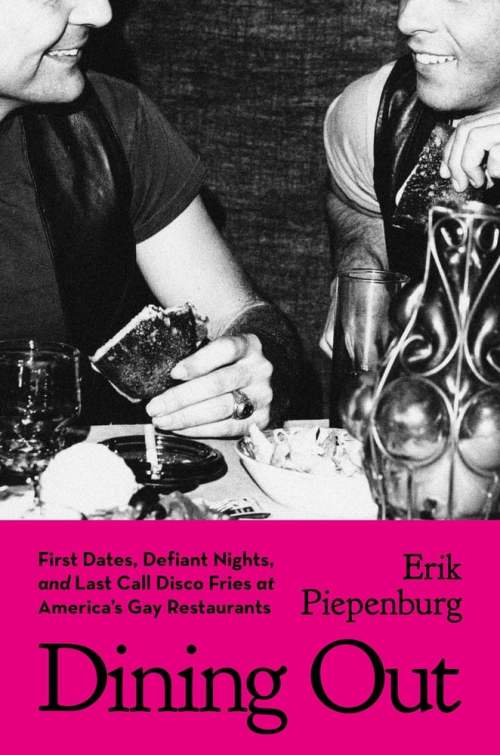
Dining Out is equal parts an investigation and celebration of queer eateries, or as author and New York Times journalist Erik Piepenburg calls them, “gay restaurants.” Piepenburg features long-standing culinary pillars of the New York gay community like Lucky Cheng’s, greasy diner hotspots for late-night debauchery like Melrose in Chicago, new wave upscale eats where queerness oozes onto the plate like HAGS in East Village, and everything in between. Dining Out is an exploration of what makes a restaurant gay and the impact that these spaces have had on queer life historically—in resistance movements, healing, savoring, loving, living, and dying.
The book’s main question, then, is what constitutes a “gay restaurant”? Is it the people who walk through the front doors, the chefs, the decor, the ambiance, or the food itself? Piepenburg would argue that it’s all of the above and more. A “gay restaurant” can look and taste however it wants, but what makes it gay is its ability to provide a safe space to be your most authentically gay self. Furthermore, a gay restaurant’s mission should be to bring queer people together not necessarily for food, but around it.
In support of this idea, Piepenburg examines the impact of restaurants on social justice movements of the 1950s and 1960s, as well as on monumental historical eras, like pre-Stonewall resistance and the AIDS epidemic. In one of my favorite chapters of the book, Piepenburg seeks to confirm whether or not a riot of flying coffee cups and glazed pastries occurred at a Cooper Do-nuts in Los Angeles about ten years before the Stonewall uprising. Legend has it that a group of queer folk—drag queens, trans women, and hustlers—fought back against police harassment in the parking lot of the once-famous donut chain, but there is no concrete evidence that says this ever actually happened. Though Piepenburg himself does not confirm the occurrence of this burning mystery, he highlights two big ideas. The first is that gay people have always resisted bigotry and homophobia, even in the face of extreme danger and brutality. The second is that much of the early resistance has been stifled and muted.
Piepenburg also underscores the incredible power and impact of gay restaurants for HIV/AIDS-positive diners amid the AIDS epidemic. Places like Florent, where the owner’s T-cell counts were displayed next to the daily specials, and Tiffany, where gay men met over a cup of coffee to talk about the implications of their diagnoses, provided comfort and community in an unfathomably terrifying and isolating time. Spaces like these allowed people to lament and cry, reunite with and remember fellow sick loved ones, while still feeling safe and taken care of.
But a gay restaurant contains multitudes. As much as they are spaces to grieve and relate, they are also spaces of unbridled and uncensored gayness. Post-shift drag queens come in full garb to share cheese fries, stunningly flamboyant divas stumble in after a night of dancing for one last cocktail, and gays on the prowl share glances as they pass each other on the way to the bathroom.
Dining Out is at once a thoroughly researched investigation of gay restaurants and their impact on the resistance movements of the past and present, as well as a dedication to the queer community that Piepenburg holds dear. His experience as a journalist is evident in the piece’s structure and voice, but so is his reverence for all those who have been othered in spaces where they should be welcomed.
Though the question of “what makes a gay restaurant?” remains fairly subjective, one thing is for sure: a gay restaurant is a place you want to be.
NONFICTION

By Erik Piepenburg
Grand Central Publishing
Published June 03, 2025


