


Many years ago, during a screening of the documentary The Business of Being Born, a woman I knew who’d recently given birth got up and left mid-film. Later, she told me it had been too triggering—her birth experience wasn’t what she’d hoped for and was in a constant mind loop of could’ve, should’ve, would’ve. I think of that woman when I find books that explore childbirth and the postpartum period with honesty, rawness, and tenderness. They’re rarer than you’d think, given the prevalence of birth. Erica Stern’s debut Frontier: a memoir & a ghost story is a welcome addition to this canon.
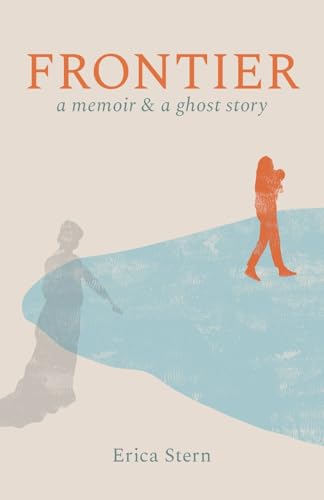
Frontier is a fascinating account that blends fiction, memoir, and research to portray the precarious landscape of childbirth, spanning centuries. Starting in a delivery room in Chicago and going back in time to the Wild West, this inventive and haunting hybrid memoir offers a chilling look at childbirth both in the present and past. It’s essential reading for anyone who wants to better understand the industrialized birth industry.
A quick event plug for readers local to Chicago: Erica Stern will be in conversation with Julia Fine on Thursday, June 5, at Volumes Book Café.
I had the pleasure of chatting with Erica Stern to discuss how she found her way back to writing after this treacherous time, the link between birth and death, and playing with time.

Rachel León:
This book deals with storytelling, and you were in the middle of your MFA program during this time (!!!), and at one point questioned if you’d ever write again. How did you find your way back to writing?
Erica Stern:
I had one semester left when Jonah was born, which was intentional. I wanted to extend my time in the program and spread out my last couple of classes. I assumed I would be back in January, about six months after my due date. After delivery, I quickly realized that wasn’t going to happen. I wouldn’t be in the right place emotionally. I wouldn’t be ready to leave Jonah with somebody else in a daycare setting at that point. So I took a full year off. I wasn’t writing at all during that time, but I was certainly thinking a lot about what happened, and that became crucial for the later writing.
I’ve always been a writer, even if I’m not physically writing. I don’t think there was ever a question that I would come back to it. Though, right after the birth, I wondered how I would make it work. On some level I think I always knew I would return to writing. I also knew it was important that I reclaim myself after that experience. I couldn’t let my whole self become a caretaker, I needed to take care of the parts of me that existed before Jonah was born. And I wanted to show my kid—especially because I had a son—that a mother can do more than just be a caregiver. It was important, from that perspective, that I go back and finish my degree and continue writing. But it did take a while. It wasn’t a quick transition back.
When I did return a year later, I didn’t finish the thesis I had planned; this book, or an early version of it, became my thesis. Before I had been writing a collection of short stories, but I couldn’t go back to those. A memoir was not part of my plan. This story was all I could write, though, and so I changed my genre by necessity. Luckily, at SAIC [School of the Art Institute of Chicago], where I went to grad school, you didn’t have to declare focus in a particular genre and so no one questioned my switch. I had taken prose poetry classes and things outside of fiction, but I’d always considered myself a fiction writer. I never was interested in writing memoir until Jonah’s birth.
Rachel León:
With the blending of genres, it almost feels like multiple books in one, though it’s very cohesive. Did it always have the multiple threads, or did they come in later?
Erica Stern:
At the very beginning, I didn’t know I was writing a book. I thought I was writing an essay. I really had no idea what this would become. Because I wasn’t a nonfiction writer, I doubted myself at first. I thought, “I have to write this story because it’s the only thing I’m able to write.” But I didn’t know what it was or what shape it would take. From my one-on-one sessions with professors, I slowly realized that it was becoming something longer and larger, and that maybe it was a book, which was a hard thing to realize partway through a project.
The initial work was more straightforward memoir. At some point, without thinking about it in advance, I started writing the Wild West sections. At first it was these little snippets that I interspersed with the main narrative. I think it came from two impulses: wanting to escape the emotional intensity of revisiting the birth, which could be intense—fiction was a bit of an escape hatch. There were also questions I had about modernity and feeling like I was closer to these women of the past. So it came from that place too, wanting to explore what it meant to feel connected to history. At some point, I realized I needed to consolidate the Wild West material because it was interrupting the momentum of the memoir. So I put them into separate sections. A lot of the revision work centered around expanding the Wild West narrative and thinking about the themes I wanted to explore in that world.
Rachel León:
Out of any time or place that you could have used to convey the past realities of childbirth, what was it about the Wild West that you were drawn to?
Erica Stern:
It wasn’t an intentional decision. It was just where I went. But I think part of what drew me to the Wild West had to do with the wildness of the place; it’s untamed. The idea of childbirth as a frontier was something I could explore through that location. I could have changed the setting in revision if I felt like it wasn’t right. But I think there’s something about the roughness of that place that really worked. It might not have been a conscious choice, but I do think it was the right one. A lot of my process is trusting my intuition in drafting, and then I do a lot of editing— it’s not like everything I put down on paper stays in the end. But I do think that letting myself go where the narrative takes me has been important.
Rachel León:
You use a lot of religious symbolism and stories from the Torah, which works on multiple levels. It acts as an anchor to the past, but also explores themes of faith—whether sincere or more like bargaining prayer—that can arise when we, or our child, come close to death. We know a mutual person, Shayne Terry, who also wrote a book that deals with childbirth/ postpartum trauma. Your book and Leave feel very much in conversation—you both highlight death in accounts of birth. I’d love to hear your thoughts on birth and death, birth as a portal, death and faith.
Erica Stern:
I love Shayne’s book. It’s so gorgeous and unflinching. And I love that her book was published months before mine comes out because they really can be in conversation.
Yeah, I think birth and death are absolutely connected. I didn’t realize this before I had a kid. There’s the intense physicality of birth. It’s brutal, and the breaking down of the body brings you to a place that’s sort of butting up against this other world. And you’re bringing some creature from an unalive place into the world—quite literally the inverse of that is death. Also I had a kid who was in an in-between place at birth. I mean, he was alive, but he needed a lot of support to breathe, to live, and to recover from his injury. And so I really was face-to-face with: what does it mean to give birth to a person who is not fully alive, at least not in the way I had come to expect “life” to mean. I love how Shayne’s book approaches this birth/death connection through the lens of her maternal injury. My book includes some illness on my part, but I focus more on my child’s injury. I like that our books can come together and explore both sides of the experience.

In terms of birth as a portal, that was one way I used the Wild West section. Because for me, I felt like there was a door that opened into this other world. Through the Wild West I could explore another version of me who died. In that sense it was sort of a double portal—an opening into both the past and to death. Giving birth in a modern hospital, it’s so sterile, it makes you forget the enormity of what’s happening on a sort of metaphysical level. And by inhabiting this Wild West life, I could crack that veneer and feel a little closer to the chasm.
Confronting issues of life and death and illness did make me consider the big questions in a way that I don’t in my ordinary life. I don’t know that I became any closer with my religion during this process, but I did find myself reaching back into this tradition to provide a path forward. Like, what are the steps that we go through when we encounter something difficult? What does my tradition have to say about things like grief? Judaism was a guidebook. What can I name my child that will convey meaning? What prayer can I recite? Not because I think the prayer is going to change my child’s outcome—that’s not how my belief system works—but because it’ll provide me with a sense of doing something. I also think Judaism encourages a lot of questioning, and doesn’t necessarily provide answers to these questions. At times it’s incredibly frustrating. Well, what does this mean? What happens after death? But in the end I appreciate that Judaism doesn’t give easy outs, and as a writer I love that it uses a lot of narrative storytelling as a way of coming to some understanding of these big questions.
Rachel León:
I loved how you play with time in this book. You write, “We don’t get to know what comes next. None of us are prophets, and we aren’t let in on the future until it happens.” That helped me see how the juxtaposition of your child’s birth story with the fictionalized ghost story, actually situates the first story not just in the present, but also in the future, which is super brilliant. Can you talk about writing time—conveying it, playing with it, manipulating it, capturing it?
Erica Stern:
There was a sense of time breaking down completely, like the rules of time suddenly had no meaning. I write about feeling disembodied and floating in the delivery room vent—and the same sense of disconnect from my physical body applied to time. Both were structures I had taken for granted and never really questioned before. I didn’t have to reach very far to find ways to talk about time. The actual experience provided the scaffolding. Jonah was in this cooling cap, the treatment for his injury, for three days, and that became an obvious way for me to talk about time. The three days felt both so long and short at once. They were all I had to hold onto at first in the NICU, because we were told that once they passed we would get some clarity on his condition. So they were everything, but they also meant nothing because the unit of a day felt so elastic.
Water breaking was another example. I had only seen birth on a TV screen, so was like, okay, water breaks—like it’s a one-time thing that happens. But I realized your water breaks, and then it’s broken for the whole labor, and you’re leaking fluid—sorry to get physical here. It’s ongoing. So I had these real things I could draw on to explore time. And then in the Wild West I was exploring time quite literally, and also the self. Is the self one stable thing? Does the self exist or is it a construct? Are you a different person in different time periods of your life? Do I somehow exist on multiple planes at the same time, in multiple universes and time spans?
Rachel León:
I see a lot of interviews end asking what the author wants readers to take away from the book. I don’t think art needs to have a takeaway so I won’t ask that. But I’ll ask a version of the question: Who do you hope reads this book?
Erica Stern: There are two kinds of birthing people I would like to read this book: new mothers or prospective mothers, because we need a new narrative to replace the What to Expect version of childbirth. We need a messier narrative. I don’t want to scare readers with this experience, but I hope to reach people who are going to give birth in the future, and mothers who have experienced a difficult childbirth, whatever that means—I don’t think it needs to be harm to the child, it can be any kind of birth trauma, or birth that didn’t go the way that they thought it would go. It can feel lonely to experience birth trauma, but it’s common. So I hope this reaches mothers and other birthing people who might face that kind of alienating experience. But also, I hate that women’s narratives, and motherhood narratives in particular, get pigeonholed as “women’s books.” I really hope that cis men read this book too. It’s not just about childbirth, though that’s of course the anchor. And even if it was only about childbirth, birth impacts all of us.
NONFICTION
Frontier: a memoir & a ghost story
By Erica Stern
Barrelhouse Books
Published June 3, 2025


