What do we remember? Of ourselves? Our mothers? Of ourselves as mothers? What remains in the artifacts we generate—photographs, diary entries, poems—and what gets lost in these renderings of experience? How do we reconcile the gap between representation and reality, between the photograph and its subject, between the self and the other?
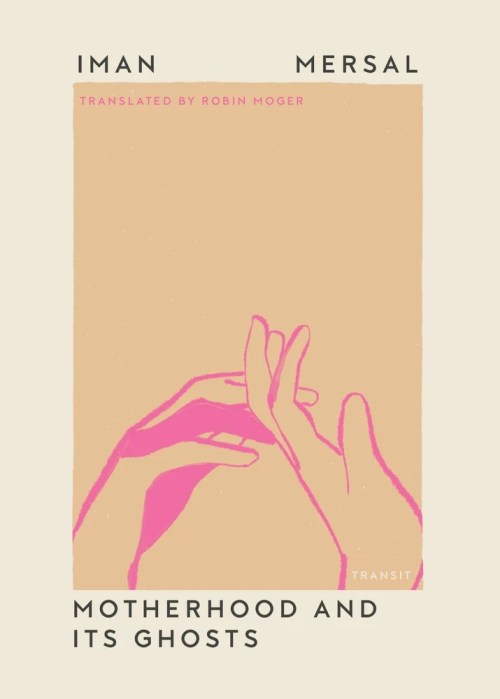
These questions form the foundation of Iman Mersal’s essay collection Motherhood and Its Ghosts (translated from the Arabic by Robin Moger), a work that mirrors in its very structure the fragmentary nature of memory and identity that it seeks to examine. Moving between analytical prose, personal reflection, photographic analysis, and literary criticism, Mersal’s text doesn’t attempt to ameliorate the gaps between maternal representation and reality. Instead, Mersal situates the experience of motherhood within a constantly disrupted linearity. New insights, unexpected associations, the practical demands of caregiving that fragment energy and attention—each disruption and pull is not an obstacle to understanding motherhood but its fundamental making.
Maternal identity, for Mersal, is formed precisely within these interruptions, in the space where academic analysis gives way to personal reflection, where photography blurs visual truth, where the boundaries between self and other exchange seemingly without limit. Like memory itself, which seldom unfolds neatly, and like the act of mothering, which demands attending to multiple considerations simultaneously, Mersal’s text takes form: drawing on the work of poets Anna Swir and Adrienne Rich alongside the photographs of Ryoko Uemura bathing her dying daughter and the Madres de Plaza de Mayo demonstrations, Mersal shares her own narrative accounts of mothering and loss. To explore motherhood is to be pulled from one consideration to another, to be constantly disrupted. By embracing rather than resolving these disruptions, Motherhood and Its Ghosts offers a vision of motherhood that emerges both with and against familiar archetypes of motherhood, suggesting an altogether different dissonance between represented motherhood—in photographs, literature, and cultural memory—and the lived experience of maternal ambivalence, love, and loss.
Mersal offers readers this dynamic, shifting vision of motherhood by attending to her own archive. Within it is a single photograph of her own mother, who died giving birth at the age of twenty-seven. This photograph becomes both the foundation and counterpoint for her exploration—a physical artifact that at once preserves and obscures. Through her entanglement with this image, Mersal shows how photography in the same breath both attests to existence and fails to restore presence. “The woman in the picture is not just different from what I remember of her, or want to remember: she is a ghost,” writes Mersal. Indeed, the image of her mother that’s in the photo documents the moment at which the picture was captured but fails to include what is outside, beyond the frame: her mother’s domestic fortress, her plaited long braids, and her absence that would come less than two months later.
And it is this absence, this haunting ghostliness, that serves as a metaphor for the larger gaps Mersal seeks throughout the text: “I would suggest that, as you look at an image of yours, an image of motherhood that concerns you personally, you are neither operator nor spectator, you are not the child in the photograph nor the mother that holds the child on her lap. You are the relationship that links you both, the relationship that is erased or hidden or even excluded from the picture itself.” Motherhood then itself is liminal. And there’s something liberatory in Mersal’s rendering. While pieces of the archetypes of mothers and motherly figurations will show themselves to us, our mother, ourselves as mothers, can never be fully rendered within these frames alone. Our liminality, its incompleteness, is, paradoxically, too full, too much.

But how are we to remember? How are we to capture that which cannot be rendered whole? Mersal suggests that “you must water memories as you do flowers, and that this watering maintains regular contact with the witnesses of the past.” Our duty is to tend, to lend ongoing, active attention instead of static remembrance. Like motherhood, memory too demands tending. And like bulbs planted in the fall, with the hopefulness of spring, memory, even tended, holds only possibility.
NONFICTION
Motherhood and Its Ghosts
By Iman Mersal
Translated from the Arabic by Robin Moger
Transit Books
Published May 13, 2025