


Lincoln Michel’s lauded debut novel, a cyberpunk noir thriller, earned him accolades from the science fiction community and bolstered his reputation as an authoritative voice in speculative literature. In Metallic Realms, his sly follow-up novel, Michel reveals he may have been a Trojan horse, after all.
This playful, genre-bending satire takes aim at a particular corner of the science fiction community, not out of any apparent animosity toward the genre, but as a stepping stone toward critiquing a whole class of New York millennials who dwell on the uncomfortable fringes of the publishing industry. Michel’s target is not, as it first appears, the average male science fiction diehard, but rather a more widely recognizable archetype — the counterculture-ish geek who might feel equally at home at a Star Trek convention or a poetry reading in a Brooklyn dive bar. Namely, the sort who might actually enjoy being skewered, as long as martyrdom garners them a smidgeon of attention. A humble species of bookworm is both the ideal reader and the punching bag in Metallic Realms.
This narrator of this clever story is Mike Lincoln (no relation, we are told, to a certain two-bit writer named Lincoln Michel), a self-important fanboy whose pomposity earns ridicule from the objects of his adulation, his would-be friends and members of a sci-fi writing group called the Orb 4. Mike is, to put it lightly, obsessed with the Orb 4. It’s an obsession with plenty of room to grow, since he is roommates with two of its members, Taras and Merlin. We suspect that Mike’s veneration for the writing group begins and ends with Taras, his childhood friend and comrade in fandom. But another writer in the group, Darya, comes between them, and Taras struggles with depression. From the first pages, Mike announces his intention of becoming the Orb 4’s number one superfan. He takes every opportunity to praise the universe where their stories take place, the so-called metallic realms, even as the Orb 4 stories devolve into a kind of cheap therapy where the authors work out their slights, grudges, and group dysfunctions.
The Orb 4 stories are reproduced in the pages of Metallic Realms and bookended by Mike’s reverent textual analysis, complete with personal digressions that reveal his many attempts to insinuate himself into the group’s meetings and to gain their respect, or at the least, their recognition. Instead, Mike is relegated to eavesdropping on their conversations from his hiding place in the apartment bathroom, and then even bugging them by installing a recording device in a coffee table fern.
Each Orb 4 writer has a corresponding character on the good ship Star Rot whose actions reflect what is really going on in the minds of their creators. Taras is Captain Baldwin, Darya is an alien named Vivian, Merlin is an advanced robot who goes by Algorithm, and Jane is a molting space creature called an Ibbet. Mike’s stand-in is the ship’s pilot Aul-Wick, an amphibious telepath in a floating aquarium. The first Orb 4 tale recounts the crew’s daring escape from a planet of warring factions that have been cloned from body parts of their colony’s deceased founder. In subsequent stories, the Star Rot is eaten by a gigantic space monster, Captain Baldwin is tempted with “assimilation” into a kind of intergalactic desk job, and the ship enters a space nebula with aphrodisiac effects. There is even a parody of Ursula K. LeGuin’s famous story, “The Ones Who Walk Away From Omelas,” with implications for the current political moment.
Metallic Realms remains entertaining while still delivering a metacommentary that can feel weighty. After all, this is a book of stories within stories, invented out of whole cloth to focus our attention on the act of reading as well as the artistic effort of the writer. In doing so, Michel draws on a rich literary tradition of self-referential postmodernism. Michel even makes a cameo in his own story, appearing as an unnamed writer at a party dressed “in a herringbone blazer over a Paris Review T-shirt” who describes his work as interrogating “science fiction tropes and conventions for subversion.” I had to chuckle at this. In Metallic Realms, it seems, the butt of the joke is the author, in all his many guises.
The engine behind this whimsical “lit fic” comedy is its bumbling protagonist, whose dogged lack of self awareness invokes television jesters like Dwight Schrute from The Office or Jean-Ralphio Saperstein from Parks and Rec. Mike’s voice bears a resemblance to Rickon’s from the Apple TV show, Severance. Mike is nothing if not dedicated to his best friend and roommate Taras, the founder of the Orb 4. He idolizes Taras’s writing — as well as Merlin, Darya, and Jane — and refuses to take their repeated rejections to heart. They think of themselves as a casual writing club, but Mike insists they are the next big thing in literature. It is his stubborn persistence, his resolute belief in his own importance and the genius of the Orb 4, that makes him somewhat lovable; if perhaps in the way that a puppy is lovable. Michel’s story succeeds due to our willingness to sympathize with Mike and root for him in the face of relentless judgment from the Orb 4, coupled with his hapless attempts to hold down a job and make the rent.
Michel’s characters ask salient questions of one another, but it’s safe to say these questions are really meant for us, his audience. Is originality even possible anymore, in this age of information overload? Is it morally defensible to spend time writing fiction when there is so much suffering and chaos in the real world? Is literary fiction “dead,” and does that make science fiction the “language of the masses?” Mike pontificates in one of his analytical chapters:
“Science fiction isn’t merely a portal to other worlds. It’s a mirror. No matter how far we venture into the future, no matter how many multiverses and far-flung galaxies we visit, SF reflects our present reality. Our anxieties appear as tentacled aliens, our hopes as gleaming ray guns, and our dreams as generation ships.”

Michel is winking at us, inviting our participation in his tongue-in-cheek autopsy of science fiction-dom. At the same time, Metallic Realms is a reminder of just how blurred the line is between escapist tall tales and reality, especially when life feels crazier than the most outrageous fantasies.
Much like the “Easter Eggs” that Mike catalogs in his role as Orb 4 “lore keeper,” frequent literary references serve as signposts for readers who might lose track of who exactly is being satirized in a given passage. Jane, the “lit fic” member of the group, reads Roberto Bolaño’s 2666. Kafka, Harper Lee, and Charles Dickens make cameos. But in tone and spirit, Metallic Realms bears most in common with the Hitchhiker’s Guide to the Galaxy. The zany humor of Douglas Adams meets the sort of experimentation with voice typified by George Saunders. I also noted aspirations to the sharp wit of Sam Lipsyte and the shameless confessionals of Otessa Moshfegh. Michel’s story benefits from low stakes and a comic sensibility appropriate to the milieu; that is, until the climactic scene, when the Orb 4 hosts a disastrous launch party that takes a dark turn.
In the end, the deep space of the metallic realms is the only universe big enough to accommodate Michael Lincoln’s delusions of grandeur. It also happens to be a great place for its true author, Lincoln Michel, to hide.
FICTION
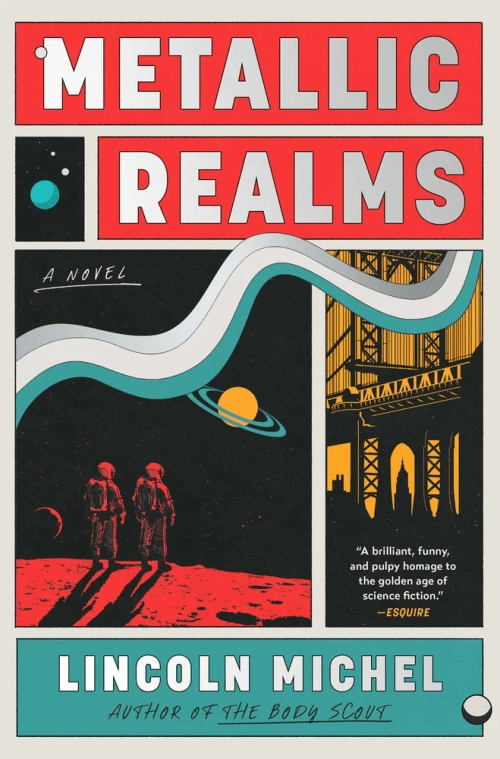
Metallic Realms
By Lincoln Michel
Atria Books
Published May 13, 2025


