


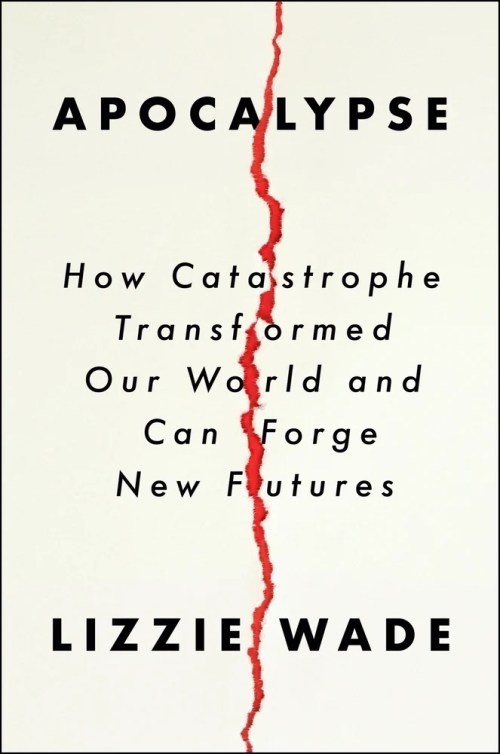
Traversing the history of humanity can be a daunting task, but Lizzie Wade handles it in stride in her first book, Apocalypse. The ease with which she navigates our sprawling history is understandable, given the thesis of her book: we’ve been here before.
Collapse, catastrophe, downfall, destruction, apocalypse, whatever you wish to call it, we as humans have seen it. So, why must apocalypse be seen as an end, when, in fact, humans are still here today, having endured dozens of these cataclysmic, almost mythic events? In this spirit, Wade begins her book by asking us, what happens when we view catastrophe differently? What kind of world can we imagine? What futures might it hold?
The word apocalypse is generally met with apprehension, if not dread, fear, and anxiety. Wade’s book asks us to reframe that conception: Isn’t apocalypse inevitable? Haven’t we, as human beings, lived through many collapses? From the unpredictable devastation of El Niño in Peru to the incredibly deadly Black Plague in Europe, humans have seen and survived. By approaching such a daunting topic through this lens, Wade carefully traces apocalypses of the past to show their complexity and impact, and how they paved the way for new futures.
By following the legacy of humanity back thousands of years, Wade demonstrates how apocalypse breeds ingenuity and radical change, as much as it spurs violence and destruction. She explains how each apocalypse sets the stage for the next, ultimately bringing us to the uncertain world we live in today. Collapse is not an annihilation, she reminds us, but rather an unraveling. And because we as humans love to leave evidence of our existence behind, archaeologists have clues to piece together these mysteries. It is through the extensive research of these remnants, detailed conversations with dedicated archaeologists, and explorations of archaeological sites that Wade lays a strong foundation for Apocalypse.
In addition to her exhaustive research, Wade also manages to include personal anecdotes and immersive narratives. In fact, it is through the depth of her scholarship that Wade is able to craft these vignettes that, oddly enough, humanize the apocalypses of the past. Her intermittent narratives help contextualize periods of history that can feel so otherworldly—which can then help us grapple with our own bleak realities. Instead of looking at Classic Maya or Old Kingdom Egypt as this ethereal Other, let us consider what it might have been like to live during those times, let us try and understand all of the very human choices that turned the world upside down, time and time again.
She interweaves historical fiction in a way that mimics the mythologizing of human history. This provides an accessible glimpse into the daily lives of people who survived these collapses. For some readers, these narratives may be refreshing and grounding, with the mixture of researched fact and informed fiction becoming a useful, comprehensive approach to history.
After surveying various apocalyptic moments of humanity, Wade encourages us to view our reality as a postapocalypse. She says this with the hope that, if we accept apocalypse as part of our shared history and recognize how choices led us to where we are today, we can imagine a different future. By describing the history of apocalypse as a palimpsest, Wade recognizes how each collapse is interwoven into the next and creates a collage of archaeological treasure. Choices of the past echo into the future, but we do have agency over the choices we make now.
For example, Wade shows how decisions made following the Spanish conquest of Mexico City reverberate into the present—actually into tangible reverberations, as the broken irrigation and water systems make the capital particularly vulnerable for devastating earthquakes. This is an instance where she draws from her own experience living in Mexico City during the 2017 earthquake. She recounts the inequities in aid and infrastructure that can be traced back for centuries.

Wade has chosen an intriguing, ambitious topic that surveys an extensive archive that is still being revealed. We, as readers, must grapple with the fact that, despite incredible advancements, there are still things we just don’t know.
Wade leans into this unknown, however, and uses it as a place of departure and imagination. Perhaps, she beckons us to think. Consider, reader, what may have been. Do anything but be uninterested, delve into your curiosity and you will find that collapse is cyclical but that we can learn a lot about ourselves by prying back the layers, that this cycle can be countered by choice, that apocalypse is riddled with survival.
NONFICTION
Apocalypse: How Catastrophe Transformed Our World and Can Forge New Futures
By Lizzie Wade
Harper
Published May 6, 2025



This article rocks for exploring this platform! Hypakle