


I first stumbled upon Shelby Hinte in the lost days of pandemic twitter, where I’d while away hours starved for motivation, wisdom, banter, any antidotal crumb to the isolation. Hinte’s voice stood out in my feed as a refreshing beacon of truth, clear-eyed and unsentimental, belying a no-nonsense commitment to writing – and to astonishingly long trail runs – I admired from afar.
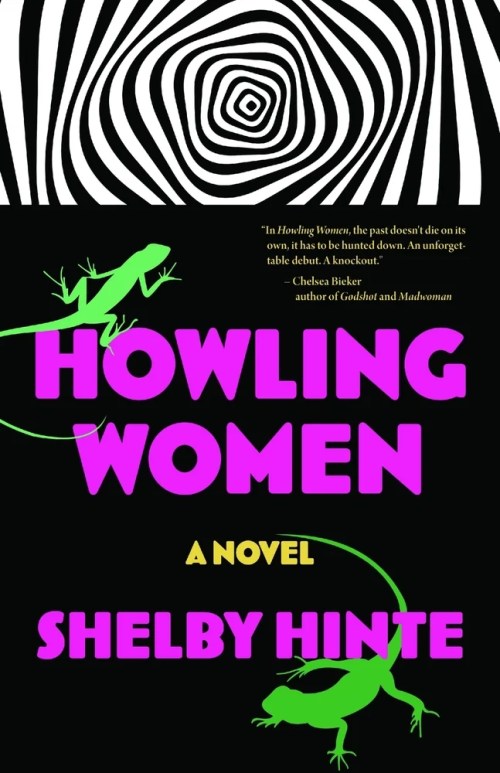
So I couldn’t wait to get my crone hands on Hinte’s addictive debut novel. Fresh, visceral, obsessional and self-aware, Howling Women tells the story of Sabine Haegan, a young woman on a quest to escape her traumatic childhood only to find herself back in her hometown state of New Mexico where she becomes swept up in the mystical vortex of small town life and its enchanting characters, paramount among them the eponymous Howling Woman. Like Sabine, who, upon wandering into a dusty bar is “welcomed in like they’d been reserving me a seat my whole life,” the reader feels instantly on the intimate inside of Hinte’s world.
Written with sharp honesty and grit, Howling Women explores the ways in which running from leads to confrontation, as Sabine ultimately realizes the only way to move on is through self-reckoning. The past may always be among the things we carry, but perhaps our darkest parts need not incapacitate us. Hinte plants a tenuous seed of hope in the expansive possibility of holding two truths: “I can still see the moon in the sky even as morning starts to give way.”
I was hoping to – finally! – meet Hinte at AWP, but alas, anyone who’s ever been to the annual conference knows the Bookfair presents its own vortex to which the writer is defenseless. Although we missed each other in the engulfing swirl, we thankfully were able to connect by email.
Sara Lippmann
Howling Women is the kind of novel that grabs you with its voice and puts its spell on you immediately, through repetition and incantations. We get sucked into its vortex and feel the sinking pull of inevitability. From the outset, the reader is in a state of disequilibrium alongside your main character, and while we know where we are headed, we read on to learn how we get there. Was this circling-the-drain emotion a driving force in your structure?
Shelby Hinte
It makes me really happy that this was your experience with the book. I feel like the image of the vortex was really important to me. Driving force is always such a tricky question in my mind because I feel like I am always struggling to maintain a plot that drives the narrative forward for the reader, but what I find most interesting as a writer is the spiraling of narrative—how a character convinces themselves of meaning. To me, making meaning does feel like we’re spiraling. In theory, we’re getting closer to the center of something, but we’re also being swallowed up. So yes, the “what” is important because that’s the plot, but I feel like the interesting stuff is the how and why. And then all the ways the how and why change.
Sara Lippmann
Your book engages, among many things, the age-old question of free will vs. determinism, or rather, of fated “elements” – whether it’s the vortex of New Mexico or the wounds of childhood trauma or inherited trauma. After years of burying, disavowing, or trying to suppress the “elements” through drinking (or fucking), her hauntings catch up to her. Sabine surrenders to the tug of desire – “I wasn’t trying to fight fate” – and feels more like herself than she’s felt in a while, as if liberation can only be won by yielding to the tides of fate. Can the self ever be free?
Shelby Hinte
If it can, I haven’t yet figured out how.
Sara Lippmann
In his craft book Truth is the Arrow, Mercy is the Bow, Steve Almond writes, “we are always telling two stories about ourselves – the one about who we want to believe we are, and the one about who we know ourselves to be.” With your choice of retrospection, your narrator embodies that duality, steering us between versions. Is there a way to integrate? Or will there always be twining versions, shadowing one another?
Shelby Hinte
This is a great obsession of mine – the disconnect between who we imagine ourselves to be and who we really are. It doesn’t feel that different from making art – what we intend the work to be versus what it becomes. And of course it’s what’s at the center of all our relationships (or at least mine) – what I say versus what I mean or what is perceived. Life feels like an infinite series of miscommunications. I am not sure they can ever be integrated. I think this is what draws me to writing in the first place. It’s an attempt to work through that disconnect with the hope of bringing the selves closer together, but I am not sure it’s possible to do so.
Sara Lippmann
Throughout her life, Sabine has been trying to be someone (a college lit major, a Californian, a wife) anyone else, to wear identity as a set of external markers instead of embracing the inner gunk that makes her. Yet the counter notion, that we are but the sum total of our traumas, also feels limiting. As a result, Sabine is adrift. She claims others don’t know her but she has never allowed herself the grace to get to know herself. A byproduct of maintaining this exhausting facade is drinking. Sabine is rarely sober. Does drinking heighten fantasy or excavate reality? Bring one closer to or farther from self?
Shelby Hinte
Hmmm, I am not sure what the answer is for others, but for me I think it brings me farther from myself. I used to think it lifted inhibitions and allowed access to some truer version, but really I think that closeness was a fantasy.
Sara Lippmann
You play with reality and fantasy so deftly that when Sabine befriends an older woman named Howling Woman, I wasn’t sure initially if this fairy godmother, if this guardian angel figure was “real” or a figment of Sabine’s imagination, if perhaps Sabine had conjured her. Throughout the novel, my conviction flipped a few times, and I can’t help but assume this blurriness was intentional, and I’d love to hear you talk more about that magical effect.
Shelby Hinte
I really like this reading of the book. I always imagined Howling Woman as real, but I was also highly aware of Sabine’s unreliability. I think a big question of this book, for me, was how does memory function and who gets to determine what the truth is? In earlier drafts, there were a lot more scenes between Howling Woman and Sabine in which Sabine was highly intoxicated, including a scene where they did ayahuasca together. As I was writing from her voice I couldn’t help but think she couldn’t possibly recall things at this level of detail from the state she had been in. She would certainly need to fill in the gaps with some imagination. Later, I think I realized that no one’s version of reality can be one hundred percent reliable, regardless of the substances they are consuming, because there isn’t really such a thing as an objective story. I cut a lot of the more gimmicky elements that spoke to this, including the ayahuasca scene. I am not sure if over the years that I was writing it I ever imagined that Howling Woman wasn’t real, but I certainly imagined that the version of her that Sabine sees isn’t the same as what others see.
Sara Lippmann
That’s so interesting! She did make me think of the mystical abuela one encounters on an ayahuasca journey. I also wanted to ask about the power of female friendship and what it’s like for Sabine, who’s always been betrayed by the women (namely, her mother) meant to protect her, to find a woman she can trust.
Shelby Hinte
The most powerful relationships in my life are with women. But this wasn’t always true…or maybe it was but I fucked those relationships up. It wasn’t until I was in my thirties that I was able to foster real relationships with women. I think I wanted to explore this dynamic in the book because I think women are so often pitted against one another (and this is true for Sabine, too. She spends a lot of time comparing herself to other women). I started writing about Sabine and Howling Woman’s relationship while I was yearning for female friendship.
Sara Lippmann
Sabine positions herself within the “howling woman” canon: invoking Monster (the movie starring Charlize Theron and based on the life of Aileen Wuornos), Thelma & Louise, and of course, the archetypal she-wolf or howling woman myth. We feel the choral echo of not only Sabine’s story, or her own mother’s story, or Howling Woman’s story, but of countless others who carry such stories. When violence and vengeance come, we get the distinct sense that although she acts alone, she is acting in concert with those who’ve endured similar pain.
Shelby Hinte
I do feel that all of our experiences are directly and indirectly informed by all the experiences of those that came before us. I think when it comes to rage, that kind of anger has to stem from something bigger than the individual.
Sara Lippmann
You write desire so well! Before there is sex, there is desire, a tension you build so beautifully. Things get HOT with sober, pony-tailed, alluring, orphaned Angel. He seems to be the only person with whom Sabine can feel like herself, even though she’s pretty much wasted the whole time she’s with him. We feel it in their every interaction as they move toward each other. Were those your favorite sections to write?
Shelby Hinte
Thank you for mentioning the sex. You are the first interviewer to bring this up. Sex scenes are some of my favorite scenes to write. I especially enjoy writing them in public settings. I spend so much of my life desiring things and it’s fun to create characters who indulge in their desires with abandon. I don’t mind making them suffer for their desires. Better them than me!
Sara Lippmann

Sabine’s “confession” is an artful construction. She says, “Truth and belief and storytelling all feel manmade.” By addressing the reader directly, we are reminded that the story is being packaged and filtered, and that “truth” lies in some slippery place in between what she’s choosing to reveal through the lens of fresh sobriety, and what really may have gone down.
Shelby Hinte
Another obsession of mine is around language and communication. Everyone thinks that what they experience is the truth, but it is just their experience. This is what makes life so painful, that to coexist with others we have to be able to agree on some truths, and yet we are all stuck inside our own subjective existence. I also feel like it’s terribly difficult for language to exist without manipulation. Even if it is full of good intentions, so much of communication is about getting someone to see your side—to be understood. I think this narrative choice is important to my work because I want people to remember that all stories have an element of fiction. Of course, this is a novel, so that is especially true, but in the novel the character is working through the difficulties of how to translate life into narrative. In On Memoir, Mary Karr talks about how the second we choose to include one detail and not another in a story, it is no longer the truth. I guess I just feel tired of narratives (whether they are in the news or history books) that present language in an authoritative voice. I always want to be pointing to this fallacy of “Truth” in some way.
Sara Lippmann
Place plays a crucial role. We are in the desert of New Mexico, not far from Truth or Consequences (a mystical town I myself found myself oddly sucked into for a brief spell last year) in the fictional town of Yu within the shadows of the hovering Chupadera mountains, home to the fabled vortex. What more can you tell us about its tangible and metaphorical energy?
Shelby Hinte
I chose New Mexico as the setting because, like most things I included in the book, I am obsessed with New Mexico. That’s where I’m from and I think of it as a mythical place. Ever since I left I’ve longed to go back, yet every time I’ve returned something terrible has happened during my visit. That probably sounds dramatic, but it’s the truth. Eventually I stopped going back. The idea of the vortex was loosely based on a running joke my friends and I had about the mountains in our town having some dark energy that made terrible things happen. I think of the desert in New Mexico as one of the most beautiful places on earth, and yet, there is a long history of violence and loss there. That contradiction has always been interesting to me.
Sara Lippmann
How does your dedicated running practice feed your writing practice – or vice versa?
Shelby Hinte
I think of my writing and running practice as nearly one in the same. I feel like I can’t write without running and I can’t run (at least not for very long) without imagining stories. I usually run after I write in the mornings and often, if the writing got off to a decent start before the run, then the run turns into a sort of extended writing session. I have often screamed voice-to-text pages in my phone while descending the hills near my home. More importantly though, running feeds my writing by reminding me not to get too caught up in the end result. Don’t get me wrong, I work hard to do well in races, but it can’t be the only reason for the effort. The race is only one day. Training happens every day. You never know what will happen on race day. If you don’t enjoy the training then you’re banking on getting all your satisfaction from a handful of days that are somewhat out of your control. It’s a recipe for disappointment. I think the same is probably true with writing books. The act of writing should be more important and meaningful than the final product.
Sara Lippmann
How does your work as an editor for Write or Die inform your own process? Is it hard to quiet the editor’s voice while generating new work? What does your writing practice look like? How and when do you hit the page?
Shelby Hinte
My work at Write or Die began with interviewing authors, which was really a way to get free books and ask authors my most pressing questions about writing. The ethos of the magazine has, at least in my opinion, always been to provide people with a place to engage meaningfully with others about literature and art. Personally, books/stories have always been the place I turn to when I am in search of some insight into myself and/or the world. Getting sober? There were books that helped make this less terrifying. Going through a breakup? There’s a book about it. Your child won’t talk to you? Yup, someone wrote a book about it. Got a weird fetish? You’re not as weird as you think, someone probably wrote a book about it. All of this is to say that books have saved my life. Whether they showed me I wasn’t alone in some feeling or they presented a solution to a problem that felt impossible, they have helped sustain me. For me, it has always been easier to turn to a book, at least at first, than to turn to a friend when I’m going through something that feels shameful or embarrassing or which I don’t yet have language for. I don’t think I am alone in feeling this way, so being part of a magazine that acknowledges how important stories are feels really satisfying.
As far as how it plays into my own writing, I don’t often struggle with the editorial voice in early drafts. I have faith in the messy first draft. I know I need to make a mess before anything good can happen on the page.
And my practice, well, when I am being a good girl, which I try very hard to be, I am up early Monday-Friday. I write for 60-90 minutes before running and starting my work day. Sometimes that looks like 2,000 words and sometimes I’m lucky if I hit 200 words. I recently gave up on word counts. I also journal religiously.
FICTION
Howling Women
By Shelby Hinte
Leftover Books
Published April 29, 2025


