


What if women took over the world? Would it be a kinder, gentler place? Not in Maren Uthaug’s Eleven Percent, her first novel published in English.
The book’s action takes place a few hundred years in the future in Copenhagen, Denmark. Ratgirls roam the city’s slums with baskets of rodents they release to nudge nature along as foliage swallows up architectural remnants of the patriarchy: crumbling sharp-angled structures with doors that lock. The Evolution occurred several generations earlier when women reclaimed dominance over men after centuries of subjugation. These foremothers are thought to have corrected the social order. In the beginning, women had ruled the planet until men took over and oppressed them, usurping and perverting earlier gynocentric belief systems. At the time of the Evolution, women had lost interest in sex with male partners. As a chemistry teacher in the novel helpfully explains, this was nature’s last effort to save the species. When they were no longer blinded by oxytocin (known as the “love hormone”), women “could suddenly see men for what they really were. . .” It is believed men contributed to their own downfall by having “too much faith in their genitals’ ability to give pleasure.”
Eleven percent is the portion of the male population allowed to live. Men are not considered human yet are kept around for purposes of reproduction and sexual pleasure. Uncontained testosterone is considered dangerous and therefore not allowed free range in the future world. Instead, men are kept locked up in spa centers where Amazons train them tirelessly on sexual performance and all manner of kink (shout-out to scat). The sexual menu includes a broad range of male types. Perhaps the spa visitor would enjoy a Lloyd instead of the usual Chris this time? Spa scientists are on hand to administer medication immediately after sex to stop pesky oxytocin in its tracks.
Eleven Percent explores the intersecting lives of the book’s four primary characters: Medea, a tiny witch with an affinity for snakes; Wicca, a Christian priestess who delights in sensual pleasures while failing to live up to her family’s expectations; Eva, a doctor who works with juvenile males at a spa center; and Silence, a plant whisperer who hasn’t spoken in decades and lives with the witches who took her in years earlier.
The book’s English-language publisher, St. Martin’s Press, describes Eleven Percent as “an inverse The Handmaid’s Tale.” Yet there are two key ways Uthaug’s novel is different. First, the atrocities in Margaret Atwood’s 1985 novel are based on documented historical precedent. Uthaug, on the other hand, invents new, wicked ways to diminish and exploit men. Second, Atwood’s book is from the perspective of the oppressed while Eleven Percent is from the vantage of the conquerors.
Potato, po-tah-toe, you say. After all, Eleven Percent’s intriguing premise is that women run the show, call all the shots. Yet Atwood’s novel is now inextricably bound up with the Hulu-adapted streaming series of the same name (2017-2025). Spanning two Trump presidencies, the series’s cultural currency is strong. In the United States, references to the show—especially costume-based ones—have even become a kind of feminist shorthand for making critiques about toxic femininity and to protest eradication of women’s bodily autonomy. Hence, some readers may be disappointed by Uthaug’s unwillingness to characterize women as having succeeded where men failed.
The possibilities for sexual orientation and gender fluidity look different in Eleven Percent than they do in the 21st century industrialized West. For example, romantic relationships with men are unthinkable because men are considered dangerous, as well as emotionally and intellectually incompetent. True, women may visit the spas for sex. But for real companionship, same-sex partnerships are considered the only natural loverly alliances to have.
By contrast, the near erasure of gender fluidity and nonbinarism in the New Time are practically a Neoconservative wet dream. Uthaug’s depiction of “manladies” and a character experiencing gender dysphoria may prompt some to dismiss the book and its author as transphobic (or at least on the spectrum for transphobia). A reactionary response amongst American readers is understandable given recent sanctions against trans and nonbinary folks. Yet the author is from a socially progressive country where she also creates satirical cartoons. As such, this reader understood the novel’s depiction of trans and nonbinary people to be the dystopian nightmare imagined by someone accustomed to a tolerant and inclusive society.

Caroline Waight’s translation is inspired—e.g., “masturbatathons” to describe popular competitions—and retains Uthaug’s dark, cheeky humor. Eleven Percent is a hilarious sendup of the manosphere, filled with irreverent throwaway comments such as the observation that men are too emotional to be in charge of anything. In Uthaug’s world, women’s bodies are celebrated and the clerics who menstruate the heaviest and the longest are considered the most powerful.
If Eleven Percent has a moral, it is that at least one adage from patriarchal times still holds true: power corrupts and absolute power corrupts absolutely.
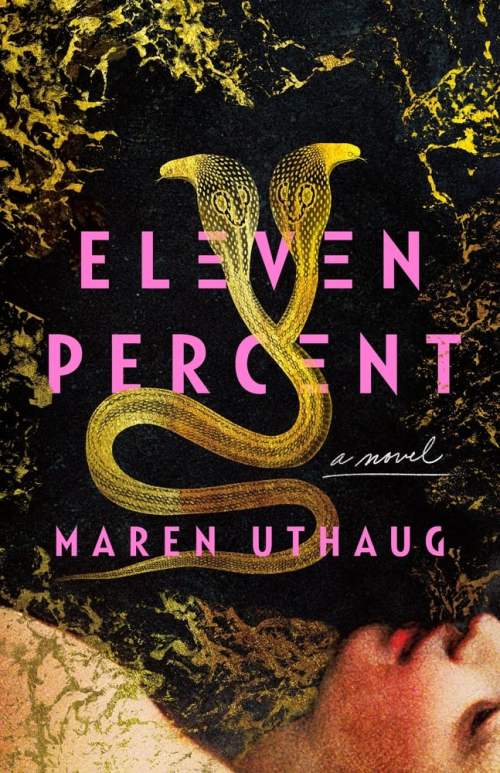
FICTION
Eleven Percent
By Maren Uthaug
St. Martin’s Press
Published April 22, 2025


