


To read Bay Area-based poet Connie Mae Oliver is to SCUBA dive into another dimension where colors are brighter, feelings are infinite, and language functions as a form of echolocation, communicating new and delightful ways of sensing and seeing. A masterful technician and a brilliant visualist, Oliver’s grasp on narrative is also downright impressive. Understanding that the past, the present, and the future are endlessly undulating, Oliver tells folkloric stories that reveal deep truths about places—like her birth country of Venezuela, or the electric Miami, where she came of age—and the people who inhabit them.
In her third full-length collection dormilona, out by Burrow Press this month, Connie Mae Oliver rows the dive boat bravely into a turbid dreamscape, where the water is choppy and memories are unmoored. We follow the narrator as she embarks on a five-part quest to heal from the grief of losing her grandmother Gladys, whom Oliver left when she emigrated to this country from Venezuela with her parents and siblings in the 90s, which leads to a time-traveling examination of the nature of the grandmother-mother-daughter dynamic. dormilona, which means “sleepyhead” in Spanish, was also inspired by Oliver’s then-preoccupation with sleeplessness, which lead her to enrolling local sleep studies, and analyzing data to locate the scientific answer to her insomnia and fainting spells.
I was lucky to speak to my dear friend Connie Mae about narrative in poetry, dream logic, female meanness, and the connection between language and time.
Christina Drill
Sleep—where and how and why it carries you—is an important theme of this collection. dormilona has a dual meaning here—“sleepyhead,” and a Venezeulan slang for “nightgown.” In the title poem, “Dormilona,” the speaker writes: “This is the costume for my transit to the other side.” Across time we see the narrator fainting, dreaming, and in doing so she returns to the “forest” of her childhood, of her dreams, of her grandmother’s childhood perhaps. I picture her making these travels in a long, flowing nightgown—it’s as if it’s her armor, but also her magic carpet, but also something she can’t take off. In the final section of the collection, sleep data, the narrator attends sleep studies for information but the scientists find nothing—the proverbial nightgown cannot simply be taken off; we are entwined with our ancestral past and will return there when we sleep for good. Can you talk more about the inspiration behind this collection, and how sleep connected you to your late grandmother Gladys, who is the prominent character in this book?
Connie Mae Oliver
Gladys fell about a year after I began writing the collection, and although it wasn’t immediately characterized as fatal, I understood that I wasn’t going to see her again. It’s common to have a grandparent in another country, and of course common to experience the loss of a grandparent. But what the book grieves, I think more palpably, is the way a certain familial and cultural knowing had long been relinquished to time and distance. I began to notice how I didn’t even know how to grieve, because the connections themselves were elusive. I thought, Okay, maybe I can access them by embracing that absence—localizing it in the hypnagogic spaces between sleep and wakefulness, consciousness and fainting.
And throughout the collection, this exercise summons an internal, known self, through the question of sleeplessness, which I think is the “sleep study.” I thought I was supposed to go to a clinic and have a formal sleep study done, and when I realized it wasn’t feasible (not covered by insurance, resources limited), I began to inspect the ways that a sleep study was already underway. My mother and grandmother (and I) have experienced seasons of insomnia, of pacing in nightgowns, encountering each other in the hallway and asking, ¿No puedes dormir? And I began to see this as a framework for matrilineal consciousness: how, in so many ways, women and girls all over the world are wandering in this suspended state, passing one another, pawing the walls, looking out of windows, testing doors—like we’re in a dreamscape, in this spell that was cast—and we learn to navigate it from our relationship (fraught or otherwise) with the women in our family.
Christina Drill
I’m so interested in the way language—both Spanish and English—functions in Dormilona. The free association between tongues almost functions to create this new dream language—or logic! And these switches also serve to delineate time. In “Mareada” the speaker writes: “Time the mother, time the story, time the amniotic vertigo.” Can you talk more about the connection between language and time in this collection?
Connie Mae Oliver
Language-as-time and language-as-logic are concepts I have been obsessed with. The collection is so much about subjective time and the elasticity of matrilineal time. When I saw Miyazaki’s The Boy and the Heron in 2023, I was at a small cinema in Oakland with my friend Chi Chi, and I remember turning to them after the credits and saying, “That was about motherhood!” From the encounter with a time portal at the beginning of the film, to the mother emerging in that world as a child, to the Epimenides paradox reference, and the undoing of “blocks” at the end of the film (which stood, I felt, for mathematical axioms), I remember it sent me flying back to the computer to embed various new ideas into the finalized drafts of dormilona.
I had also started reading (clumsily, with scant proficiency) Gödel, Escher, Bach: An Eternal Golden Braid, Douglas Hofstadter’s 1979 tome about infinity and logical loops. The poem “Challenger, January 1986” came about because of these influences; my mother had watched the live television broadcast of the Challenger explosion while feeding me baby formula, and I couldn’t help thinking of the resonances with the time-stamp of motherhood, the precarity of life on earth, mathematical recursion, and the question of infinity as inherent to what a child learns (meta-linguistically) as they pass from water into consciousness (which is why “piercing/threading the meniscus” recurs in the collection—signifying birth as an event horizon). Ryan Rivas at Burrow Press was massively patient and supportive about my new notes and updates during this time.
Christina Drill
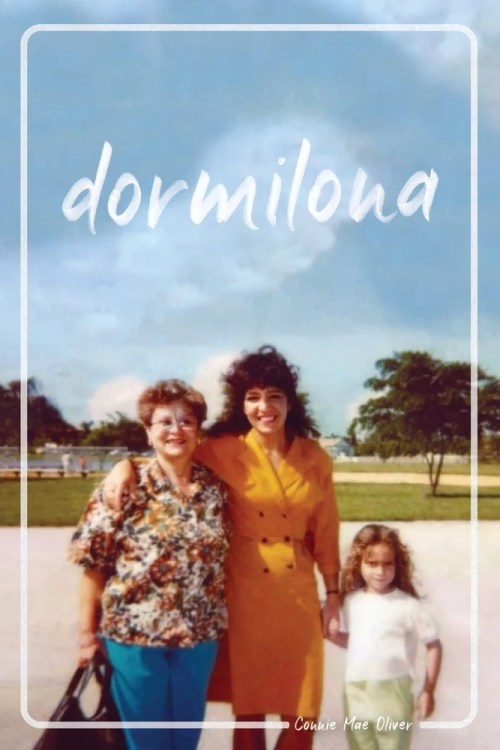
We learn a lot about the speaker’s grandmother Gladys—who is pictured on the cover alongside your mother and you in childhood. We learn through the poems that Gladys is herself a poet, albeit a secret one, and that she had a fall in her later years that rendered her irascible and angry. Eventually we learn she received a Parkinson’s diagnosis, and the distance between the narrator, the narrator’s mother and Gladys expands exponentially, what feels like beyond repair. One of my favorite lines in the entire book comes in the early poem “Mareada”:
Sometimes my mother and I discuss what it feels like to be lost in a forest. She says my grandmother is the forest she is lost in. She says she is sorry for having placed me in a forest of my own, she is sorry that I haven’t found my way out. We wander in our respective forests.
And then later we see them together navigating the forest in “Cuchinaza 2019,” on a phone call between the speaker and her grandmother, facilitated by her mother: (!Dile que estas bien! / Dile que estoy bien / aquí también tienes tus primas y a tu amiga.”) So much is left unsaid here; I found this to be one of the most heartbreaking poems in the collection (as wel as “Si me encuentra el que me busca,” which I took to be from Gladys’s POV). “Cuchinaza 2019” takes these three connected souls—grandmother, mother, daughter—and observes them on a phone call together where communication fails—you can feel the desperation, and also the love. Can you talk more about this lineage of grandmother, mother, and daughter, and how this triangulation—or line, I think it is both, shapeless and shapeshifting at once—influenced form in dormilona?
Connie Mae Oliver
I love that you connected genealogical lineage and the phone line here, because it was meant in precisely that way, and it was meant to extend from the beginning of the collection to the end, and to be merged/tangled with the forest. The phone call on Ditmars Ave really did happen; Gladys didn’t recognize my voice anymore, and it was the last time I heard hers. The person facilitating the conversation was her neighbor, who sat with her in Valencia and sort of narrated to me what she was doing as we spoke. At one point, the neighbor said, “Wait a moment, she is searching for a photograph of her mother” (my great-grandmother), and I remember feeling this terrible pang, like she was searching for the same thing I was searching for. But she was becoming the photograph, and she didn’t recognize me as I reached for her too.
All I could say at the end of the call was that I loved her and that I knew she loved me. I found it painful then, and interesting now, that she could not say my name—and in the poem I added it anyway. I don’t know why. Maybe as a form of self-soothing, of transferring her more lucid voice from the letter to her airy and distant voice on the phone. I recently saw Joy Harjo deliver a keynote address at a conference in Berkeley, and she spoke about the space of dreams—how they are sites of knowing ourselves and the story we are all collectively writing in real time. I feel that Gladys would have understood that.
She was such a surreal person; she understood art and the power of dark and perhaps dreary places in creative ways I often struggled with. I chose the cover image for lots of reasons, and one of them was my expression. I was a shy child, and my entire universe began and ended with whether my mom was happy and safe, and I think you can see that contrast between their carefree expressions and my tiny worried face. I think, in some ways, I learned to be brave by standing up to my grandmother, by learning to engage her in challenging discourse, by trying to impress her with my developing wit. Even now, I wonder if she would have liked my book. I wonder if she would like the poems, if she would feel known or represented, as a human, mother, and poet. When I met Joy Harjo after the keynote and she signed my copy of her memoir, Poet Warrior, she wrote “Be brave” above her signature. I feel like Gladys would have said: You see?
Christina Drill
The word “mean” comes up a lot in this collection, mostly in relation to Gladys. In one repeating memory, Gladys urges the young speaker to call 911, “for practice.” In “La vuelta,” verbal abuse is touched upon. In “Deep Fake Deep” the speaker writes: “and in all her former meanness I want / to shield her from “having been mean.” This is a bit of an abstract question– how would you define meanness, in the context of this collection? Or what does it mean to you now, having explored it here in Dormilona?
Connie Mae Oliver

Thank you for asking this deeply compassionate question. I think the meanness of this collection corresponds with the threaded porfía structure (a lyrical duel) from Florentino y El Diablo, which is a folk poem that was adapted into a Joropo song. It’s about a young man (a cuatrista) who battles the devil in the Venezuelan countryside and defeats him through song. Nearly every country has its version of this trope, but I wanted to weave it into the collection because I think lots of times girls in Latin America are conditioned to take on the perspective of un Florentino battling the specter of an embittered older woman—una Malinche, una bruja—whom we are meant to guard ourselves from ever becoming.
Like that’s the ultimate social danger encoded into girls and women: not the encounter with a “mean other” but the becoming of one. And Gladys was outwardly, especially for 20th-century sensibilities, “mean.” Sometimes I received that meanness, sometimes my mother did (and then that sadness found its way to me), and one component of that dynamic that is often overlooked is the social genealogy of women’s historical anger and grief.
The later poems try to cradle her back to what might have been her former self—whoever she was before a world of misogyny warped her nervous system (or before she tore her face from the family photograph shown in the collection) and who she was when she was resting, sweet, and letting me fasten her hair into curlers. I think, unfortunately, many women know this pain: of enduring misogyny and long-term abuse (not just personally, but societally), and then having the resulting expression of that trauma deemed a foundational characteristic. It is penalized, vilified, essentialized, etc.
So in this book I tried to take the position of curiosity and deep listening toward my grandmother’s irascible demeanor. By no means do I aim to totalize the conversation, but I think it’s important to extend this specific form of consideration to women and girls and femme and gender nonconforming people, because aside from the obvious vestiges of societal oppression, the world is made of a psychological mesh that is so often antagonistic toward them. The story of La Mala (el diablo), etc., is a potent weapon wielded by misogynists, and it is leveraged in ways that are overt and subtle.
In the poem “Time of Death,” Gladys is portrayed resting in bed. After completing that poem, I realized that she was ready—I was ready—to release her from all of that. Perhaps (I hope) that original song-battle between Florentino and “el diablo” was translated into a lullaby.
Christina Drill
I think this collection is so brilliantly organized; we tend to think of sleep as ~the cousin of death~ but in this collection sleep is the setting for our hero’s journey. We begin at light sleep; followed by RORAIMA, in which poems like “Corotos” and “Hallacas” reach back into the past; in azabache time expands outwards in every direction; in deep sleep we are “En la noche más oscura”; and in sleep data, the heartbeat goes quiet, we are in the amniotic ocean where poems like “Amor Eterno” prove nature’s endless rehabilitation where the forest is always blooming (“The rainforest is older than thinking, and I think my way back to it”)—and Gladys is born again, emerging crystal clear in memory—her on her Georgian sofa in “Time of Death,” a photo of her on her wedding day. How did you go about assembling and ordering this collection? How were you able to create such a strong narrative arc through individual poems? Was the beginning always the beginning; was the end always the end?
Connie Mae Oliver
I love thinking of sleep as a setting—how it correlates with the nonlinear passage of time and a certain suspension that aids in making sense of things. In my writing (and perhaps generally) I am a combination of organized and spacey that I think helped me put this particular collection together. It’s kind of absurd, but I created the sections and architecture of the book before even writing the pieces. I knew I wanted it to begin with “light sleep” and end with “sleep data,” and I wanted the progression to mirror the undulating passage out of consciousness and into dreaming. And then, I suppose, I walked into my own house and started looking around, surrendering to it.
light sleep and RORAIMA are focused on the ground view of the domestic world for the child—the materiality one reaches for in the absence of the ability to visit familiar places. In deep sleep and sleep data the writing process grew more philosophical, concept-driven and almost expository. It’s also the section where I noticed myself trying to talk to Gladys, inviting her into the submerged world of sleep, where I was suddenly able to swim. Between these four sections is the shortest: azabache, which was the most research-based. It arose from inspecting the tiny set of special pieces of jewelry my mother has kept in a small plastic box since the 1980s. When she showed me the azabache bracelet that I wore as an infant (an heirloom; she’d worn it as well), I became hypnotized by the idea of apotropaic practices, geology, perception, and how that specifically correlated with the disoriented nature of my connections to home and femme lineages.
I think the concept of azabache and talismans is visited beautifully by many artists, including Firelei Baez, whose mosaic of plantain trees bearing combs and azabache pieces can be viewed in the 163rd Street and Amsterdam Ave station in New York. I was aware that the sanctity of this topic for fellow Caribbean artists and writers has been thoughtfully elaborated upon, so I was mindful to keep it close to the motifs in dormilona: namely language, sleep, and matrilineal memory, and how it is situated culturally in Venezuela. Early drafts of the manuscript were proofread by Gloria Muñoz, a dear friend and cohort from the Brooklyn College Poetry MFA (now poet laureate of St. Petersburg, FL) and that lateral support (her intuitive knowing, as a Colombian-American poet, of the overall discourse) became part of the book’s infrastructure. dormilona exists thanks to the presence of kind, generous women and femme community in my life. Overall, my aim was to build a book that feels like a tender place that invites syncretic sensibilities (linguistic, cultural, dream-based) for all readers—across regions—that hold these concepts closely too.
POETRY
dormilona
By Connie Mae Oliver
Burrow Press
Published April 22, 2025


