


Before I started writing this review, I dreamt I was writing it. In the sweaty haze of a migraine – whereupon every emergence into consciousness I tried to drop back into unconsciousness to not feel the drilling pain in my skull – my unconscious pieced together fragments of my waking life. These pieces came together in a likely incoherent argument that Maggie Nelson’s Pathemata, Or, the Story of My Mouth was both simultaneously authentic to, and performative of, femininity. Unreality was, fleetingly, reality. Then, I woke.
Unreality as projected reality is the spirit in which Pathemata operates, exploring chronic and acute pain’s broad, intimate consequences for our lives and our experiences of time, sense and materiality. Throughout, Nelson writes about the impact of pain using the apparatus of vignettes unbound by expectation of linear progression. These vignettes accumulate, and are jumbled, between a range of temporal experiences; memory, dream, present, past. Instances of particularly heightened sensitivity, as well as the movement between and through differing scenes, embody the disorientation and unreality which can accompany acute pain.
Dreams have peculiar consequences for our waking lives; who has not had an intimate or frightening experience in a dream which, in our internal recalling of it, begins to feel indistinguishable from memory? The dreams Nelson describes are often violent and distressing – a skull turns into “radiant phosphenes with horrifying cavernous teeth” – while the unconscious bleeds between reality and unreality: an inappropriate mention of a “blowjob” by a dentist is reanimated in a dream, the presence of tumors in a beloved’s body become transposed to a “fur tumor” in Nelson’s own. Over and over Nelson lulls us into a false sense of security about a perceived reality then subjects us to whiplash, undermining it completely. Pathemata’s narrative is continuously disturbed by dreams in between descriptions of a world wrought by the pandemic, the difficulties of marriage, and fear of what to do in the face of a stranger or loved one’s anguish.
Countless efforts towards medical interventions form the thrust of Pathemata’s narrative; pain is desperation. Nelson charts the history of her mouth, from a childhood habit of speaking often and with “velocity”, an orthodontist’s intervention of a metal spike glued to the back of her teeth to discourage a “tongue thrust”, all the way to the present where pain is a “snake” which loops “from jaw to eye.” The relentless nature of her pain informs a persistent account of visits to a Lyme Disease specialist, a sexist dentist, a myofascial therapist, another dentist, a body worker, a guru etc. Nelson chronicles these consultations, the writing of Pathemata, as well as her writing of a detailed medical document to bring to these appointments: “I start a file on my desktop, wherein I catalogue the conditions of the pain’s onset, the doctors I’ve seen, the results of their imaging, the medications and physical therapies I’ve tried.” This document is dismissed, and the reader gathers a growing sense of the nefarious intentions of people who attempt, or successfully manage to, profit off the urgent desire to alleviate suffering.
In her seminal text The Body in Pain Elaine Scarry explains that “the relative ease or difficulty with which any given phenomenon can be verbally represented also influences the ease or difficulty with which that phenomenon comes to be politically represented.” Through diligent documentation of her experiences, Nelson depicts the negative of pain – its imprint on a life – revealing her personal encounters with the exploitation of desperate individuals integral to the corrupt economy of healthcare in America today.

Pathemata’s sensitive exploration of suffering is a profound reflection on vulnerability, persistence, and how we try to move towards connection with others in the aftermath of trauma, pain, and death. With subtlety and deftness, Nelson’s writing is sensational in its stark and touching heft; facts are emotional experiences — “As I cycle through my shame—visible, as always, on my face—I realize that the magic isn’t in the dishwasher—it’s in the bloodjet, the mortifying abundance of telling.”
FICTION
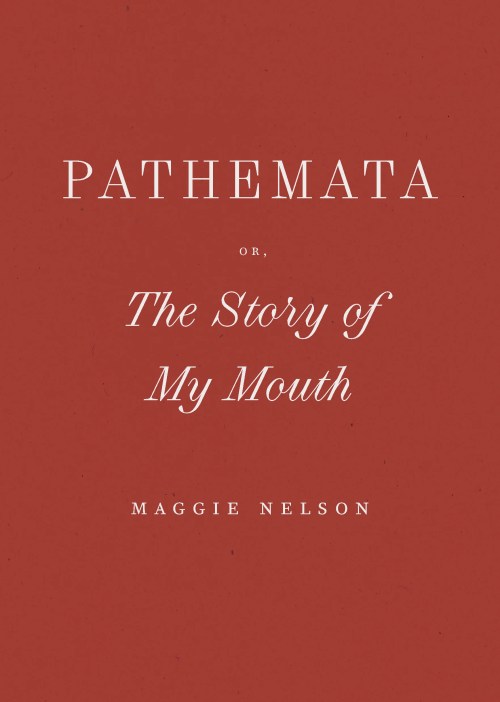
Pathemata, Or, the Story of My Face
By Maggie Nelson
Wave Books
Published April 1, 2025


