


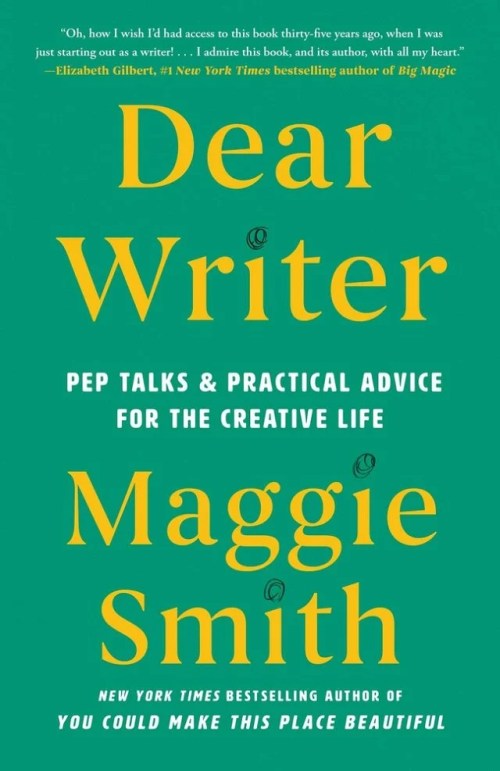
New York Times bestselling author and poet Maggie Smith does not think you need to write every day to be a writer. Do you need that permission? She offers it in the first pages of her newest book, Dear Writer: Pep Talks & Practical Advice for the Creative Life. More specifically, she calls out any insistence on a daily writing practice as a privileged suggestion that “ignores women’s realities in particular” i.e., household duties, childcare and all the other tasks that add weight to our mental loads. This is not to say all women have such responsibilities (I am happily child-free). But Smith’s approach in this book is a refreshing change from the accomplished writers who insist writing for hours each day is the only path to success.
Instead, Smith asks writers to consider this: “being sensitive, attuned, observant—these things don’t just improve your writing, they improve your life.” The through-line of her inspirational and instructional advice in Dear Writer is that we slow down enough to live our lives and notice the world around us again, perhaps even with a childlike wonder (if we can stop doomscrolling on our phones long enough to do so).
Wonder is one of the ten essential elements of creativity that Smith explores in this book, along with attention, vision, play, surprise, vulnerability, restlessness, tenacity, connection and hope. Several short essays on related topics fall within each section, which begins with a cozy letter addressed to the reader (dear writer) and ends with a generative writing prompt and many recommendations for further reading. I would not suggest reading Dear Writer in one sitting; it is the sort of book you come back to again and again, reading one section at a time and considering the writing prompts and how they might apply to your own work.
Smith frequently uses her own poetry to illustrate craft elements in Dear Writer, flexing her twenty years of teaching experience to clearly explain each concept, but I found much of her poetry-specific advice applied to my own fiction writing as well. Seeing how craft plays out on a line-by-line and word-by-word level is helpful in poetry and prose alike. While I think poets may find additional Easter eggs hidden throughout this book, even those without a strong background in poetry will find this an accessible text.
I will admit: as a writer who has participated in numerous workshops over the past few years, and finished writing and editing my first novel, I was skeptical as to whether Dear Writer would still speak to me. But the beauty of writing is that we are never finished learning or seeing the world around us in new ways. The section of Smith’s book that I most connected with is titled “Surprise,” with craft essays on the act of discovery, embracing imperfection, and strengthening endings. And I was, indeed, surprised at how these essays resonated with me and my work, as I grapple with what it means to be an artist in this moment. I suspect many other writers will feel the same way.
Maggie Smith is teaching at StoryStudio Chicago’s in-person StoryBoard Conference & Festival in August of this year. More details and registration information at www.storystudiochicago.org/storyboard-conference.

NONFICTION
Dear Writer: Pep Talks & Practical Advice For The Creative Life
By Maggie Smith
Washington Square Press
Published April 01, 2025


